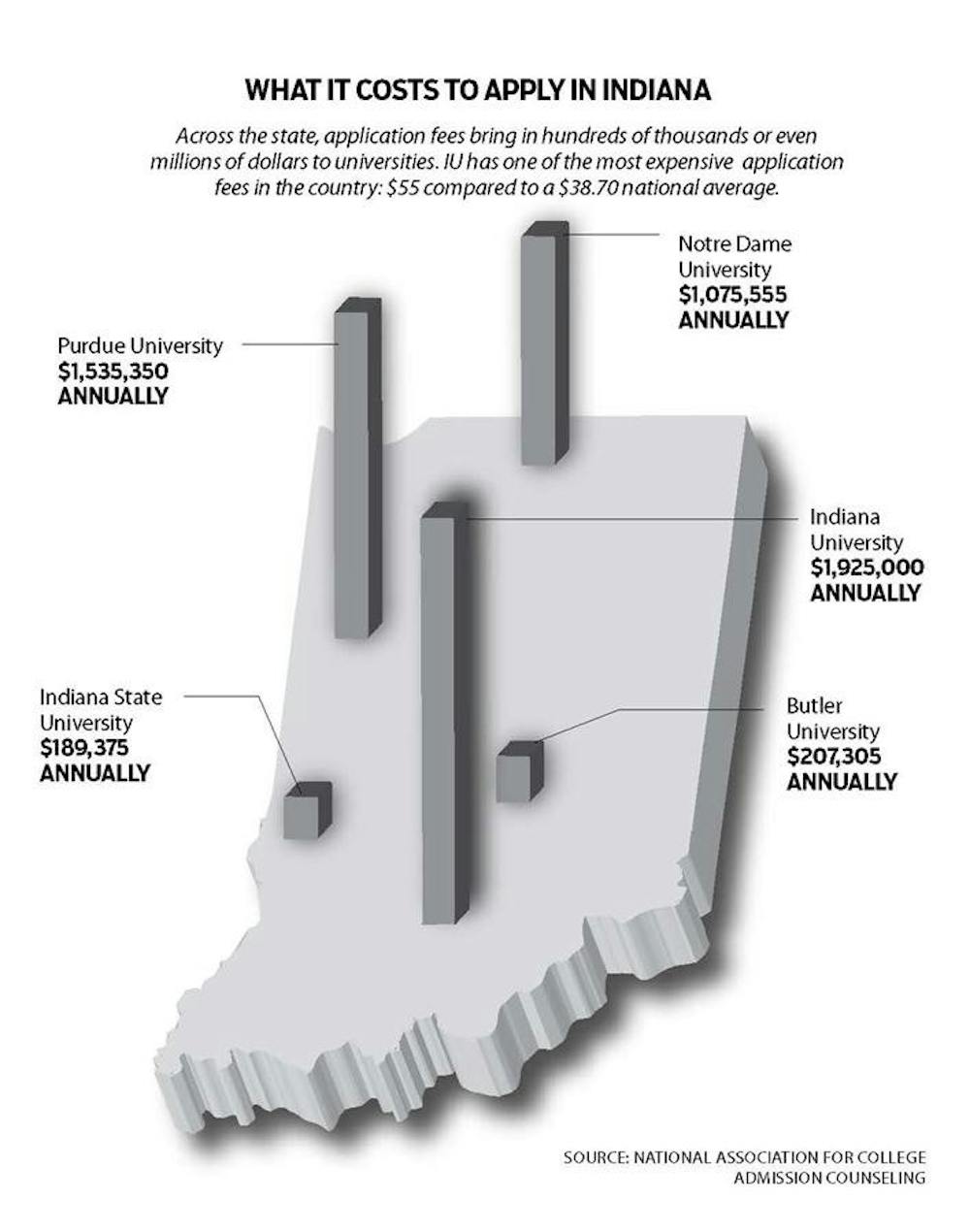
The IU Office of Admissions should bring in approximately $1,925,000 in application fees each year.
But IU Senior Associate Director of Admissions Terry Knaus said 8 percent of last year’s budget went to waived applications, subtracting about $154,000.
“If you think about it, the waived applications, we don’t get money from them, but we’re still processing,” Knaus said.
Five years ago, IU received about 24,000 applications a year, and when the number began to increase, Knaus said the University raised the processing fee by five dollars, bringing it to $55.
However, even with the increase in applications, Knaus said he has not noticed a difference in students asking to waive the fee.
“We waive applications for any student who shows financial need,” he said. “But I haven’t noticed an increase or decrease in waivers.”
The percentage might seem small, but waived fees do reduce the processing budget, which is used to send and receive applications, review transcripts and other documents from high school counselors and prospective students, as well as pay for a staggered staff.
At the Purdue University Office of Admissions, application fees go toward the same processes.
“It is a process,” said Al Hefner, assistant director at the Purdue University Office of Admissions. “It costs a lot of money, just in the manpower required to track those applications. The application fee is a way to pay for that expense. I suppose there could be arguments over how much does it really count.”
But besides paying for processing costs, the application fee also offers a small form of commitment, Knaus said.
“One of the things that makes applying a more serious decision is the processing fee,” he said.
Hefner, however, said the commitment aspect is more heavily weighted at elite
universities.
“There are institutions that charge $100 or even more,” he said. “At some point, it perhaps becomes a way to reduce the number of applicants to only those that are really interested. Otherwise, Harvard might, if they only charge $10, get all kinds of people applying to at least get a letter of denial from Harvard University. I think most state institutions, it’s more the former — to pay the cost of processing.”
In 2009, IU participated in College Goal Week, an initiative through the Indiana Higher Learning Commission, and did try its hand at letting students apply for free — if only for a week.
“Enrollment officials across the state said their staffs wasted hundreds of hours sorting through applications, many of them incomplete, and trying to follow up with students who had no intention of attending college,” according to the
Associated Press.
On the other hand, Joel McKay, a guidance counselor at Bloomington High School South, said the fees are simply a form of predictable revenue.
“Universities, as much as they don’t want to be called businesses, they are,” McKay said. “What do you love more than anything as a business? Predictable revenue.”
But continuing to waive the fees for students with financial need is necessary, Knaus and Hefner agree.
“It’s not like, well, if you can’t pay it, you can’t apply,” Knaus said. “I think it’s important for students to investigate if it can be waived.”
In Indiana, students in the Twenty-first Century Scholars program can waive their fees, as well as students whose high school guidance counselors recommend them for a waiver.
The National Association for College Admission Counseling suggests guidelines for annual family income to fall between $29,900 and $46,000 to receive a waiver.
At Purdue, online applications are set up to ask if prospective students are in that range. The application asks if students are eligible for free or reduced lunch through the National School Lunch Program or the Twenty-first Century Scholars Program, as well as the student’s household size and income.
But whatever the cost of the application fees or how many are waived, McKay said they fall short on the scale of college costs.
“I think the parents are just sacrificing more now than they used to,” he said. “I don’t think that’s a decision factor. I think it makes them grumpy, but they don’t sweat it.”
Fees raise $1.7 million for IU
Incoming student applications pay for processing, admissions officials say
Get stories like this in your inbox
Subscribe