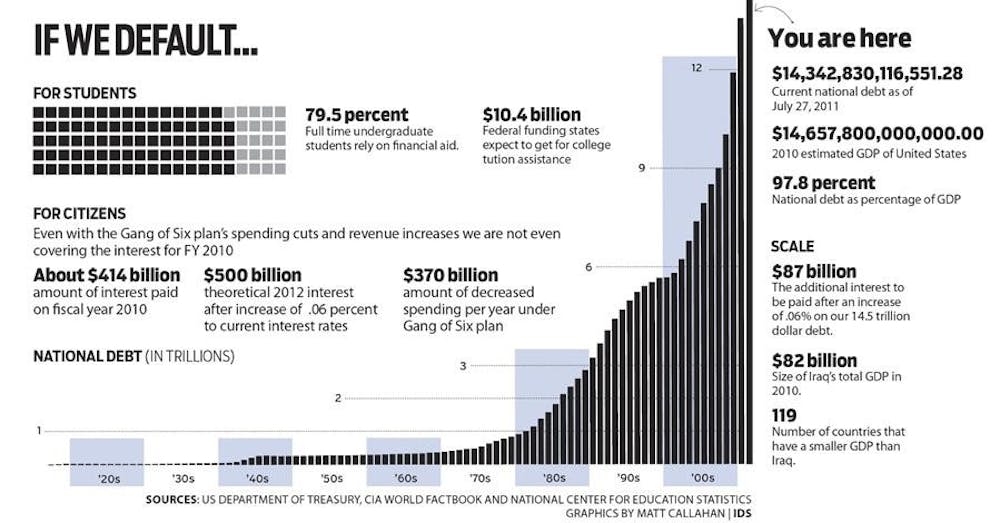
For the first time since the Reagan administration, the idea that the government could no longer borrow money to pay its bills is becoming increasingly plausible.
The deadline to increase the nation’s debt ceiling is inching closer with every passing minute. Many people are beginning to wonder what the actual consequences of a government default on its financial obligations would be.
The alarming thing is, people seem to employ an overwhelming sense of apathy at the entire political situation. This could be due to a lack of general understanding of how it would affect them personally.
With the climate in Washington being highly polarized, it is past time to understand just how exactly this could affect the way the government issues monetary funds.
The simplest way I can explain this convoluted mess of an issue is in terms of good and bad news. This, of course, pertains to the scenario of the government not raising the debt limit before the August 2 deadline.
The good news: the government will not come to a crashing halt in day-to-day operations. This is in stark contrast to the event of a government shutdown due to lack of appropriation.
What would happen is comparable to the government’s bank account running like a debit card instead of a credit card. Essentially, it would just mean the government could spend only collected revenue.
There are countless scenarios of how this would work. The likely would be a system of prioritization, although this presents its own set of legal and political issues.
Prioritization basically means the government must choose what bills get paid on time and which don’t.
Because the government currently runs on a deficit, without either increased revenues or decreased spending, the nation’s accounts will inevitably run low on funds.
This is where the bad news comes in. Without the ability to borrow, the treasury will eventually lose necessary funding for appropriated spending.
The government bouncing checks is a scary thing to fathom. It is not difficult to envision the slew of problems created if the government can no longer fulfill its obligations to its lenders and, more importantly, its citizens.
To put it bluntly, if people don’t get paid, they don’t eat. If funding for social welfare programs runs out, millions of hard-working Americans will lose the little help that is provided by their government.
Money for unemployment, food stamps, Medicare and countless other programs that keep the American standard of living the highest in the world could just disappear.
This is not to even mention people who rely on indirect government spending that would be affected. If the government can’t pay your company, how can your company pay your wages?
It is absolutely ridiculous the partisan rift tearing through Washington, D.C., is creating potential for such a dire situation. If lawmakers really had their constituents’ best interests on the agenda, this would be a non-issue. While I agree whole-heartedly this nation must have radical changes in the way that we spend, failing to raise the debt ceiling is not the path to fiscal responsibility. It puts too many Americans in a situation of desperation. This game of political chicken has got to come to an end before the livelihoods of innocent Americans crash and burn.
— ogwise@indiana.edu
National default affects all
Get stories like this in your inbox
Subscribe