
As talks of defaulting on our national debt in Washington become less theoretical, I am becoming more aware of a tendency toward unhelpful obstinate posturing.
This is basically to say I am noticing even more unhelpful obstinate posturing than usual.
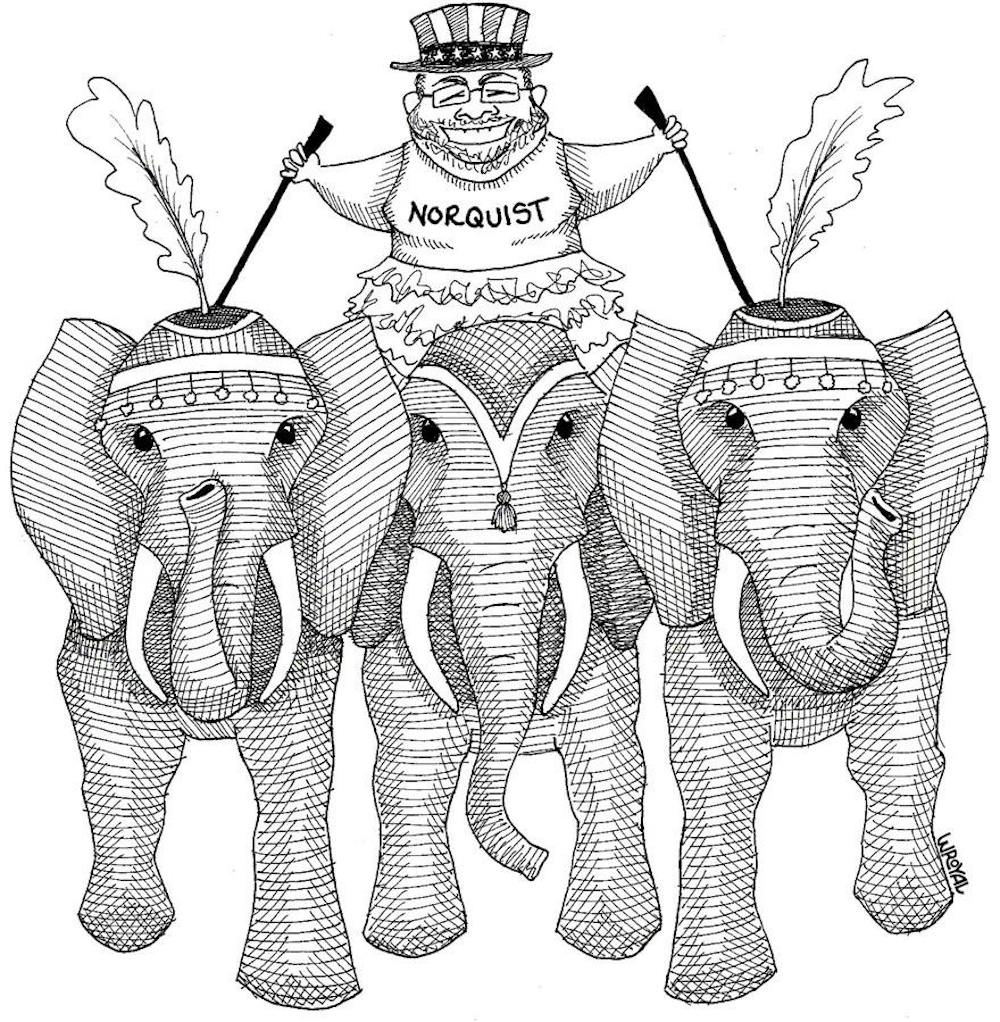
An example of what I’m talking about is the political purity pledge of the sort Grover Norquist and Americans for Tax Reform have created. His pledge is certainly not a new thing.
It’s been around since the early 1990s, but I bring it up now because it is being cited as one of the many justifications for conservatives refusing to budge on tax increases, even increases on the top 1 percent of income earners.
Here is Norquist’s pledge:
“I, _____, pledge to the taxpayers of the (____ district of the) state of ______ and to the American people that I will: One, oppose any and all efforts to increase the marginal income tax rate for individuals and business; and two, oppose any net reduction or elimination of deductions and credits, unless matched dollar for dollar by further reducing tax rates.”
Approximately 233 of the 240 Republican Party members and 40 of 47 Republican senators have signed that pledge.
Let’s talk a little bit about what it means to oppose any and all efforts to increase the marginal income tax rate.
Say, theoretically, it’s discovered there are fundamental problems with our national infrastructure. For example, electric grids that are no longer capable of keeping up with usage or crumbling highways and bridges.
It would be much more difficult to find the funding to solve such problems if we could not increase national revenue, unless we completely eviscerated other social programs.
Or, if you prefer a different example, imagine we had a mounting national debt, the continued increase which threatened our financial security and our international reputation — not to mention a fragile economic recovery.
It would be tremendously difficult, if not devastating, to try and remedy such an issue on spending cuts alone.
If only these were just theoretical issues. We are facing problems as a nation that are some of the most serious we have ever faced, and our leaders are signing pledges that, if kept, remove one of the most powerful tools that legislators have — an effect tying their own hands.
Is there anything in Norquist’s pledge that is legally binding? No. The primary threat used to enforce compliance with the pledge is that the reaction from the constituency to the legislator’s vote for tax increases would be enough to drive the legislator out of office.
Certainly there are some voters who feel this way and would act accordingly. However, I have enough faith in the average American to acknowledge that a balanced solution — both spending and tax increases — is the only reasonable compromise.
A recent Gallup poll confirms as much. Seventy-three percent of respondents noted their preference for achieving a solution to the deficit would include at least some tax increases.
To continue to hold taxes as sacred and untouchable is naïve, irresponsible and, as the Gallup poll would suggest, not even close to being broadly representative of the American public opinion.
The art of politics is compromise. If all tax increases are off the table, any hope of real compromise is shot.
In the end, the widespread prominence of pledges like Norquist’s are symbolic of a much more dangerous societal phenomenon. Our national leaders have become ensnared in the fringe’s fascination with holding all aspects of their political ideology as sacred.
If we are always unyielding on every issue, is there any room left for representative, democratic governance? Plainly and simply, the answer is no.
— jontodd@indiana.edu
In Politics: Not everything can be sacred
Get stories like this in your inbox
Subscribe



