In September 2010, at least five U.S. teenagers committed suicide after being bullied or harassed because of their sexual orientation.
Other reports put the number closer to 10, with three of those deaths occurring in Indiana.
Now, new research released this week by the Gay, Lesbian and Straight Education Network suggests Indiana middle and high schools continue to be a hostile place for gay, lesbian, bisexual and transgender students.
The findings are based on data collected in GLSEN’s 2009 National School Climate Survey.
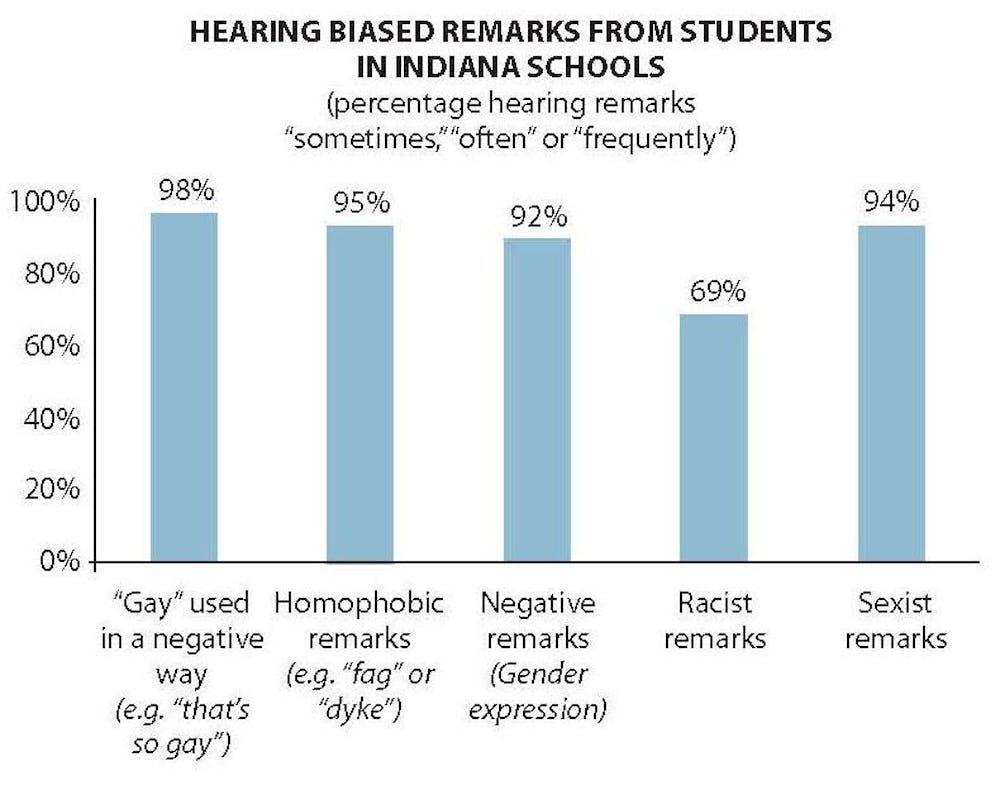
Ninety eight percent of the students in the survey said they heard “gay” used in a negative way, as in the phrase “that’s so gay,” and 95 percent of the students heard homophobic remarks such as “fag” or “dyke.”
Thirty percent of the students reported faculty and staff members “regularly making negative remarks about someone’s gender expression” and 19 percent heard school staff make homophobic remarks.
And the harassment doesn’t stop with just words, the findings suggest.
Three in 10 students reported being physically harassed or assaulted because of the way they expressed their gender and one in five were physically assaulted because of their sexual orientation.
Doug Bauder, the director of the IU GLBT Student Support Services Office, said the data is not surprising.
“We’re making progress, but it’s not state-wide,” Bauder said. “You talk to students who come here from other places in Indiana and it’s a remarkable contrast.”
Bauder said GLBT students may have a particularly hard time in some smaller towns or more religious areas. He said these communities do not need to change their religious beliefs to make the students more comfortable, however.
“You have the right to think someone is going to hell,” he said. “But you don’t have a right to make someone’s life a living hell.”
Bauder said the research can serve as a hard data “springboard” to start focusing on high schools, despite the office being part of a university.
“We just have to get schools to start dealing with this,” he said. “There’s just so much silence in these situations. No one is an ally in these schools because they are scared as well.”
Carol Fischer, producer of the local radio show BloomingOUT, which has interviewed school counselors about the issue, said she is also not surprised by the results of the study.
While Bloomington, including its high schools and IU, do a good job of promoting GLBT acceptance, the same cannot be said for the whole state, Fischer said.
“Bloomington is an oasis in a rather threatening, demoralizing environment,” she said. “Indiana is one of the most backwards states in regards to GLBT acceptance.”
Fischer said the University can do things to help, such as putting more emphasis on GLBT issues in classes at the School of Education, but ultimately, IU can only do
so much.
“IU can do more to help educators be more accepting and knowledgeable, but it’s really up to school administrators to say ‘this has to stop,’” Fischer said. “Schools have to step up.”
Robert Clayton, the president of the GLBT student group OUT, said he thinks the circle of responsibility should be expanded even further.
“When kids see that the leaders of our state look down on homosexuality, that serves as encouragement for their own discriminatory behavior,” Clayton said. “This is definitely a social issue that needs to be addressed on the macro level before we can really solve the problem in Indiana schools.”
Clayton said he believes this would cause a trickledown effect that would not only improve the environment in schools, but also the self-confidence of GLBT students.
“I truly believe that when young gay boys and girls begin to feel accepted by those around them, they will become more accepting of themselves,” Clayton said.
Research suggests high rates of harassment against GLBT students in Ind. high schools
Get stories like this in your inbox
Subscribe