Growing up, senior Richard Goodly knew all too well the difference a college education could make in a person’s life.
By the time he was in seventh grade, one of his older brothers had gone to prison.
By the time he was in high school, all three of his older brothers were incarcerated.
Goodly said his mom used to tell him, “Don’t you forget that college education is the most important thing in this world.”
He knew that college was the way out of the cycle of poverty that afflicted both his family and his community.
“I had the impression that people who went to college did big things — higher
education, higher wages — and it seemed like the thing to do,” he said.
IU needs students of a minority race, like Goodly, an African American, Vice President of Diversity, Equity, and Multicultural Affairs Edwin C. Marshall said.
“We want to instill this in students and give them the image that college is in their future,” Marshall said. “It’s not about if, it’s about when.”
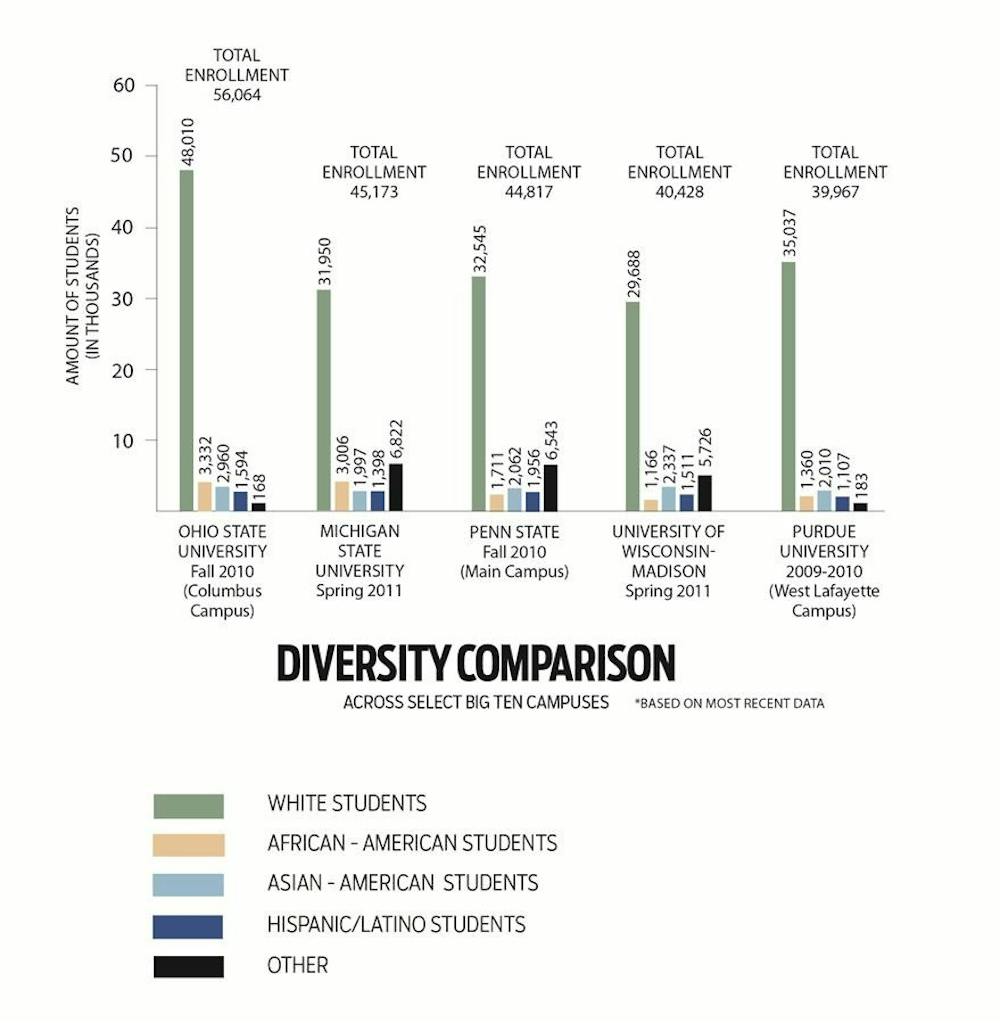
In 2000, white students constituted more than 81 percent of the student population.
African-American students made up around 4 percent, and Hispanic/Latino students comprised just above 2 percent of the student population.
Today the percentage of white students has decreased to 74 percent.
African-American and Hispanic/Latino students have only risen to 4.3 percent and 3.3 percent, respectively.
Other minority groups have actually decreased slightly in recent years.
Lillian Casillas, director of La Casa Latino Cultural Center, said that IU can do much more to attract students of Hispanic/Latino background.
However, less funding by the state and the University hinders organizations’ efforts for outreach potential.
“There are some good people on campus making a really hard effort to reach out to Latinos,” Casillas said. “Unfortunately, they are few. This has to be a university-wide effort.”
The biggest percentage increase over the past 11 years has not come from the United States, but from abroad.
In 2000, 8 percent of the student body was international students.
Today, that number has increased to 11.5 percent, the largest student minority group on campus.
Asian-Americans are the third largest minority group behind African-Americans.
Marshall said part of the reason is the pool of students that IU has tried to attract, which tends to focus more on the international community.
However, Marshall said IU tries to compare its diversity with the rest of the country and to measure whether student diversity and acceptance of other cultures is being realized on campus.
“Part of the role of the University is to help grow understanding, including how different cultures interact, which comes through conversation and interaction,” Marshall said. “We all need to be conscious of the fact that we all have something to bring to the conversation.”
Programs like Hudson and Holland Scholars Program, the Groups Program and Twenty-first Century Scholars are designed to increase the college participation rate of traditionally underrepresented students, he said.
When he was in sixth grade, Goodly learned about the Twenty-first Century Scholars program.
Offered to students from low-income families, the program provides students with a full-ride to the public Indiana college of their choice. Students must remain drug free and maintain at least a C average throughout high school.
Goodly never had enough money to open his first bank account until he was 18.
He said he realizes that without the Twenty-first Century Scholars program, his chances of studying at IU would be slim.
While the programs continue to help those students for whom a college education might not be so certain, IU-Bloomington has only seen marginal increases in minority enrollment over the past decade.
Originally from Kokomo, Goodly said he grew up living with his mother after she divorced his father when he was 2 years old.
They were always on the road, moving from place to place, traveling from school to school, often times with little more than a moment’s notice from his mother.
“I hated it because I was always a new student,” he said.
But now, he’s lived in Bloomington for three years, attending IU and finding a love for music and filmmaking.
“It’s the way I can express myself,” he said. “I feel that artistic expression is an outlet, whether it be making a visual narrative or creating an audio ecstasy.”
Diversity trends show an international focus
Get stories like this in your inbox
Subscribe