
As tuition rates and student debt continue to rise across the country, many colleges and universities also must tighten their belts.
IU is no different.
Gov. Mitch Daniels signed Indiana’s biennial budget into law Tuesday.
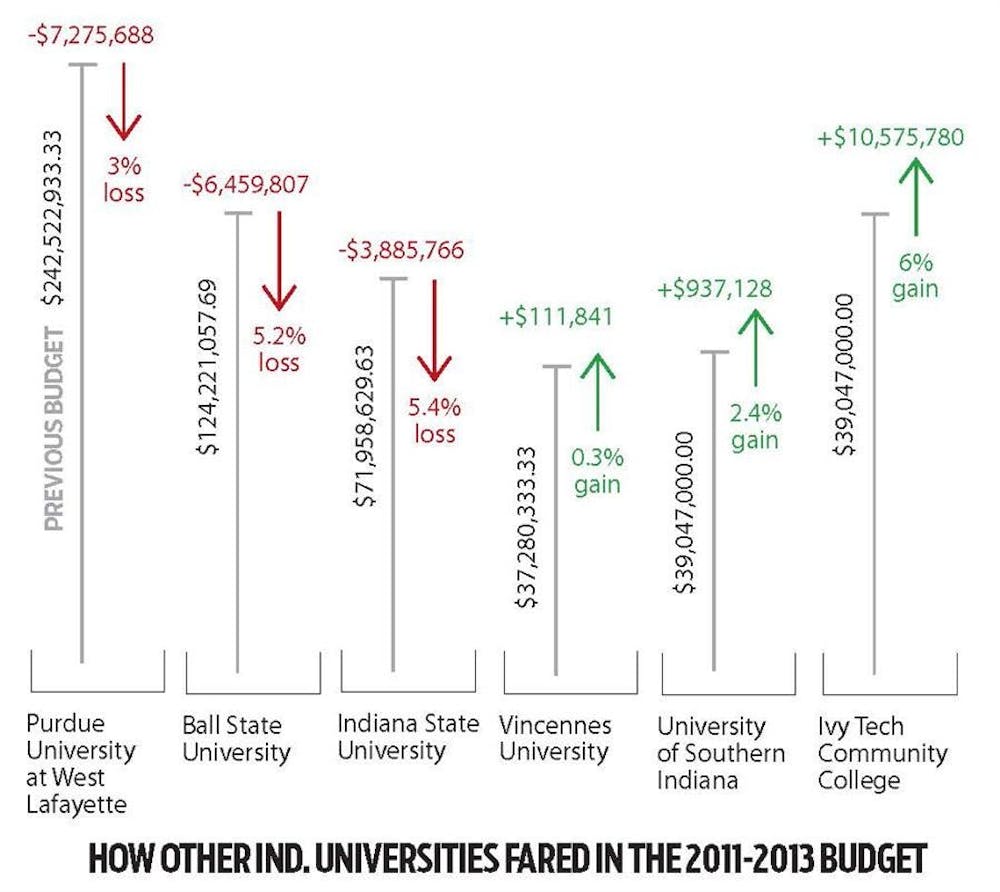
The new budget will reduce IU’s overall share of state operating funding by $9.1 million, or 2 percent. However, the impact varies by campus. While some campuses will receive an increase in funds, IU Bloomington will face a 5.5 percent cut next year, a decrease of more than $10 million. Other campuses will actually be seeing an increase in funds, which accounts for this discrepancy.
Part of the decrease is a result of a 2008 initiative by the Indiana Commission for Higher Education, which focused in a report released May 11 on increasing degree completion rather than access to higher education.
This initiative divides $61 million between the state’s public universities based on seven key performance factors, including degree completion rates and research funding, said Jason Dudich, associate commissioner and chief financial officer for the commission.
“The performance formula acknowledges that every college has room for improvement given that even at our most selective public universities, fewer than half of Hoosier students graduate within four years,” said Teresa Lubbers, the Indiana Commissioner for Higher Education in a guest column for the Indiana news media.
In a letter to the faculty, IU President Michael McRobbie called this system “well intended but deeply flawed.”
In the letter, McRobbie said half of the $61 million is allocated to public universities based on increases in degree completion, and since IU Bloomington has the highest graduation rate — 71 percent — of any Indiana public institution, there is less of a chance of improvement in comparison to other campuses in the state.
“Our point is that those performance measures aren’t really relevant to the Bloomington campus,” said Larry MacIntyre, the assistant vice president for university communications. “You can’t really compare what Bloomington does, say, to a community college campus.”
One of the major flaws that McRobbie pointed out was the fact that the funding initiative does not take into account the differing missions that IU’s eight
campuses have.
Therefore, programs like the IU School of Medicine or Dentistry have no chance at competing for funds since they are largely graduate-based. Because they are graduate-based they will not have an increase in attendance as undergraduate schools and have no suitable dual-credit courses.
“Incentivizing quantity — at the expense of quality — can only lead to a downward spiral in educational opportunities for all our citizens,” McRobbie said in his letter.
However, the Commission for Higher Education’s purpose in instituting these particular incentives was not to improve the quality of Indiana’s public institutions.
“The quality really lies with the institution,” Dudich said. “These metrics are not supposed to look at quality, they’re supposed to look at output and how well the institution is performing with those metrics and the commission. I would hope that the institutions would not sacrifice quality in order to try to win in this performance formula.”
MacIntyre said it is still unclear how these losses in operating expenses will be accounted for in the University’s new budget.
He said the trustees will most likely meet and decide on tuition rates by the end of this month and will adopt a budget shortly after.
“Tuition is one of the larger sources of revenue available to the president,” MacIntyre said. “It’s not the only source, but it’s the largest. The president right now, and hopefully over the next couple of weeks, will be working on his tuition recommendation and he hasn’t reached it yet.”
2 year Ind. budget favors quantity of graduates over quality, McRobbie reacts
Get stories like this in your inbox
Subscribe



