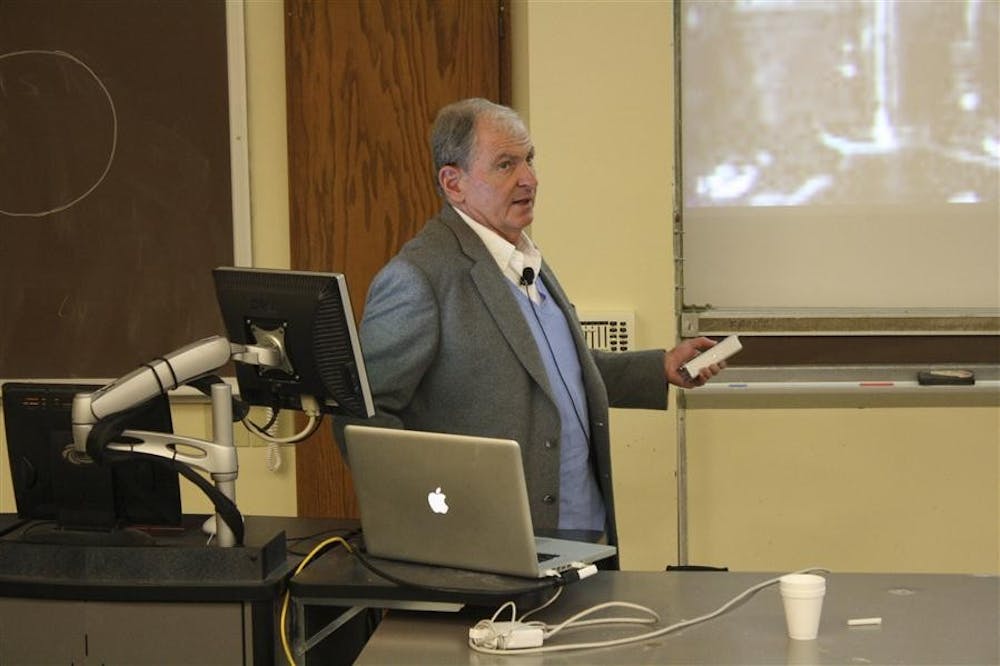
David Goodstein, professor emeritus of physics and applied physics at the California Institute of Technology in Pasadena, Calif., spoke Wednesday about his book, “On Fact and Fraud: Cautionary Tales From the Front Lines of Science.”
Goodstein began his lecture on a light note.
“The title of my book is coincidentally the title of this lecture,” he said.
Goodstein went on to explain some mistaken ethical principles.
“Scientists don’t bend over backwards to show their theories are wrong — they bend over backwards to show their theories are right,” he said.
He also discussed examples of scientific fraud.
In 1974, William Summerlin reported he could transplant tissue from animals without rejection by the recipient animal if he kept the tissue from the donor in organ culture for four to six weeks. Summerlin demonstrated his claims by showing white mice that had black patches on their backs due to skin transplants. He was caught using a black felt-tipped pen.
Isaac Newton, when calculating the speed of sound, got it wrong by 20 percent, Goodstein said. Newton went back to fix his calculations.
“Is this fraud? No, because he showed exactly what he did,” Goodstein said.
According to the National Science Foundation, scientific misconduct is “fabrication, falsification, plagiarism or other practices that seriously deviate from those that are commonly accepted within the scientific community.”
As vice provost at Caltech, Goodstein was responsible for investigating all allegations of scientific misconduct, according to his online biography.
Goodstein talked about why the bulk of scientific fraud is in biomedical science.
“There is sometimes a conflict between clinical ethical and scientific ethical,” he said. “I think the main reason is biological variability.”
He also discussed why people commit fraud.
“I’ve seen many people under career pressure, so it’s not always for monetary gain. It might be for more subtle reasons,” he said.
Next on the list of scientific fraud was the kind found in scientific textbooks and
papers.
“‘Fig. 1 shows typical data’ really means ‘these are the best results I got,’” he said.
Goodstein lectures on scientific fraud
Get stories like this in your inbox
Subscribe