
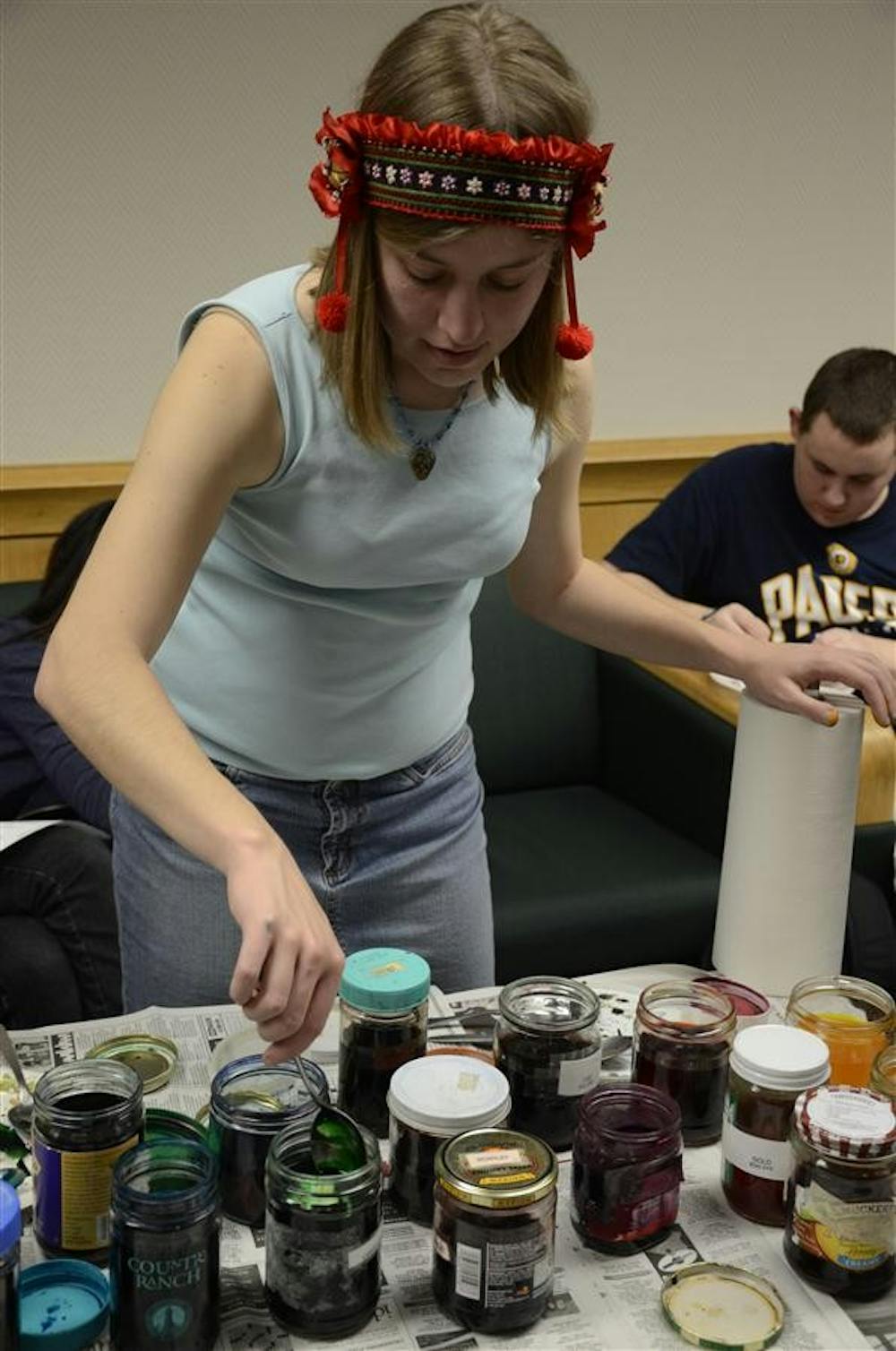
Newspaper covered every surface of the tables in Ballantine Hall 004. The air smelled of wax and matchstick smoke. As people leaned over their hollow eggs, intricate patterns began to emerge on the surface of the shells.
Pysanky are Ukrainian Easter eggs, traditionally created to celebrate the holiday. When finished, these eggs contain layers of color and amazing detail.
The Russian and East European Institute and the Department of Slavic Languages and Literature sponsored the pysanka-decorating event Monday.
“It’s very much a part of Ukrainian culture, and has been for millennia,” Dr. Monica Kindraka-Jensen said. She brought her Introduction to Ukrainian Culture class to the event.
Kindraka-Jensen explained the Ukrainian word pysaty, meaning “to write”, is linked to pysanka, the word for these detailed eggs. With wax, pencil and traditional keestka tools, participants are literally “writing on the eggs,” Kindraka-Jensen said.
The first step in the “writing” process involves penciling designs on the emptied eggshell, which has been dipped in a diluted vinegar solution to prepare it for dying. Next, the pick-like keestka is used to draw wax over the penciled-on designs.
The keestka is about the length of a golf pencil. A piece of copper wire attaches a tiny piece of rolled metal, which is driven through the wooden pole approximately a quarter of an inch from the top.
Candle wax is transferred onto the surface of the egg via the keestka.
After the wax is applied to designs, the egg is dipped in brightly-colored dye.
After three or four minutes, the egg is taken out to dry and the wax is scraped off.
The entire process is repeated as many times as desired, until patterns are revealed as different colors on the smooth surface.
“It gets pretty involved once you get several colors on there,” second-year Ukrainian language student Desi Rybolt said. Rybolt remembered last year’s event, when she spent two to three hours creating an egg with red, yellow and green designs.
Department of Slavic Languages and Literature lecturer Olena Chernishenko said the process can seem daunting at first. It’s the same every year, Chernishenko said.
“First they’re scared, and then, you know, we can’t kick them out after four hours,” Chernishenko said.
Junior Michael McCoy, a student in Kindraka-Jensen’s class, said it was nice to get a peek of culture outside of the classroom.
Before dying his egg a deep purple, McCoy spent time designing an egg covered in tiny stars.
He said it seemed simple, until he realized how difficult it would be to draw the stars in wax.
“It’s a lot harder than it looks,” McCoy said.
Celebrating Easter with Pysanky
Get stories like this in your inbox
Subscribe



