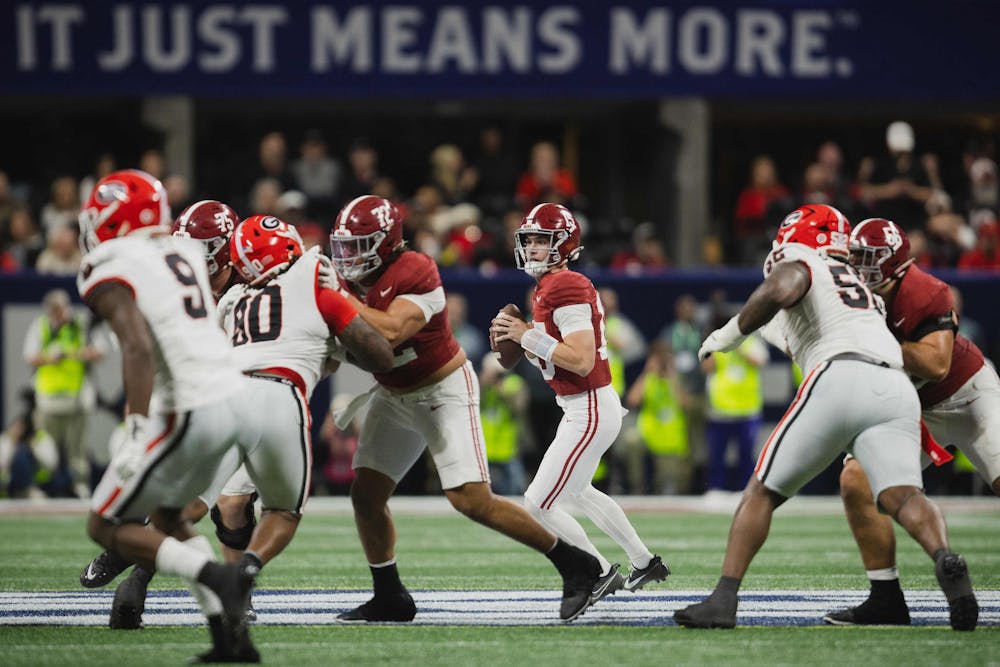
The University of Alabama’s inclusion into the 12-team College Football Playoff field Dec. 7 became a hot-button topic, as it became the first three-loss squad to reach the CFP.
The Crimson Tide had just lost to the University of Georgia by 21 points a day earlier. They began the season with an embarrassing loss to Florida State University, which finished the season 5-7, before also falling to the University of Oklahoma in mid-November.
Still, Alabama reached the playoff and earned a rematch with Oklahoma on Dec. 19 in the first round. Although the Sooners led 17-0 early in the second quarter, the Crimson Tide responded with 27 unanswered points en route to a 34-24 victory.
After earning a Rose Bowl Game date with No. 1 Indiana, Alabama received roses on the field just after the game ended. Its celebration with the roses spilled into the tunnel and eventually the locker room, where The Notorious B.I.G's “Goin’ Back To Cali” blared.
The Rose Bowl isn’t an unfamiliar place for the Crimson Tide. They’ve played in seven in Pasadena, California. Although they reached the Rose Bowl in 2020, the game was played in Arlington, Texas, due to the COVID-19 pandemic. Alabama also won the 2009 national championship inside the Rose Bowl Stadium.
Conversely, the Hoosiers have played in the Rose Bowl just once: a loss to USC on Jan. 1, 1968.
Now, the two historically opposite programs will meet with a trip to the CFP semifinals at stake. Here’s what to know about how Alabama defeated Oklahoma to reach the Rose Bowl.
Alabama’s defense
Throughout much of the first quarter and the early portion of the second, Oklahoma redshirt junior quarterback John Mateer dissected Alabama’s defense with ease. Not only was he firing from the pocket, but he also extended plays with his legs and found pass catchers on the run.
When Alabama defensive coordinator Kane Wommack adjusted, such as bringing another rusher or two, Mateer didn’t have time to sit in the pocket and find openings in the defense.
In turn, Oklahoma’s offense gained just 121 yards through the air in the second half compared to 186 in the first.
“I know they (the defense) went out there, they're very proud of what they've accomplished, and really did a nice job as the game went along of making adjustments to get more pressure on the quarterback,” Alabama head coach Kalen DeBoer said in a Rose Bowl teleconference Monday. “... And the game came back to us.”
Ty Simpson
Alabama redshirt junior quarterback Ty Simpson struggled in the season opener against the Seminoles. He responded with a 19-to-one touchdown-to-interception ratio during the Crimson Tide’s eight-game win streak.
But over the last four games of the regular season, Simpson threw five touchdowns to four picks and completed just 58.3% of his passes. Simpson returned to his old form after a lackluster first quarter, finishing the game 18 for 29 for 232 yards passing with two touchdowns.
Benefitting from self-imposed mistakes
When Oklahoma defeated Alabama in the regular season, the Sooners benefited from unforced errors. Simpson threw a pick-6, and the Crimson Tide fumbled twice.
However, the roles reversed in the first-round matchup.
Oklahoma redshirt junior punter Grayson Miller dropped the ball when he attempted to punt downfield, setting up Alabama in plus-territory. The Crimson Tide converted the mishap into a field goal.
Mateer threw a pick-6 just three minutes later that tied the contest at 17 just before halftime. Then, with the Sooners trailing in the fourth quarter, redshirt junior kicker Tate Sandell — who won the Lou Groza Award as the best kicker in college football — missed consecutive field goal attempts.
Alabama coaching staff’s familiarity with Indiana
DeBoer spent 2019 in Bloomington as Indiana’s offensive coordinator, and his greatest memory as a Hoosier was their road victory over Nebraska that clinched a bowl berth.
When he was a Hoosier, DeBoer felt increasing investment into the program that resulted in growth. The program built momentum in 2019 and 2020 with consecutive winning seasons and bowl berths. However, Indiana won just nine games over the next three seasons, leading to former head coach Tom Allen’s dismissal.
Although he’s been away from Indiana for six seasons, DeBoer has kept up with the program from afar.
“Coach Cignetti, just what he's done is amazing here these last two years, just building the program as quickly as he's done to the level it's at,” DeBoer said. “... Coach Cignetti has done a great job providing the spark, which really leads to people continuing to be all in. As you get more people all in, you get the moments that you're in right now.”
Alabama co-offensive coordinator and quarterback coach Nick Sheridan coached at Indiana from 2017 to 2021 in a multitude of roles, including offensive coordinator. Wommack served as the Hoosiers’ linebackers coach in 2018 and the defensive coordinator in 2019 and 2020.
Alabama assistant defensive backs coach Jason Jones was Indiana’s safeties coach from 2020-22.
Crimson Tide director of sports performance David Ballou served in an equivalent role at Indiana in 2018 and 2019. He also played fullback for the Hoosiers from 1997-99.
A sign of the times
Alabama claims 18 national championships, including six since the 21st century began. Indiana has lost the second-most games in the Football Bowl Subdivision with 715.
However, Indiana is a new program under Cignetti. The Hoosiers are favored over the Crimson Tide by 6.5 points. A win would send the Cream and Crimson to the semifinals, as they look to bring the program’s first national championship to Bloomington.
Follow reporters Dalton James (@DaltonMJames and jamesdm@iu.edu) and Conor Banks (@Conorbanks06 and conbanks@iu.edu) and columnist Quinn Richards (@Quinn_richa and qmrichar@iu.edu) for updates throughout the Indiana football season.