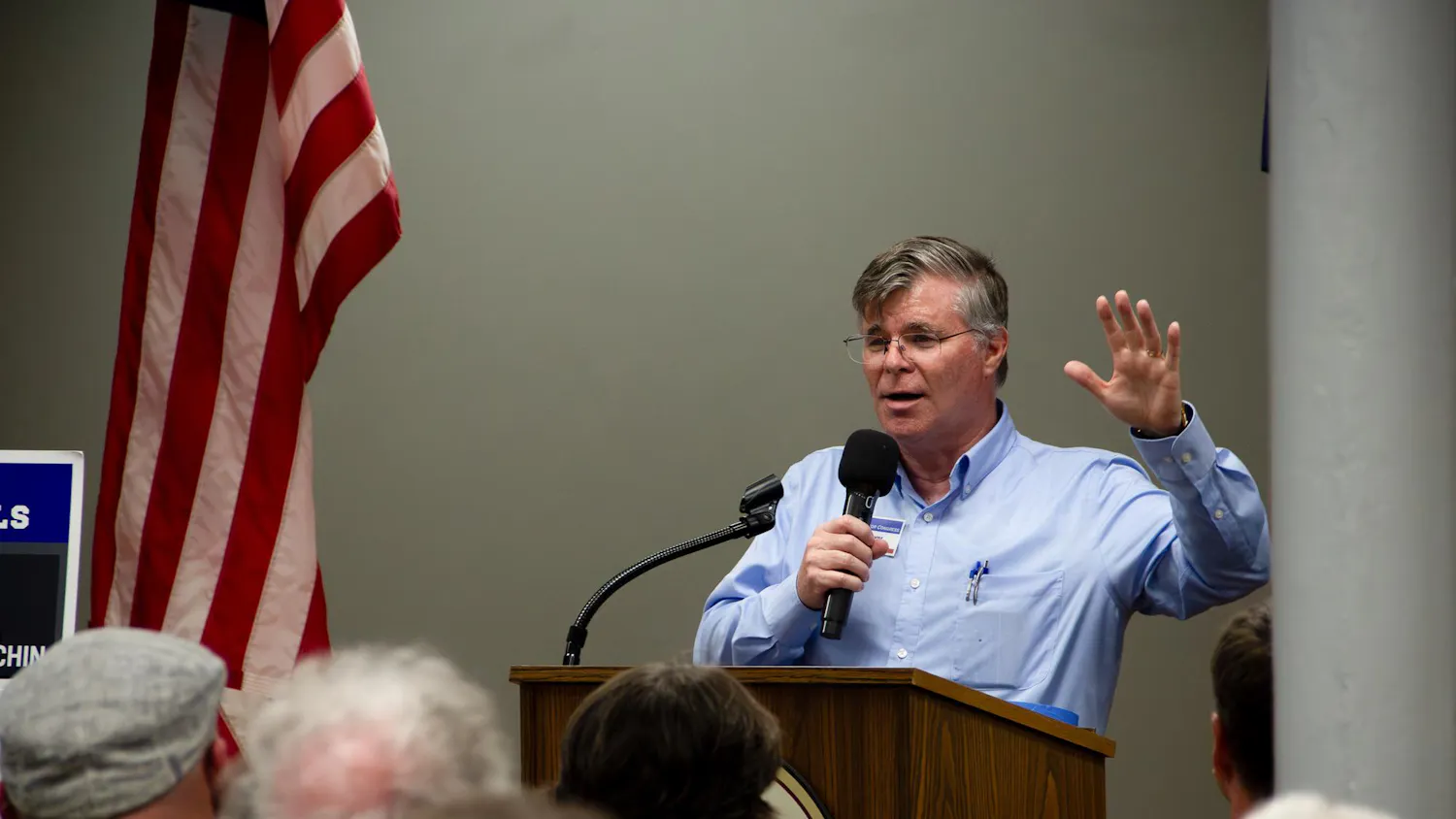
The group of 11 parents and educators was not able to fill the Large Group Room at Bloomington High School South, but they said the ideas they discussed are big enough to change the future of education for the Monroe County Community School
Corporation.
Staff from the MCCSC’s Office of Curriculum, Instruction and Assessment met Tuesday evening to present and discuss information about Professional Learning Communities and other initiatives that are being implemented to support student learning at the elementary, middle and high school level.
Fran Stewart, a district literacy coach for MCCSC, said Professional Learning Communities will soon be a way of life in every school in the district.
“This is not a fab diet or a canned program,” Stewart said. “Instead, it is a way of thinking and a way of collaborating. It’s an ongoing way of staying in shape.”
Professional Learning Communities are organizational arrangements that offer staff development and a strategy for school change and improvement.
Teachers and administrators who participate in the communities continuously seek and share learning so that students can benefit.
Stewart said PLCs have been implemented nationwide for more than 20 years and yield high rates of success and student improvement.
Stewart said PLCs are centered on three major ideas.
Learning the fundamental purpose of schooling, working in a collaborative school culture and being result-oriented are all contributing factors to the foundation of a PLC.
Marilyn Schwartzkopf, another district literacy coach for MCCSC, said PLCs are a way to look at state standards and create a curriculum that is specialized for the students.
“I’ve heard that if we teach every indicator (of the state’s standard of success), we will have kids in our schools for over 22 years,” Schwartzkopf said. “Our PLC teams help figure out which indicators are absolutely essential and how they should teach them.”
PLCs have not been fully implemented in MCCSC.
But some nearby elementary schools are beginning to embrace the new way of doing business.
Summit Elementary Principal Doug Waltz has already seen positive results come from the PLCs within his school.
“This program has support nationwide, and I’m really proud to be a part of it,” Waltz said. “It’s the most exciting thing in a long time, and we’re starting to learn what we want the kids to have.”
Currently, elementary schools in the MCCSC have implemented PLCs for
language arts.
Teachers of each grade level form a community and collaborate for 50 to 60 minutes each week to discuss the plans for their respective PLC program.
The teams develop common formative assessments and create a common knowledge base.
“Usually teachers will gather their kids, close their door and start teaching,” Schwartzkopf said. “But rarely have I seen a situation when two or three or four heads aren’t better than one.”
PLCs have not been developed for math or science programs yet within the MCCSC.
But Stewart said the process is an ongoing one and that PLC curriculum can be developed for the MCCSC in the near future.
Schwartzkopf said another large change that comes with PLCs is the grading scale.
She said her team feels the 100-point grading scale is flawed.
She and her team feel rubrics could soon be the preferred grading system within the PLCs for MCCSC.
“The rubrics show what students know, not whether a student is a teacher pleaser or does a lot of extra credit,” Kimberly Williams, the coordinator of high ability education for the MCCSC, said.
Stewart said the PLCs will provide a no-fail environment which will guarantee students are going to learn the material presented to them.
The communities will also offer support for teachers, too.
“PLCs offer a more secure and collaborative environment for teachers,” Stewart said. “And likewise, they will make our students feel more secure.”
PLCs could mean MCCSC student improvement
Get stories like this in your inbox
Subscribe