
The ball is tipped, and Kurt Pangborn sees a orange blur thrown into the air.
It’s the same orange blur he has been watching his entire life, whether it was sitting inches away from the television set watching IU basketball, witnessing Zach Hahn drain a jumper for New Castle in the 2006 3A state championship game or helping rebound at an IU women’s basketball practice.
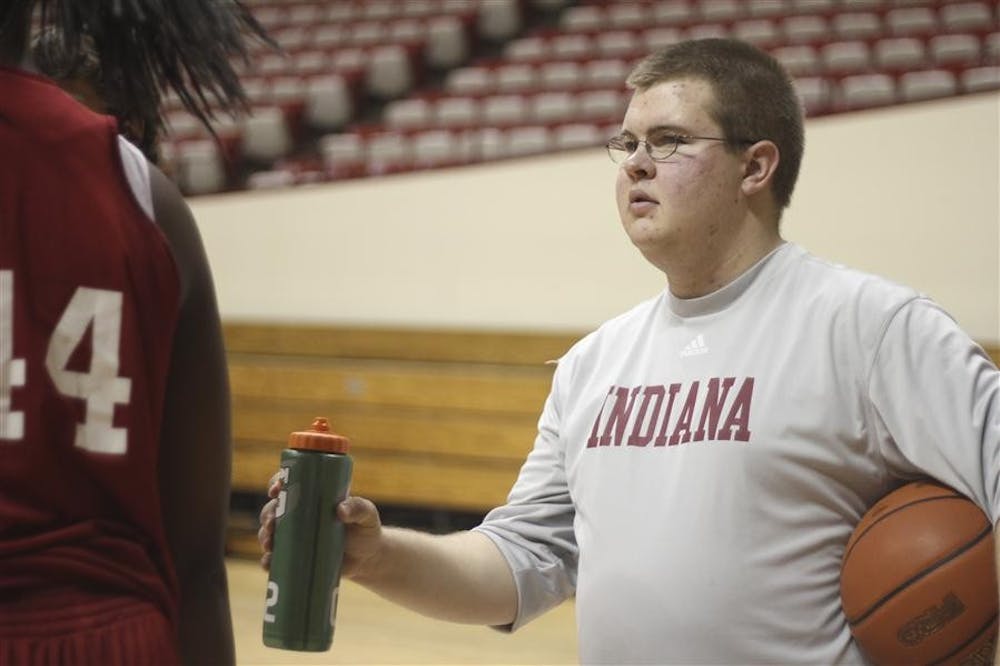
Pangborn, a student manager for the IU women’s basketball team, said he has always loved basketball despite being legally blind in both his eyes.
He was born with primary congenital glaucoma and bell’s palsy on his right eye, disorders that have caused his sight to worsen with age. He said now his vision is at 20-450 in the left eye and 20-300 in the right. Both are worse than the 20-200 considered to be legally blind. Pangborn said he is almost totally blind in the left eye, only being able to see light and motion. In his right eye, he said he has more stable sight but has lost his peripheral vision and can only see a certain area in front of him.
He has had 37 different eye surgeries to try and “salvage” what vision he has left.
After being diagnosed the day after his birth, Pangborn’s mother, Rosie Dellinger, said he was sent to Riley Children’s Hospital to have what she thought would be the first of only a couple of eye surgeries.
“I left him that night and it was horrible,” Dellinger said. “You’re expecting a baby and you think you’re going to be able to take him home and enjoy it, and that’s not at all what happened.”
Pangborn’s vision was already so impaired since birth that the expected “couple” of surgeries could not save his vision.
A FUZZY FUTURE
This is where Kurt Pangborn’s life could have stayed dormant, a point at which he could have lowered his head and accepted his disability as the means to a life without goals or aspirations. But that just wouldn’t be him.
“There’s going to be barriers in your life, but why make them barriers? Why not make them hurdles that you can jump and rise above?” he said.
Early on, Dellinger was determined to raise a son that believed just that.
“I would always say to him, ‘Kurt, just because you’re legally blind does not mean you can’t be normal. I don’t want you lying around the house and living off of the government for the rest of your life. You can be just as good as anybody else. You can be the president if you want to be. It may take you longer, it may be twice as hard, but you can do it.’ And I think he really took that to heart.”
This determination to succeed was applied to sports. Growing up, Pangborn said he loved watching IU basketball and was raised in a household of big Hoosier fans. However, Dellinger said playing and watching quickly became two very different things.
“There was something about basketball. He wanted to play it because he would constantly tell the doctors, ‘I want to play, I want to play.’ And they would tell him no,” she said. “And I think to him it was like, if I can’t play and be actually in the game, I want to find something to where I don’t care if it’s on the sidelines. I want to be a part of the game.”
Pangborn got his chance to be put in the game late in his tenure at Union Elementary School.
“I was always directed not to play sports,” Pangborn said. “When I was young they let me play tee-ball, but once I got to a certain level of competition, for health reasons, they said that it wasn’t a good idea because of the scar tissue and molteno tubes. So any kind of contact to the head could cause me to lose all vision.”
Although Pangborn does not see his three-year stint in the tee-ball league as significant, his mother said that was when she saw the potential in him.
“He got up to where they used the pitching machine and it was amazing to watch,” Dellinger said. “His eyesight had grown worse gradually, but he was getting to the point where he was hitting home runs. And I asked him how he was hitting those and he said, ‘Mom, the pitching machine sounds different and I know my timing when to hit it.’”
Pangborn said as his sight gradually worsens, his other senses grow stronger. He said he is able to especially use his hearing to help during basketball practices.
“There’s so many tools you can use to learn the game. It doesn’t have to simply be getting in the game, playing those years and getting all that experience,” Pangborn said.
His first experience as a basketball manager came in fifth grade when he traveled with his elementary school’s team and assisted them.
However, Pangborn said his career really took off while at New Castle High School, where his friend Hahn, a basketball player, told coach Steve Bennett to give Pangborn a shot at being student manager.
“Coach Steve Bennett has one of the highest winning percentages in the state,” Pangborn said. “So for me it was a great place to build a foundation of basketball, how it should be done, and I learned an awful lot there.
“There was some involvement within high school basketball where I actually had the opportunity to get on and play a little bit with them. So that was really neat because I never had that opportunity in my younger years to actually get out and play.”
New Castle went on to win the Class 3A Indiana State Championship his junior year. Dellinger said that remains one of the highlights of Pangborn’s life.
“When they won, it was as if he had won. He was part of the team.”
COMING INTO FOCUS
After graduating high school with an ignited passion for basketball, Pangborn attended Vincennes University, where he resumed his duties as student manager. But he said women’s basketball coach Harry Meeks was understandably hesitant.
“I went in, told him (Meeks) my story and he said, ‘Well, we’d like you to help.’ But it’s funny because you can always see that little bit of hesitation,” Pangborn said. “It’s like, ‘Oh no, I’m going to work with this guy who’s visually impaired. I want to help him but what is he going to do?’ So at every level there’s that little bit of hesitation: What do I do? What do I say? What don’t I do?”
At Vincennes, though, Pangborn excelled.
In addition to his usual duties managing the uniforms and equipment, Pangborn supervised and created individual workouts for the players.
This year, Vincennes is ranked second in the National Junior College Athletic Association. Pangborn said the coach there still uses a black book he used to keep track of all the systems for shooting drills and workouts. To Pangborn, unlocking a player’s potential at Vincennes was a welcome challenge.
“It’s kind of like a puzzle where all the pieces start coming together, where we all formed a system off of the input that I had,” Pangborn said.
One day after a game, Pangborn was asked to see Meeks on the court to meet someone. That someone was IU women’s basketball coach Felisha Legette-Jack.
She was on a recruiting trip scouting now IU senior Hope Elam.
However, she learned that Pangborn was finishing his second year at Vincencess, earning his associate’s degree in sports management and marketing.
She offered him a position as her team’s student manager, knowing that he would be attending IU in the fall. He gladly accepted, relishing the opportunity to work for the school he had watched in his childhood.
In 2009, Pangborn resumed his role as student manager, but this time, for the Hoosiers.
In addition to the responsibilities he carried at New Castle and Vincennes, Pangborn has become a member of the IU women’s basketball family off the court.
He frequently hosts players at his home, cooking dinner as they watch game film.
“A lot has to do with not necessarily what you have on paper, but more of being that support system for a player and talking with them and working with them through things,” Pangborn said of being a student manager.
“I consider him to be pretty much my brother,” fellow student manager Britanny Hollingsworth said. “He’s important to this team and he’s important to me as well.”
Sophomore Aulani Sinclair, who arrived in Bloomington the same year as Pangborn, agreed.
“He’s just a genuine, great person. He’ll do anything for us on the court or off the court.”
CYRSTAL CLEAR
Pangborn will be earning his bachelor’s in recreational sports management from IU this year and said he plans to head to graduate school. He does not know where he will end up, but he knows he wants it to be somewhere offering him a position as a graduate assistant and he prefers to stay in Indiana.
Ultimately, he wants to become a collegiate athletic director.
“I’m amazed but I’m not surprised,” his mother said of where Pangborn has gone in his life.
“So many people that have a disability or are visually impaired, unfortunately don’t make it out of high school. So to be able to take that next step into college and work in college athletics is such a blessing to me,” Pangborn said. “I can’t explain every day there’s a sense when I get up that I really am doing something and making a difference when there’s people like me that could be sitting at home saying, ‘What am I going to do the rest of my life?’
“There’s days that are worse than others when you think, ‘Am I doing the right thing?’ But the absolute thing that I always think of is my faith, and I’ve come so far, so why would you want to quit? Why should I fear tomorrow when I don’t know what’s out there? But if I just simply try and give it my all, then nothing but good can come out of it.”
Legette-Jack put it simply: “We just need more people like him in this world. He’s a good man and I’m going to miss him.”
Legally blind IU student manager continues duties, passion for basketball
Get stories like this in your inbox
Subscribe



