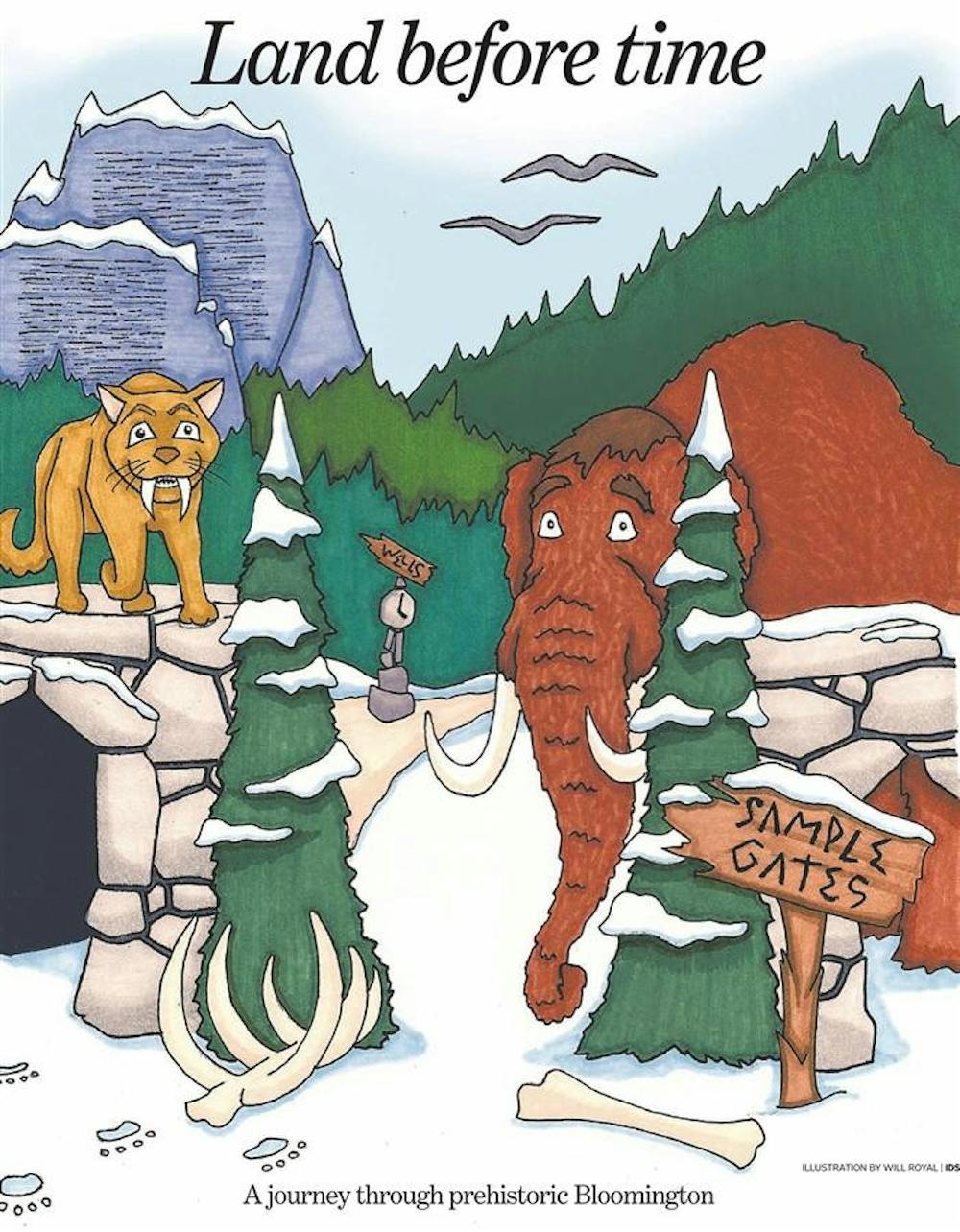
Bloomington had no students or professors a million years ago, but there were plenty of mastodons, saber-toothed cats and horses.
These and many other animals were a part of the environment in southern Indiana. Thousands of years before Europeans came to settle, and even before the arrival of the first indigenous people, Indiana had many ecological and environmental differences from today.
“The most recent geological history we have a record for is less than 2 million years during the last warm period,” said David Polly, associate professor of geological sciences. “Indiana is covered with remains of glaciers.”
Before man came to Indiana, the state was a part of the Wisconsinan glaciation, which was one of the last major continental glaciers, Polly said. The glacier extended from Canada to about Martinsville.
Because the glaciers only extended through Martinsville and never covered the area that is now Bloomington, the topography is very different between northern and southern Indiana, Polly said.
“10,000 to 12,000 years ago during the glaciations period, Bloomington wasn’t under glaciers, but the more northern areas were,” professor of biology Keith Clay said. “Because of the glaciers, the land up north became flatter. You can see where the glaciers stopped as the land becomes hillier.”
Glaciers formed on the northern half of Indiana, but it was valleys and rivers that carved southern Indiana’s hills, Polly said.
Glaciers weren’t always a part of Indiana. As we go back in time, Polly said, we see that the earth has had many temperature cycles.
“We’ve been through 10 or more of these cycles,” Polly said. “If we go back 120,000 years, it was warm like today.”
One of these warm cycles gave Bloomington a partially tropical environment, Polly said. This environment had some shallow seas which made the limestone quarries that still exist now.
After 100,000 years of this warm cycle came another cold cycle. This brought in the glaciers, which covered the continent and would eventually form the Great Lakes.
Because of this change in environment, Polly said, Indiana has seen many interesting big animals, such as the American mastodon, the muskox, the mammoth, the giant beaver, the dire wolf, the ancient bison, the saber-toothed cat, the giant ground sloth, the Pleistocene jaguar and the Pleistocene horse.
One of the reasons why Indiana had so many big animals was because of the colder environment. The cold and large landmasses made Indiana an ideal home for larger animals. Many of these bigger animals reigned during the Pleistocene Epoch, which is the world’s most recent period of repeated glaciations.
Big animals were not the only animals that lived in Indiana, Polly said.
Indiana also had many of the same smaller animals as it does now, such as rabbits, armadillos and squirrels.
After the Pleistocene Epoch, came the Holocene Epoch, a warmer period in which we are still living today.
As the temperatures warmed and glaciers melted, the land became more accessible to people, Edward Herrmann, a graduate student in the anthropology department, said.
Some theorize that people came to North America by walking over the Barringland Bridge, while others theorize that the first people came by boat, Herrmann said.
“As glaciers recede, the first record of people here is about 13,000 calendar years ago,” Herrmann said.
The first people to come into this land were the Clovis, Herrmann said.
“They were fully modern humans; they had emotions, feelings, thoughts, abilities to analyze, art, ritual burial,” Herrmann said. “They were very skilled. Many of the projectile points they made were more complicated than the ones that come later.”
As humans started to enter the land, the archeological and geological history started to change. Many of the people who came here were hunters and gatherers, Herrmann said.
“We know the human groups ate mammoth and mastodon because we see their tool cut marks on the fossils,” Herrmann said.
With the changes in climate and increasing number of hunters, many of the large animals such as the American mastodon went extinct, Herrmann said.
“After major climate change around nine to 10,000 years ago the environment starts to look similar to today,” Herrmann said.
The environment in Bloomington and southern Indiana is still changing. In 1800, 87 percent of Indiana was covered in forests. By 1870, forests occupied only 29 percent of the state, and by 1910 only 7 percent, Polly said.
Indiana is now 18,000 years into the warm period and should progressively start to get colder, because every 100,000 years the earth goes through climate cycles, Polly said. However, because of global warming and high CO2 levels, it is not getting
colder.
“Even though it’s cold now, it’s a fairly mild winter,” Polly said.
As the weather progressively gets warmer and warmer, spring comes earlier every year, Polly said.
“You will notice the difference of climate change when you’re your grandparents’ age,” Polly said. “Maybe we won’t get snow in Bloomington anymore.”
As winter grows shorter every year, animals in colder climates are negatively affected.
“We can generally learn about fauna groups by looking at megafauna that have died out,” Herrmann said. “What are many people predicting for the polar bear? As habitats change, species die.”
A journey through prehistoric Bloomington
Get stories like this in your inbox
Subscribe