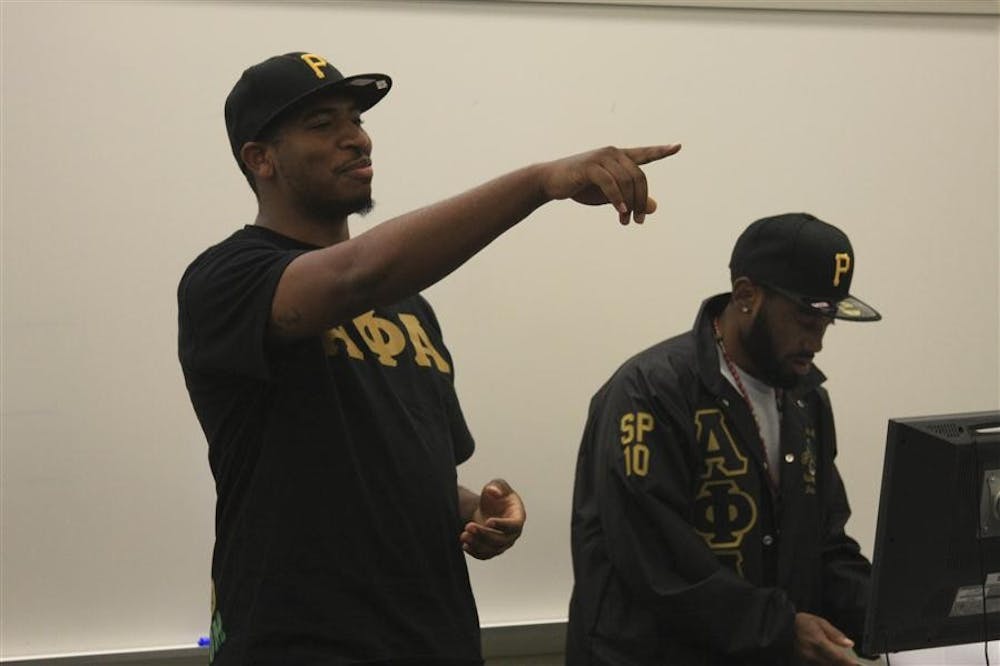
Amidst the houses on Third Street and Jordan Avenue reside several traditionally black greek organizations.
Governed by the National Pan-Hellenic Council, these organizations do not have houses or formal rush processes and typically recruit fewer people.
But they are no less greek.
“This is an opportunity — a leadership opportunity, a social opportunity, a cultural opportunity — kind of all wrapped up in one,” Fred McCall, IU’s NPHC adviser, said.
Nationally, there are nine historically black organizations, referred to as the “Divine Nine.”
Many of the nine were founded in a time when black students could not join existing fraternities or sororities.
Junior Aaron Barnes said history and culture remain particularly important to the
organizations.
“It’s always a question of whether or not we’re living up to our founders and what history has set in the way for us,” Barnes said. “What the organization was founded upon and what happens today is always in the very foreground of our minds.”
The first black fraternity at IU, Kappa Alpha Psi, was founded in 1911, The rest followed,and the latest was created in 1995.
“We were excluded from those organizations that were in IFC (Interfraternity Council) and PHA (Pan-Hellenic Council),” said senior Brittany Bullock, NPHC public relations chairwoman. “So we have to show homage to the founders, the people, who gave us a way to wear our letters.”
Interested members have to take the initiative.
To join these organizations, there is no formal rush process.
Typically students research, choose and then contact the organization they want to join.
Members are selected based on grade-point average, letters of recommendation and strong evidence of community service.
“As far as ‘recruiting’ we are quality over quantity,” Bullock said. “We would like for people who actually want to be in our organizations to understand what we were founded on.”
As a community, Bullock said the chapters interact a lot with each other.
But while they have their own reputations, they aren’t as pronounced.
“Because the minority community is so small, NPHC gives us a way to bring it together closer and be able to do community work and show the campus that we are supportive,” Bullock said.
Though all members of NPHC are currently of a minority background and its chapters are traditionally black, anyone can join.
NPHC is evolving, trying become more visible and changing how they interact with other greek organizations on campus.
“We will always have ties to the African-American community,” Barnes said. “Our organizations are assimilating and becoming more involved with the whole campus. It’s in our best interest to branch out.”
But part of NPHC’s involvement campus-wide, McCall said, means all students have to know the council exists.
“The first thing people need to know is that NPHC is here,” McCall said. “A lot of people don’t know we exist. This is part of the greek community that isn’t as well known because we don’t have houses and things like that. We’re still a part of the campus culture and need to be celebrated.”
Minority organizations work to stand out
Get stories like this in your inbox
Subscribe