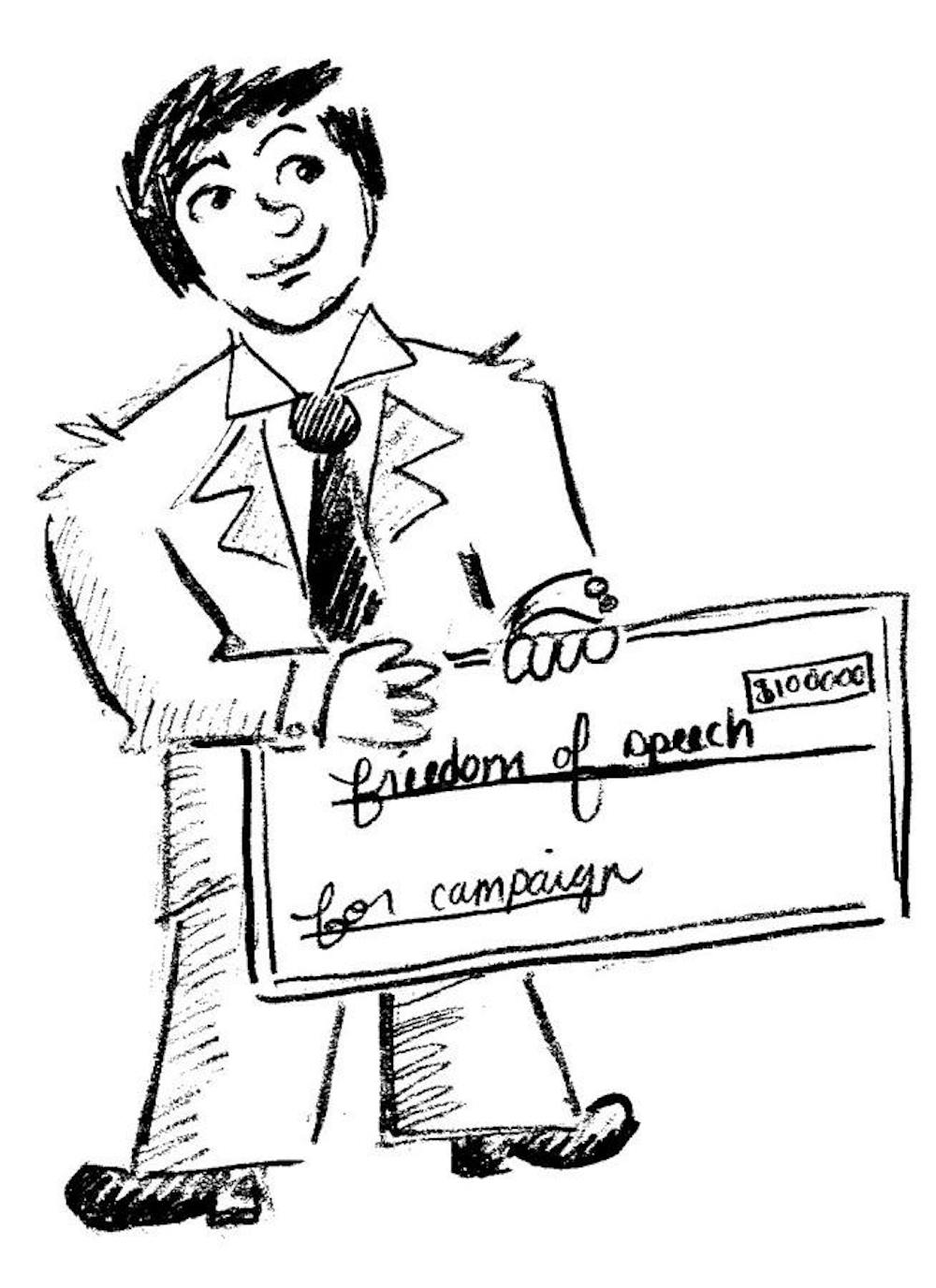
Last Thursday, the Supreme Court eliminated restrictions on corporations’ campaign contributions, thereby potentially – if not probably – endangering the democratic process of Washington.
The 5-4 ruling took out decade-old restrictions that prevented corporations from spending their own money on media supporting or opposing candidates for public office. While special interest groups have been manipulating loopholes for a while, this decision removes the need for their deception.
The Obama administration has tried to limit the power of lobbyists in its first year, but this should not be a partisan issue. When the voice of the common people is diminished, both sides lose. If you do not control the money in a corporation, you have now had your voice weakened in our democratic process. Sen. John McCain, R-Ariz., was a co-author with Sen. Russ Feingold, D-Wis., in 2002 of the most recent major act to limit corporate influence in political campaigns. It’s puzzling why Republicans like House Minority Leader John Boehner, R-Ohio, are supporting this decision.
This is not an issue of free speech, as some of the decision’s proponents have claimed. In our lawsuit-happy world, it has become vital for entrepreneurs to be able to separate their personal lives and accounts from that of their start-up businesses.
This allows new competition to enter the market and is generally a good practice. Lawsuit protection is an entirely separate idea than volunteering your support for a politician, but that’s what supporters of this decision are trying to connect. Special interest groups are not like some advanced artificial intelligence desperately wanting to express love despite being spurned by society.
If business owners want to support a political cause, they are perfectly capable of doing that in their private lives. To allow corporations to act apart from that would essentially grant its controllers a “double vote,” allowing them to donate as an individual and then again through the business. If you thought the medical industry was already stifling health care reform, it will only get worse from this point.
It’s worrisome that political news is becoming closer and closer to a dystopian novel. The news story comes across like pages directly from George Orwell’s “1984” or Warren Ellis’ “Transmetropolitan.” This decision must be reversed quickly or else things will get double-plus ungood.
DISSENT The Citizens United ruling is a victory for free, albeit unpopular, speech.
In the week since the Supreme Court’s ruling in Citizens United v. FEC, which struck down provisions of a number of statutes restricting corporations’ and unions’ right to express support for, or opposition to, candidates for political office, reactions have poured in from all sides. The tenor of those reactions has been interesting indeed.
On the one hand, groups from all over the political spectrum who share an interest in the protection of free speech, including the U.S. Chamber of Commerce, a pro-business lobby; the AFL-CIO, a major labor union; and the American Civil Liberties Union, have expressed support for the ruling.
On the other, President Barack Obama; Sen. John McCain, R-Ariz., who coauthored the bill best known for restricting political speech, the Bipartisan Campaign Reform Act; and Sen. Chuck Schumer, D-N.Y., have all criticized the ruling. In his weekly radio address, Obama said he couldn’t “think of anything more devastating to the public interest.”
Hopefully Obama was being hyperbolic and didn’t mean to imply he cannot imagine the prospect of Sept. 11-style terrorist attacks, runaway inflation caused by fiscal excess, or – to use one of his favorite nightmare scenarios – the engulfing of our coasts by rising oceans, as worse than free speech for corporations.
As shocking as the reactions of Obama and others have been, though, they appear yet more chilling in light of the statements his own lawyers made while arguing the case. When the case was first argued last spring, Deputy Solicitor General Malcolm Stewart answered yes when Associate Justice Samuel Alito asked whether the government’s power to regulate corporate speech would, in his opinion, extend to prohibiting publishing companies from publishing books containing political endorsements.
When the case was re-argued this past fall and Obama’s solicitor general, Elena Kagan, was put on the case, she clarified the Obama administration’s position by stating that books would not be censored but that “pamphlets” could be. Given that the dividing line between books and pamphlets is universally agreed upon (oh wait, it’s not), this at least is comforting. Oh wait, it’s not.
– Jarrod Lowery
Poor little 'big guy'
Get stories like this in your inbox
Subscribe