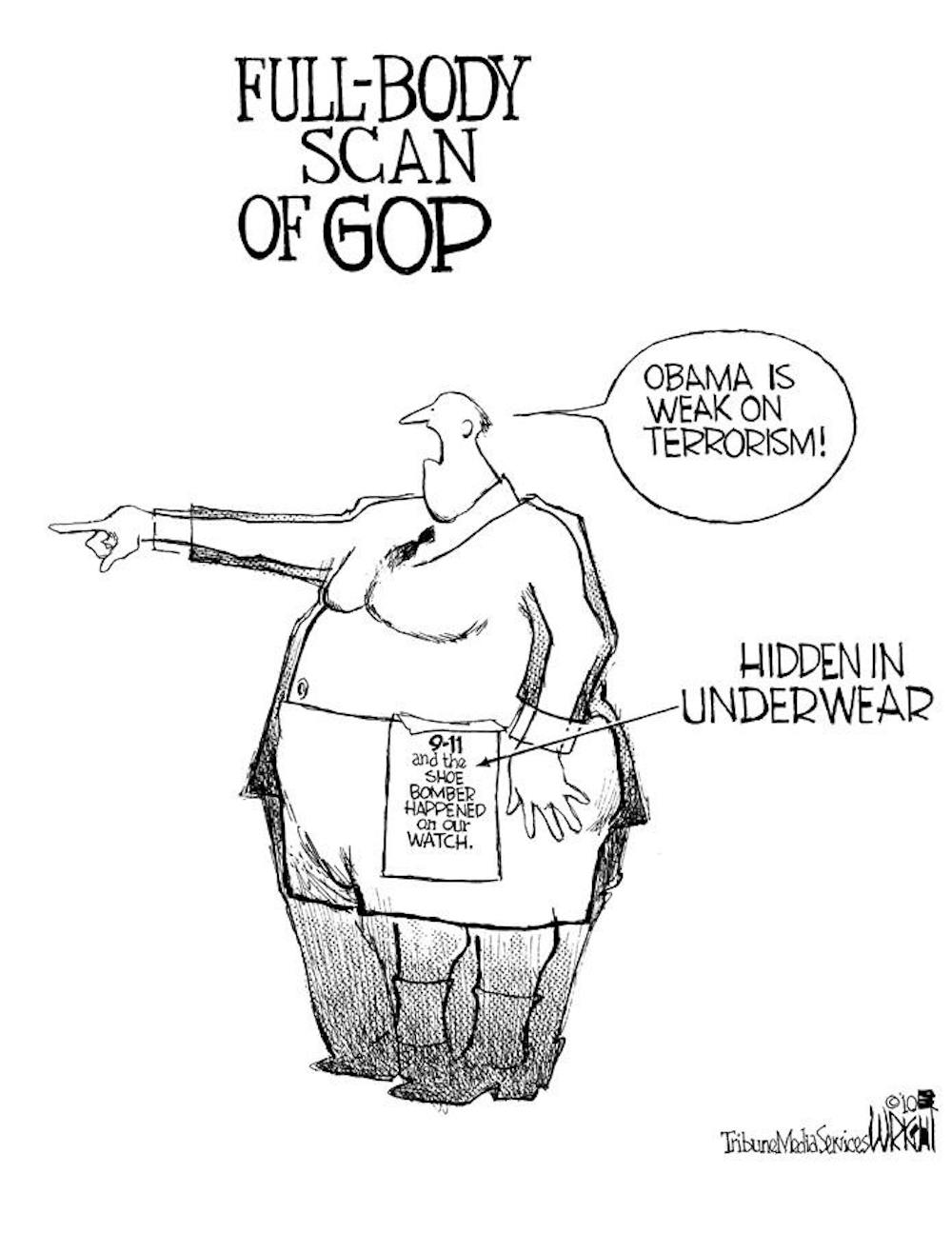
Since the attempted bombing of a Detroit-bound airliner on Christmas day by Nigerian Umar Farouk Abdulmutallab, few issues have garnered as much attention as the Transportation Security Administration’s decision to order some 300 new full-body scanners for installation in U.S. airports. The scanners, which are already in use in 19 airports nationwide, are defended by supporters of more stringent security measures on the grounds that the images look, in the words of one TSA spokesman, “like a chalk etching of a passenger.” In addition, supporters note, people’s faces would be blurred out in the image, the person viewing the images would be in a remote location from the scanner, and people would be able to opt for a full-body pat-down instead of going through a scanner. Privacy advocates such as the American Civil Liberties Union, however, counter that because these machines would reveal body features such as mastectomy scars, they are too great an invasion of privacy to tolerate. Opponents further note that if the scanners become widespread, terrorists will simply adapt to them, as they have to almost every security measure that has been implemented only after an attack has been perpetrated or attempted with the use of whatever method the security measure is trying to stop.
Of course, the fact that terrorists tend to adapt to new security measures is not by itself sufficient reason not to implement them. After all, one could argue that the more methods terrorists are dissuaded from using, the more difficult it will be for them to devise plans they will be able to carry out.
The perpetual game of catch-up that the TSA and other agencies must constantly play, however, evinces some room for improvement. Although the embattled nation engages in some controversial practices, such as racial and ethnic profiling, Israel has a spotless record in terms of airline attacks (and even attempted attacks) in the last three decades. Their approach focuses less on blanket bans on certain items and random choice of people to scrutinize further and more on taking stock of individual passengers in order to determine if they harbor ill will and anticipating terrorists’ tactics before anyone attempts to employ them.
In Israel, before boarding a flight, every passenger is subjected to a few brief questions, and, as the Wall Street Journal’s Martin Himel reports, “An Arab, a Muslim, a young European will go through more stringent questioning than an American Jewish tourist.”
Himel also reports, “Israel airline security does not react to terrorist plots. It tries to devise them before the terrorists come up with the idea.”
While the decision to make major changes to policies such as the ban on ethnic profiling should not be made lightly, the TSA and others would do well to take a leaf out of Israel’s book and adopt a smarter, more proactive approach to counterterrorism.
Of scanners and scares
Get stories like this in your inbox
Subscribe