The young and young at heart who were hoping to sample a myth or relive a generational touchstone were disappointed last month when Michael Lang, one of the original organizers of the 1969 Woodstock Music and Art Fair, abandoned his plan to hold a commemorative free festival,citing a lack of sponsors and funds.
Has this decade’s failure, piled on top of 1999’s violent disaster, finally put an end to the symbol of the 1960s’ resurrection?
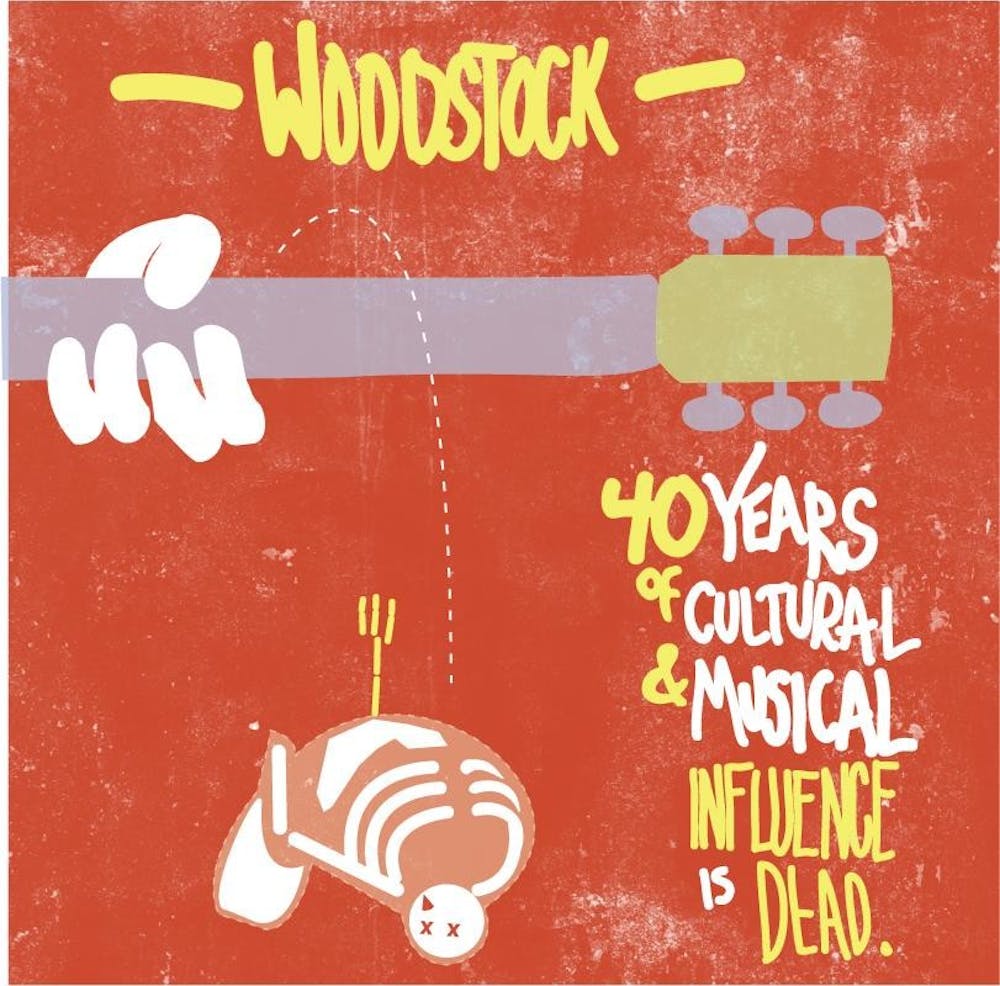
Of course not – that happened a long time ago. Woodstock was over on Aug. 18, 1969, and it isn’t coming back, despite weak attempts in 1994 and 1999 that shared only a name with the original.
“Woodstock in 1969 was hundreds of thousands of people creating their own history,” said Michael McGerr, a professor in the history department who teaches a class about the 1960s. “Doing it again is like trying to live someone else’s history.”
A ’60s flashback
Woodstock is known as the counterculture’s most vehement demand that music be free. And it was free – for the droves of people that showed up without tickets.
It wasn’t free for the promoters or the people who paid to get in. Ticket sales totaled $1.4 million, according to the Encyclopedia Britannica’s 40th-anniversary report, and other necessary money was offered up by well-to-do Ivy League graduates John Roberts and Joel Rosenman, who hoped the event would be a lucrative business venture.
It was only when attendees defied the call of capitalism and started streaming through holes in the venue’s flimsy fence that the festival became free. This disconnect between the intentions of the bank rollers and the intentions of the concert-goers, McGerr said, was a stark demonstration of the tension in ’60s counterculture between “living in a capitalist society that provides material benefits, and deciding to reject the system that produced these benefits.”
“Of course you could hold a big rock festival today,” said junior Andrew Crowley, who is one half of the duo from WIUX’s Breakfast with Rob and Big radio show. “But it would be less genuine since it’d probably be sponsored by Budweiser and Motorola.”
Besides being a musical illustration of anti-consumerism, Crowley said to him Woodstock stands out as a time during the conflict-torn decade when young people were gathered together for good instead of war.
Woodstock also spawned other peace works, he said, such as the idea of charity benefit concerts like 1985’s Live Aid.
While the influx of unexpected people was a testament to ’60s idealism, it also led to a lack of food, medical care and public sanitation, which in turn led N.Y. Gov. Nelson Rockefeller to declare the festival a disaster area.
Though originally threatening to shut down Woodstock, the governor’s office eventually sent medical teams in U.S. army helicopters to aid attendees.
Still, in all the chaos only two people were killed. According to a 1970 documentary, re-released this year in director’s-cut form as “Woodstock: 3 Days of Peace & Music,” one young man was accidentally run over by a tractor as he lay in a sleeping bag, and another died of a heroin overdose.
“The only bad things Woodstock left behind were trash and bad acid,” Crowley said.
What has changed in 40 years: politics, economics and technology
Eric Deines, who works as a publicist for local labels Jagjaguwar, Secretly Canadian and Dead Oceans Records, had the same sentiments as McGerr. He loves the idea of creating a “generation-defining” music festival for today’s young people, but said that Woodstock belongs to the particular politics, art and social conditions of the ’60s.
“I’m not sure why we feel the need to recreate this very specific thing, as rad as it may have been,” he said. “It all kind of feels like a Civil War reenactment or something to me.”
To McGerr, the most essential thing the ’60s had to help in the creation of Woodstock which subsequent decades haven’t had was a sense of optimism. Just as many in mainstream culture had optimism that humanity would reach the moon, put an end to poverty and strike down racial inequality, the counterculture was optimistic that a huge undertaking like Woodstock could be peaceful and musically revolutionary. Some of the desire to recreate Woodstock, said McGerr, comes from the “nostalgia for an America capable of doing things.”
“Like the ’60s in general, Woodstock represents an America that’s very different,” he said. “We’re just not that confident anymore.”
Abe Morris, who is also a publicist at Jagjaguwar, said increased corporate branding and more focus from promoters on selling commodities, including “$10 beers and $8 hot dogs,” are so entrenched in today’s mass music festivals that the creation of another Woodstock would be even more difficult than it was in 1969.
“At this point music festivals are still a ton of fun, but they’re a different beast,” he said. “The beast has been tamed.”
McGerr also pointed out that the original Woodstock came at a point of revolution in the sound and substance – especially in terms of its focus on political issues – of American music.
There is no longer the same “sense of discovery,” regarding popular music. Appreciation of music was also more communal in the ’60s, he said, a phenomenon that is hard to replicate in the age of the iPod.
Today’s radio format also plays a role quashing that sense of discovery, Crowley said, with the consolidation of media outlets meaning fewer large groups of people get introduced to newer or less well-known artists.
And because new technologies allow young people to experience music on an individualistic level, they are also taking a toll on live events, Morris said. When you can watch concert footage online at any time, it dampens the drive for people to be there in person and takes some of the thrill out of seeing iconic bands live.
“I mean, I really think it would have killed the mythical allure of artists like the Beatles or Elvis if you could have followed them every day on Twitter,” Morris said. “Sometimes you don’t want to know what your heroes had for breakfast.”
Why it happened and why it’s not coming back
Get stories like this in your inbox
Subscribe