
Senior Paris Gray knows all too well how hard it is to get a job in Washington, the goal of many political science majors after college. Jobs and paid internships seem to be disappearing, and the cost of living in a place like Washington is hardly cheap.
But rather than fret about all of the networking and resume-sending he’ll need to do in order to get that ideal job, Gray has decided to quit it all for now and try teaching instead.
Gray said he is applying for Teach For America, a competitive nationwide program that allows recent college graduates to become teachers for two years in underprivileged and poverty-stricken inner-city schools across the country.
“Being a political science major, it will definitely be something different from the path I’m supposed to take,” Gray said. “But there are just a lot more opportunities in teaching right now than there are working in Washington.”
Gray is not alone, either.
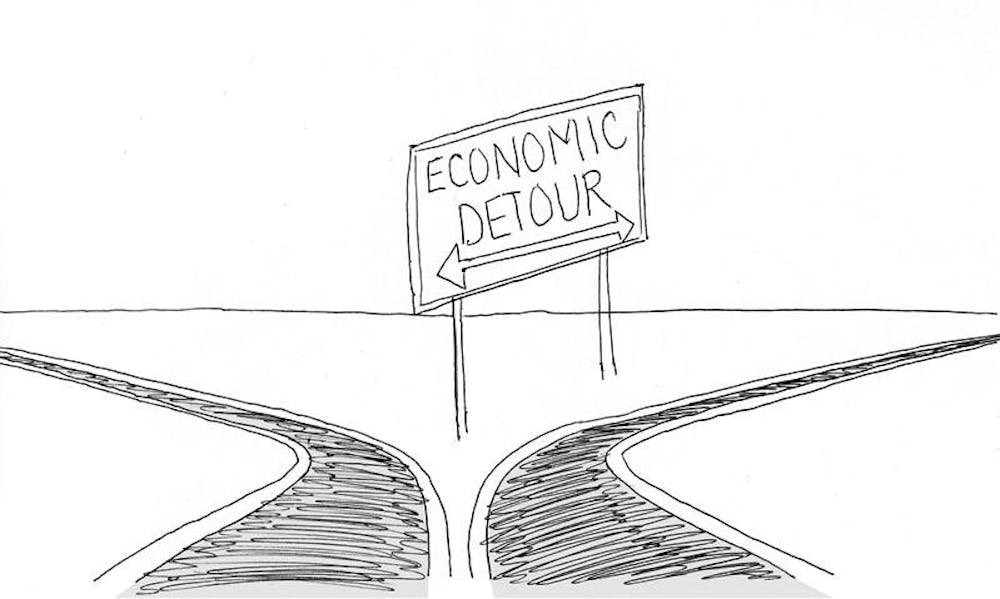
According to a March 13 New York Times article, the recession has sparked a new sense among many young people to take the challenges of finding traditional work into their own hands. Whether it is through more unique jobs in completely unrelated fields or in entrepreneurship, many students are suddenly finding that the recession is providing opportunities to gain experiences they otherwise would not have considered.
Some said their experiences will be an advantage when they return to the traditional job market.
“I’d say probably if I could find something working for the government, I would definitely go there first,” Gray said. “But the way the economy is, I would definitely take a short thing first and then see what I could do from there.”
Experts who work with students in finding jobs said being flexible is key during a recession.
“It’s a challenging market for all job seekers across the board,” said Eunice Donovan, associate director of professional development at the Graduate Career Services office at the Kelley School of Business.
“Whether it’s the liberal arts student or the business student or the student who has even had a few years of solid work experiences, there are just fewer opportunities,” she said. “With the market, students have to be very persistent and very creative with their job search approach.”
Because of these increased challenges of the job market, Donovan said many career service offices have started emphasizing flexibility and openness to positions that might not necessarily be what they immediately desired.
“Certainly, we’re encouraging a little bit more flexibility with their searches,” she said. “Maybe they’re not going to get this specific position with their dream company that they thought about maybe getting after graduation, but what is the next step to getting there?”
For some students, that next step can come in unusual places. In graduate student Daniel Weddle’s case, it came when trying to deal with an entirely different economic problem.
After having trouble paying rent with his fiancee, Weddle said he recently found an opportunity to work on the Kiss My Grass farm in Morgantown, Ind., where the food he cultivates can be sold to a Bloomington co-op for money he can use to pay his rent.
Weddle said the farm is part of a system called Community Supported Agriculture, which has become increasingly popular in the recession and provides people with an opportunity to work on farms and receive a share of food in return. In Weddle’s case, however, his share of food is sold for rent money.
“It’s kind of a convoluted process, but it’s a way to use hours worked to earn food, to use food to earn rent,” Weddle said.
Weddle said he had no prior farming experience before hearing of the opportunity to work on a farm. But he said that he has had an ongoing interest in alternative local currencies, which emphasize community involvement instead of simple monetary transactions.
But if he hadn’t had trouble paying rent in the first place, Weddle said it is unlikely he would have even bothered.
“There are definitely some overtones of recession fear,” he said.
And with this new farming experience, Weddle, who holds an undergraduate degree in business, said he is now interested in using his experience to seek an internship this summer in permaculture.
Gray, on the other hand, got teaching experience through working summer jobs at schools in Baltimore, his hometown, and even took a semester off to be a teacher’s assistant at his former high school. But his interest in the Teach For America program has just as much to do with an interest in simply trying it out.
“I really just want to test teaching out to see if I like it,” he said. “And if it’s not my cup of tea, I’ll definitely go to Washington or go back home and do something with politics.”
Gray said he expects an opportunity with Teach For America to provide experience that will help him with his government job search after his two-year commitment with the program.
“Teaching puts you into perspective, especially wanting to be a politician,” he said. “Working in the school system and seeing how it works, I would be able to have an insider’s view that could help me later on.”
And even beyond the career search, Weddle said the opportunities available to students within the community can provide an even more profound sense of relief from the recession, as well.
“These are the kind of places that, when the money dries up, the social currency and social respect that you build up in those areas can become the support that helps you in a bad economy,” he said.
Pressed to find jobs, students get creative
Get stories like this in your inbox
Subscribe



