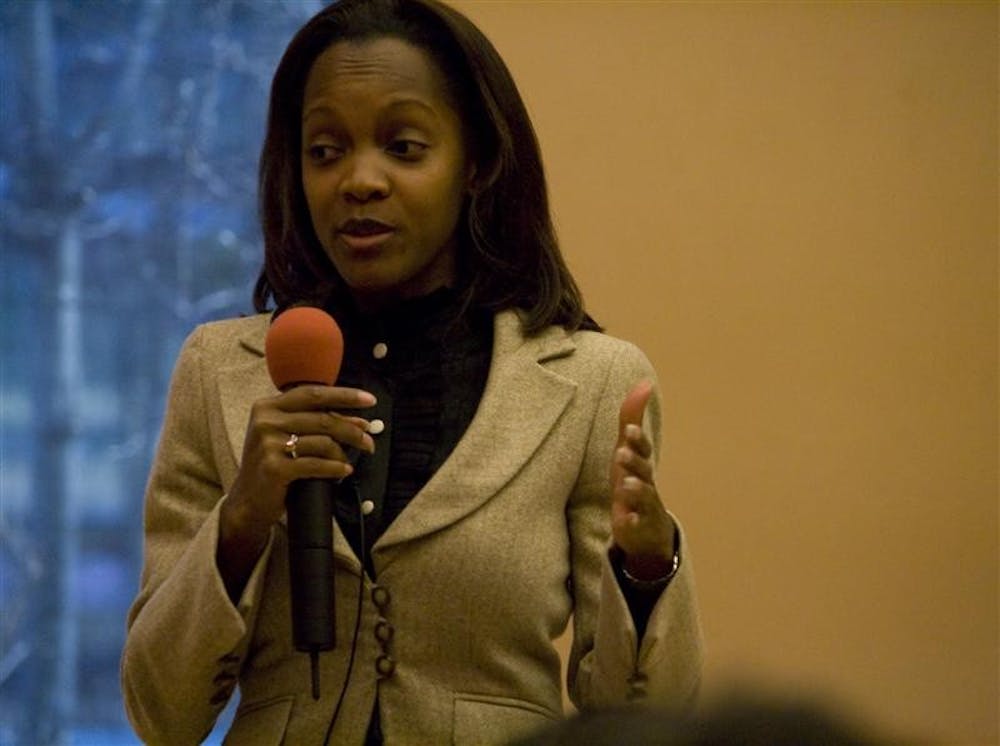
IU graduate Ebony Utley admitted she listens to hip-hop songs and even sings along, shortly after telling the crowd hip-hop is rooted in sexism and is influenced by slavery.
Utley, a 2001 graduate, spoke about “Sex, Sexism, and the Search for Pleasure in Hip Hop” as the first speaker in the Neal-Marshall Black Culture Center Alumni Lecture Series.
The series began Wednesday and is in celebration of the center’s 40th anniversary.
“Women are expected to be sexy, but not sexual,” Utley said, and added this double standard and other forms of sexism hurt both men and women by promoting exploitation of others.
Not only are women exploited by men, but women exploit other women because they identify with men and want to be in control of someone. The “hardness” of men in hip-hop makes people believe men are supposed to portray that image.
Utley said men pretend it is hard-core to forget their problems, and this has created a generation who view oppression and objectivity as safer than reality.
“It’s still about how you perceive yourself,” said sophomore Marchan Richmond, who said she had her own views about exploitation before the speech, but Utley reinforced her beliefs.
“What brings you pleasure one day will persecute you on another,” Utley said.
Most hip-hop fans think it’s just fun and something to dance to, but don’t understand the history of exploitation associated with the genre.
The exploitation has deep historic roots, beginning with slaves on plantations who were viewed not as people, but as tools to make money, Utley said.
She said 80 percent of the music company is controlled by four companies, none of which are led by African-Americans.
“Black sex makes white millions,” Utley said, and added that the success of hip-hop wouldn’t be possible if consumers didn’t thrive on exploitation.
Hip-hop didn’t create exploitation, it just found a way to harness it and make money, she said.
“Hip-hop is a creative expression that emerged from African-American culture,” Utley said.
She said it has many different definitions and is more than music. It is also a wide range of literature and culture.
Utley said she wasn’t asking for the audience to stop listening to hip-hop. She just wants fans to think about the hip-hop culture in a more critical way.
“People just stand by and think sexual exploitation is commonplace,” Utley said. “Young adults see sex as relationships.”
She said women who are sexually assaulted are usually assaulted by someone of the same race who they know, and this has created a lack of trust and love in the hip-hop community.
Sophomore Maeve Peterson-Miller said she had never thought of how black sexuality and white sexuality differed until reading about the topic. However, Utley’s speech clarified some of the historical impacts on sexuality for her.
Utley added that she wanted the audience to continue the conversation she started.
“I don’t want the models to go away, I don’t want Michelle Obama to go away,” Utley said. “I want more in between, more representations of black women.”
IU graduate speaks on hip-hop and gender
Get stories like this in your inbox
Subscribe