
The media often take political polls out of context, Charles Franklin, professor of political science at the University of Wisconsin-Madison, said during a speech Tuesday night in Woodburn Hall.
Franklin, the co-developer of Pollster.com, spoke on “The Shape of the Campaign: Composition and Dynamics in the 2008 Election,” as part of a three-part series sponsored by the Institute for Advanced Study, where scholars talk about the election.
The media often uses a single poll that fits its purpose to predict and explain political phenomena, he said.
One problem with that, he said, is random-sample polls often conflict each other. One might show one candidate ahead while the other shows the opposite candidate winning.
This is partly due, he said, to a naturally occurring margin of error of usually 3 to 4 percentage points. A hidden error is added when randomly chosen people choose not to respond to the poll. More error occurs in the way questions on the polls are worded, he said.
These hidden “non-sampling errors” can increase the already present error by up to 50 percent.
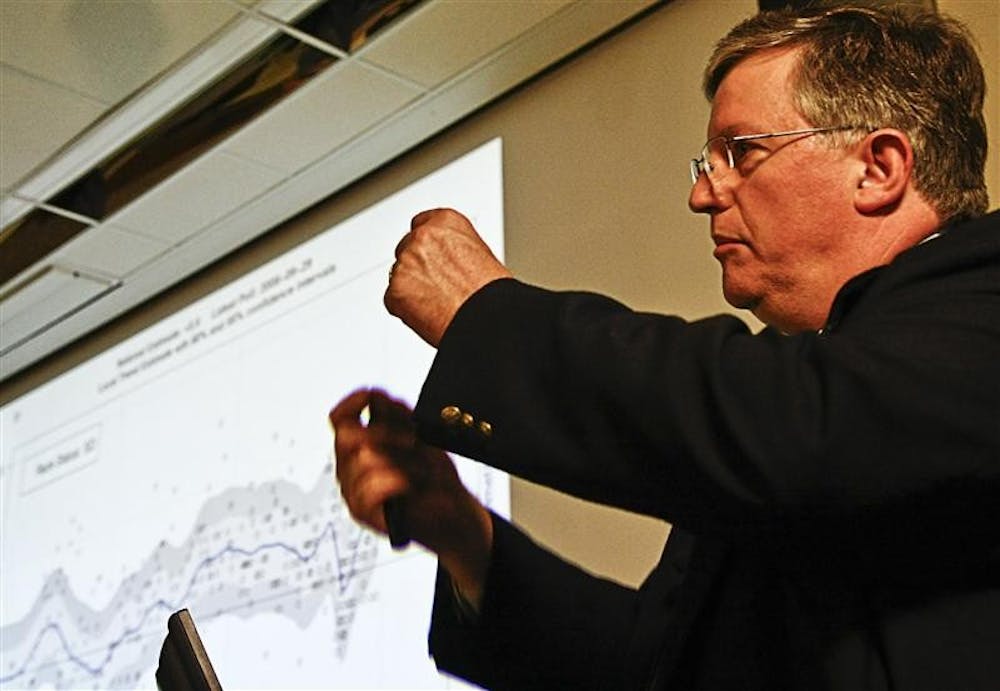
So, looking at just one poll isn’t enough, he said. But, if you take about a dozen polls, you can average them to track trends. The graphs show which candidate is ahead at what point in time.
During the speech, Franklin displayed several graphs showing trends he created from many different polls. They showed dramatic shifts over time presenting the support for John McCain and Barack Obama.
“I’d like to remind you that races are dynamic,” Franklin said.
It also showed dramatic shifts in support for the two candidates in states where Republicans or Democrats usually win by a big margin, while states that could go for either candidate have much smaller margins.
Franklin said he guessed this was because in less competitive states, when something bad such as the financial crisis occurs, the candidates leave questions largely unanswered because they don’t spend money on advertisement for those states.
People in those states have to rely on news media that might be hard on the candidate.
Franklin explained the graphs and trends weren’t designed to predict who would win.
The polls aren’t weighted by the number of Electoral College representatives.
IU alumnus Phil Hanley, who still audits classes at IU, said he supposes media using polls for their own purposes is to be expected because of what he perceived as bias.
He said it was interesting to learn the inside story on how polls work.
Freshman Neil Kelty said he is surprised there is so little statistical variation in the more competitive states.
Kelty said when people look at single polls the media publishes, they should look at who conducted the poll and why.
“You have to take it with a grain of salt,” he said.
Wisconsin professor: ‘One poll isn’t enough’
Get stories like this in your inbox
Subscribe



