
At 8 p.m. Saturday, junior Amit Pithadia, cultural chair of IU’s Indian Student Association, looked nervous and worried as he walked through an empty room at the Monroe County Convention Center that was supposed to be filled with the 100 people expected to attend the ISA’s annual Garba Festival.
“I’m sorry,” he said, “I’m sure we’ll get started soon.”
By 8:45 p.m., the same room was a blur of color as more than 200 students began to do a dance they had been doing all their lives.
Garba is an Indian dance form done during the nine-day Hindu festival of Navaratri,
which honors the goddess Durga, the protector of the heavens and conqueror of evil.
“The dance is sort of a prayer,” said freshman Ronak Shah. “In India, you might have this kind of dance every night for the nine days.”
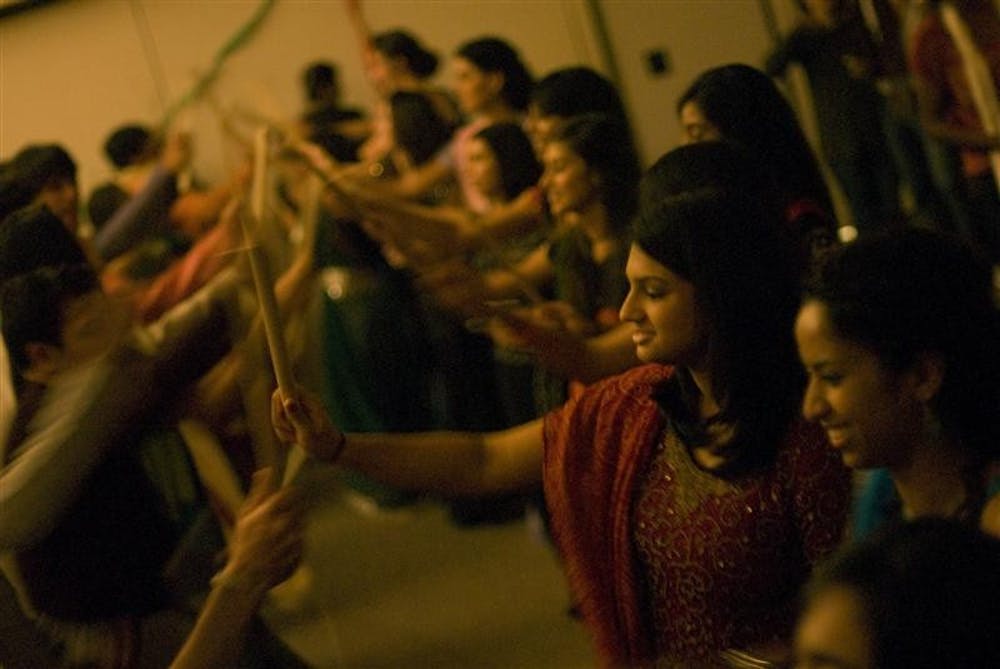
The dancing began with only a few but caught on quickly, as more people poured in, slipped off their shoes and began to dance to the Indian music around the glowing tower-like centerpiece representing Durga. With every other step they bent sideways, their arms sweeping together to end in a clap. The room was a whirl of purples, pinks and oranges as people dressed in traditional sarees and kurtas spun exultantly.
As the night progressed, the lights dimmed and the white Christmas lights and glowing candles were all that kept watch over the ever growing large group. With a change in music, everyone flocked to grab Dandias, the wooden sticks traditionally used in the next dance of Raas. They coupled up and danced toward one another, raising both hands to hit their sticks with their partners’.
Karan Chawla, president of ISA, said they had provided 100 pairs of sticks for the event. He was being pestered for more by 9:30 p.m.
At one end of the room, two rows of people stood facing one another, dancing Raas with their sticks in a manner reminiscent of a divine line dance.
For many Indian students, the dancing came naturally. And for the two dozen or so non-Indian students who had no clue how to dance Garba or Raas, people like Shah gave step-by-step instructions.
“I think it’s absolutely vital for any community to really spread its wings,” he said. “It’s a lot nicer to see people of different colors and different races coming and doing this.”
First-year graduate student Anastasia Wypasek stood out in the crowd with her blond hair and white T-shirt. She said she had come to the Garba Festival because it sounded like fun.
“Is it going to be hard if I don’t know the dance?” Wypasek had nervously asked before the dancing began. Two hours and a few lessons later, she was a natural.
Senior Nichole Tramel and junior Karina Garipova from Theta Nu Xi, a multicultural sorority, each borrowed sarees from their sorority sisters and were learning to dance Garba and Raas.
“It’s a little complicated because I get kind of dizzy,” Garipova said.
“And it was a little intimidating to go out there with everybody who had already known it,” Tramel said. “But it’s fun, even with the dizziness.”
By 11 p.m., broken sticks and hundreds of pairs of shoes lined the floors along the walls of the room. Chawla said he was pleased by the unexpectedly large turnout and attributed it to an increase in Indian students in the freshman class.
For one of those freshmen, Deepti Joshi, who is from India, the festival was the first Indian meeting she had attended at IU.
“I’m away from home and it’s nice to get dressed up like you’re back at home,” she said. “I meet so many who are doing the same, so yeah, it was a lot of fun.”
More than 200 dance to honor goddess at Garba festival
Get stories like this in your inbox
Subscribe



