
Kale, beats, radishes, potatoes, eggplant, broccoli and peppers don’t even begin to cover the variety of fresh produce currently in season at the Bloomington Farmers’ Market.
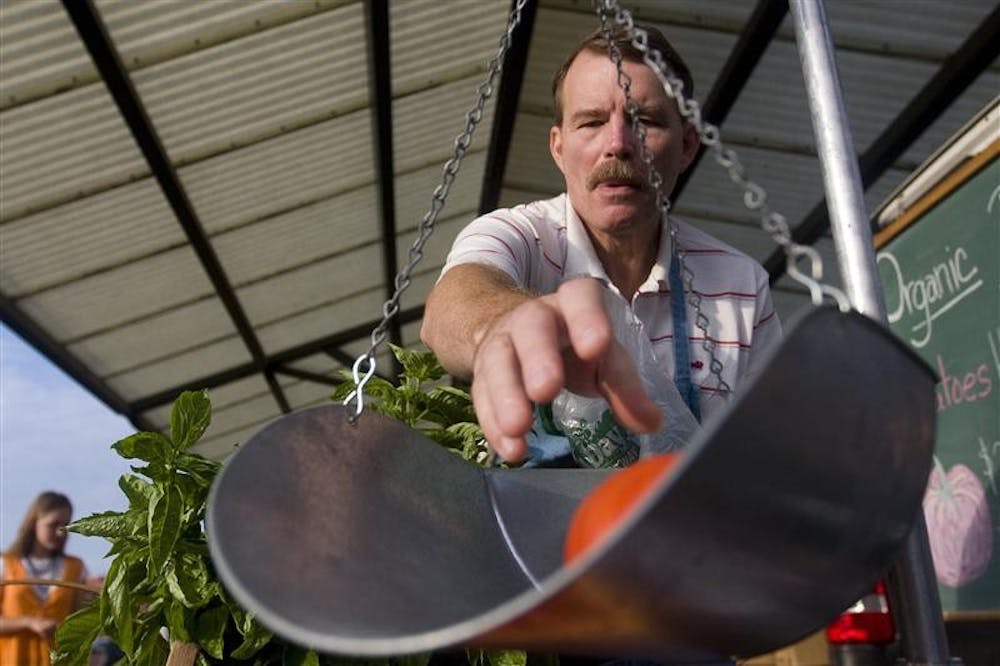
Every Saturday from April through November, health fanatics, amateur cooks and those craving more than the store brand of frozen cut broccoli wriggle out of bed for fresh locally grown food. Some weekends, more than 8,000 patrons come out to Showers Common on Morton Street.
Both vendors and the Market Master Bradley Drake agree that the market has been attracting more and more customers. Late summer and early fall are ripe times for fresh produce, Drake said, and the market has seen a 15 percent increase in customer counts in the last two years.
Drake acknowledges a variety of reasons for the increase, but he said many customers say local food “just tastes better.”
The city-operated market requires all 80-some vendors to produce food within Indiana. However, the average processed food at a chain grocery store in the United States travels about 1,300 miles, and fresh produce travels more than 1,500 miles, according to “Food Miles: Background and Marketing,” an article published this year by the National Sustainable Agriculture Information Service.
“Our teenage boys notice – corn on the cob and frozen corn are not the same,” said customer Hilary Anderson from Bloomington.
Bobbi Boos, a local farmer and treasurer of the Local Grower’s Guild in Bloomington, agreed that more and more customers are choosing to buy locally for a variety of health, environmental, economic and community benefits.
She said locally grown foods tend to be healthier because crops can be harvested when they are ripe, allowing “all the nutrients to develop” because they don’t have to travel as far. Many store-brand foods are specially engineered to have a longer “shelf-life,” according to the Food Miles article.
Boos said buying local produce is healthy for the environment because often smaller, local farms tend to use fewer chemicals because they are expensive. At local markets, customers can talk to the growers “to learn how they grow,” so customers can learn which, if any, chemicals are used, Boos said.
Pesticides, herbicides and other chemicals can leak into surrounding groundwater. Boos said smaller farms tend to choose crops “because they grow well in Indiana,” meaning fewer pesticides, water and energy resources are used.
In addition to the environmental effects of growing, energy consumption to move food longer distances contributes to carbon emissions. From growing to preparing food, it’s estimated that the U.S. food system uses as much energy as France’s total yearly energy consumption, according to the Food Miles article.
However, the article also mentions that while transportation requires a lot of energy, some foods aren’t necessarily environmentally cost-effective to grow locally.
Customer Martha Vebelhoer said she tries to buy locally.
“We kind of feel like it helps with the prices of things – you’re not paying for shipping, wasting gas,” she said. She also wants to “give to my neighbor.”
Boos agreed that lowering food miles can help the local economy.
“When you spend a dollar at a local store, it circulates more times,” Boos said. “You’re re-investing in your neighbor.”
Both Boos and Drake agree that many customers like the direct interaction with the grower and the overall atmosphere of the market.
“You’re buying from the folks that produce it; it’s nice to have that connection,” he said. “People really like talking to their grocers.”
Greene County grower Jeff Hartenfeld said the market is nice because, unlike a grocery store, people actually talk to each other.
“There’s a whole aspect of community,” he said.
Drake agreed.
“People come to socialize; it’s a community gathering you’re not going to get at the grocery store,” Drake said.
Several weeks out of the year, there are special events including tastings and apple, soup and salsa contests. Many local organizations set up informational booths, and while grocery shopping, customers can enjoy a variety of live music.
Hartenfeld, who has seen the market grow and move to larger locations over the past 32 years, agreed that now “it’s reaching a whole range of people.”
More area residents are choosing city-operated market over grocery stores
Get stories like this in your inbox
Subscribe



