
From 8-tracks and cassettes to CDs and MP3s, the way people listen to music has evolved throughout the last 80 years.
Lately, more and more people are turning back to a format popularized decades ago – vinyl long-play records.
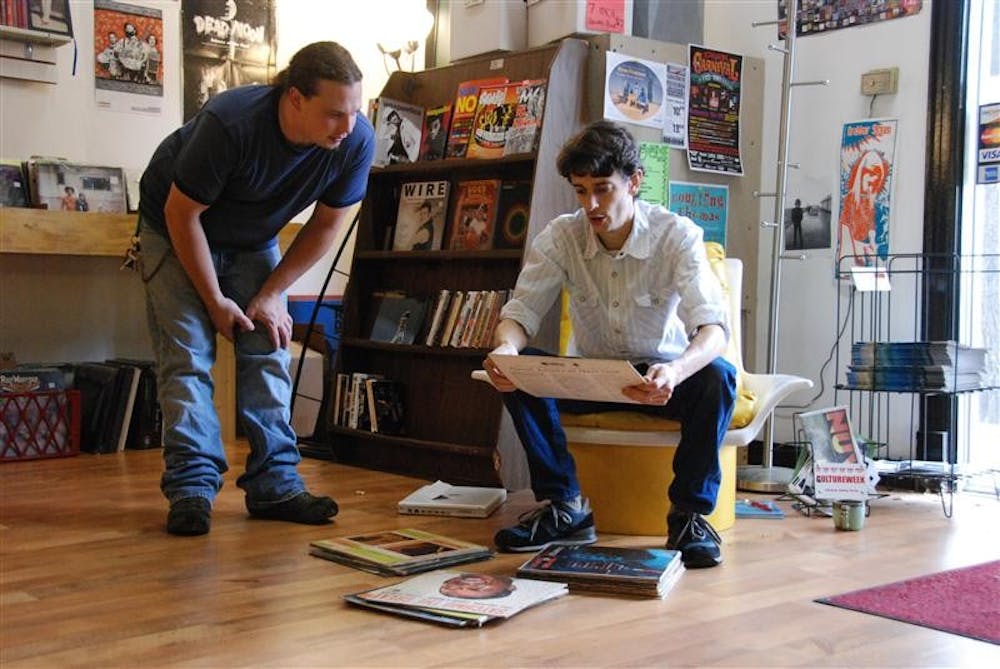
The medium – known for its unique sound and full-size cover art – is making a comeback, much to the delight of local and national record shop owners.
Last year, manufacturers shipped nearly 1.3 million vinyl LPs, a nearly 37 percent increase from the year prior, according to the Recording Industry Association of America, a trade group.
That spike comes as no surprise to Landlocked Music co-owner Jason Nickey, a lifelong vinyl fan.
“Given the choice of whatever, I always pick vinyl,” Nickey said, adding that the selection is pretty eclectic. “I sold a Justin Timberlake record on vinyl yesterday.”
However, while the resurgence may be noticeable on a national level, Bloomington has always been a hotspot for records, Mickey said. The city boasts three record shops – Nickey’s Landlocked on Walnut Street, TD’s CDs & LPs and Tracks Music & Video, both on Kirkwood Avenue.
“Bloomington is a little ahead of the curve on the national trend,” he said. “There are three independent record stores in a town of about 100,000.”
Konrad Strauss, director of recording arts in the Jacobs School of Music, said part of the attraction is vinyl records hearken back to days when the industry was smaller and more personal.
“There’s a certain romantic attachment,” Strauss said. “It’s a link to the past.”
Junior Ian Custer said the covers alone draw him to vinyl.
“There’s an aesthetic to it for sure,” he said. “There’s a lot more space for cover art ... CDs are just kind of boring for the most part.”
More importantly, though, Nickey said vinyl offers a fuller sound.
“It’s more the tangible aspect, but I think they sound better, too,” Nickey said. “CDs are going to sound the same on pretty much any CD player... There are just so many more variables with records.
CDs are composed of a series of digital music bits, while analog vinyl is less compressed and gives listeners smooth, continuous sound waves. Because of this, vinyl cannot fall victim to the industry “loudness war” demonstrated on CDs, Strauss said. Many CD producers try to make discs as loud as possible, reducing the dynamic range, he said.
Strauss credits disc jockeys in part for popularizing vinyl again.
“The DJs who like to do scratching and spinning had to work off vinyl,” Strauss said. “For hip-hop primarily, artists kept using vinyl because they knew DJs would be looking for them.
Then there are those who see records as just business.
“For some people, it’s an investment,” Nickey said. “People come in here looking for out-of-print records to sell on eBay.”
While vinyl might have seniority, CDs and MP3s still dominate at the moment.
“There is a resurgence in vinyl,” Strauss said, while noting that “compared to CD sales, vinyl sales are infinitesimal.”
Manufacturers shipped 511.1 million CDs last year, for instance, which overshadows the 1.3 million LPs shipped in the same year.
But after several decades, vinyl has proven its staying power.
“CDs degrade over time, and pretty soon they probably won’t be around anymore,” Custer said. “It was the first format and it will probably be the last.”
Music industry sees surge in vinyl record sales
More and more people turning to vintage medium for its unique sound, durability and full-size cover images
Get stories like this in your inbox
Subscribe



