
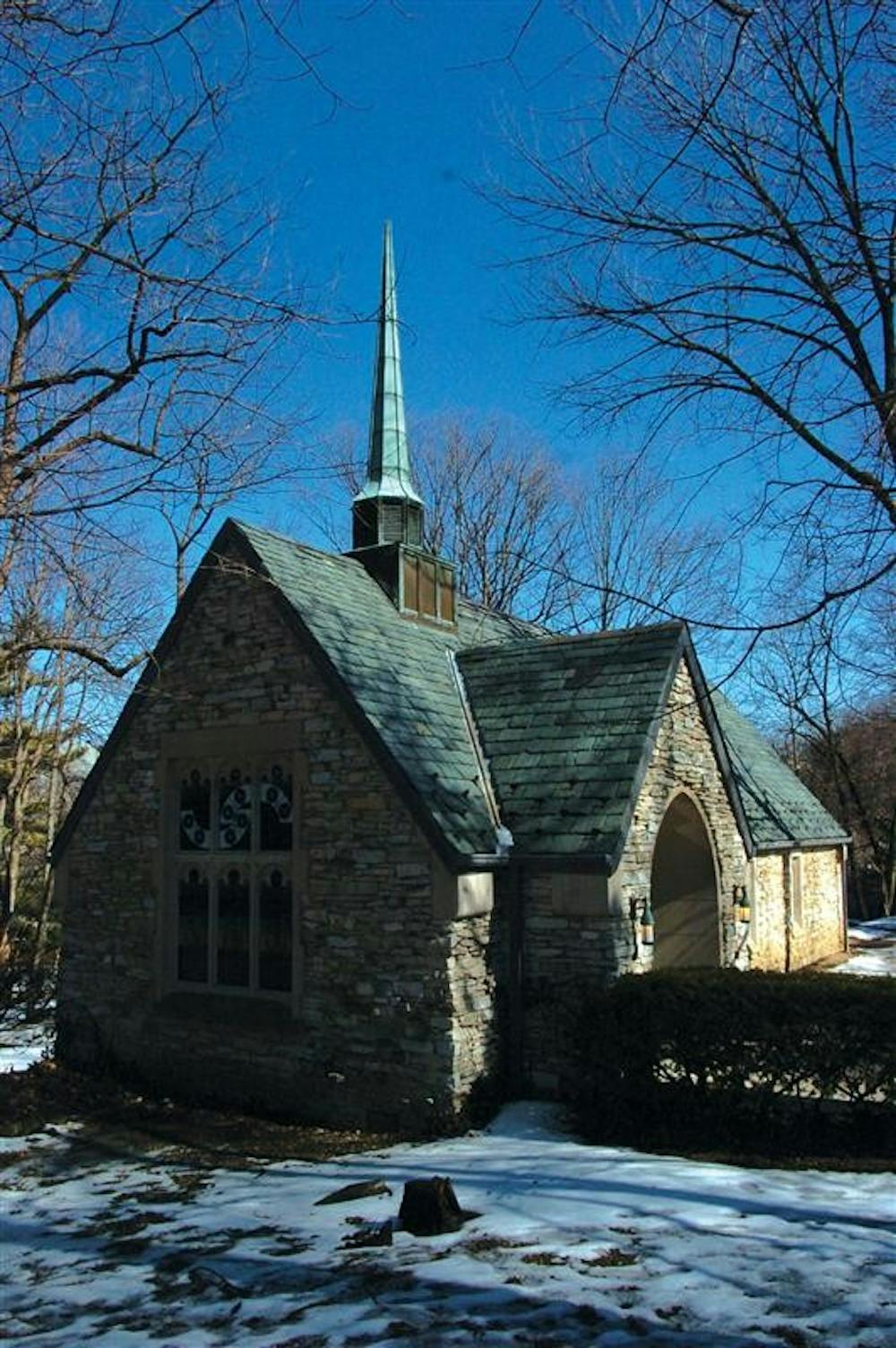
It often goes unnoticed, hidden among the likes of Ballantine Hall, the Chemistry Building, the Indiana Memorial Union and other buildings. However, this small, tucked-away building houses the many faiths of IU, from Islam to Judaism, Christianity to Buddhism, and everything in between.
This is Beck Chapel, a classic in its own right.
The Tudor style chapel, which is 67 feet. long, 21 feet. high, and 20 feet. wide, has been present at IU since 1956. Since that time, Beck Chapel has played host to more than 1,000 weddings, with 150 in the first five years after its construction.
The chapel became a part of IU’s history in 1941, when Frank O. Beck and Daisy Woodford Beck presented the first endowment toward the construction of the chapel to former IU President Herman B Wells and the board of trustees in front of 400 faculty, students and guests in the Indiana Memorial Union Alumni Hall.
In the piece “The Dream Becomes a Chapel,” an anonymous author wrote “On a January evening of 1941, at one of the largest and most memorable dinner meetings ever held in the Alumni Hall, the initial gift for a small campus chapel was accepted and the seed idea moved to flowering.”
The cornerstone of the chapel was placed on June 10, 1956, according to documents in the IU Archives. Wells, Frank Beck and many others who influenced IU tradition were present.
“The ground on which we stand is sacred soil,” said John S. Hastings, president of the board of trustees at the time, in a 1956 address to the community present. “More than a century ago, our pious pioneer parents laid the foundation of an early educational institution, which, with the guidance of Providence, and by dint of hard labor and love, has brought forth our beloved Indiana University.”
Since that time, Beck Chapel has been a symbol of the religious culture of IU. The chapel is a nondenominational church, holding copies of the Bible, Torah, Koran and other religious texts. To represent this unity of religion throughout the campus, “The Grove of all Faiths” tree was planted on Feb. 10, 1942, with three original trees representing Protestantism, Catholicism and the Jewish faith. On May 2, 1951, another tree was planted to represent the Eastern religions. The trees still stand today.
The chapel hosts about 75 to 80 weddings per year.
“It is primarily used for weddings, originally just for IU students and alumni of IU,” said Jennifer McDonald, reservationist for meeting services at Beck Chapel.
Be they alumni or students, people get married at Beck for one main reason, said chaplain Joe G. Emerson.
“They all want the same thing,” Emerson said, “an opportunity to exchange vows in a setting that speaks of tradition and hope.”
Throughout the years, several meetings have been held concerning the chapel, which has its own committee, the Beck Chapel Committee. Most meetings pertain to the upkeep of the chapel.
Hollie Lutz, a member of the committee, works with 14 other members to ensure the preservation of the chapel.
“There are various people on the committee,” Lutz said. “The trustee’s office has an official. The president’s office has an official. There’s a curator on there. There’s a broad variety. The committee oversees the general chapel usage guidelines and make sure it is cared for properly.”
As long as religion continues to have some role in the lives of students at IU, Beck Chapel will continue to be a major facet of IU’s culture.
As Hastings said in an address on March 23, 1953, “Such a chapel will be an inspiring symbol for all time to come.”
A small chapel with big influence
Monolith still stands as symbol of religious unity
Get stories like this in your inbox
Subscribe



