As an international student from India, I’ve always been a fan of travel and broadening my horizons.
And after meeting a new college friend from Dubai, I began to develop a keen interest in the place.
Dubai, for those of you who are not familiar, is one of the seven emirates (states) that comprise the United Arab Emirates. On a map, Dubai appears minuscule. It’s about the size of Rhode Island.
As a player in the international arena, however, Dubai is larger than life.
I heard wondrous stories about Dubai, previously a vast desert, now transformed into a sprawling metropolis. I couldn’t believe it and had to go see it with my own eyes.
Throughout my stay, I made many observations about Dubai’s unique cultural identity. Mosques met me on every street corner.
But if religious tolerance were not practiced, I wouldn’t have seen such a melting pot
of culture.
The city was lined with high-rise buildings that reminded me of downtown Chicago. When I ventured into the residential area, however, I saw Arabic architecture integrated into beautiful villas that dotted the seafront.
I began to see progress in a new light. This progress doesn’t necessarily involve Westernization. The Dubai locals ultimately do a wonderful job of keeping with tradition while also keeping up with the times.
Dubai is a place in which anyone can feel comfortable. Creating such a metropolitan environment within an Islamic state is no easy task, and thus I must commend the sheik on his efforts in that direction. Everywhere I went I was greeted by a wide assortment of races and cultures.
Whether walking down the street, through the mall or down the beach, I heard different languages being uttered. Russian, Polynesian, English and several of African descent were certainly not an uncommon to my ears.
But what fascinated me most was my observation of the local Arabs. They continue to maintain both their culture and traditions. This is something I admire, considering they are a minority in their own state.
The Arab women wear the “abaya” (a long black garment that covers the body from head to toe) with pride. Likewise, the men majestically wear their white robes and red-checkered headdresses (called “thobes”). I noticed that these garments were well-tailored, and many of them concealed names such as Dior and Armani in the cuffs of the sleeves.
The ability to maintain one’s traditions while moving forward with the times requires a certain degree of creativity and adaptability. The designer abayas were fascinating because they exemplified the ability to express love for fashion within established cultural boundaries.
They incorporate the traditional with the new. That is what Dubai is all about.
This notion of new and old was reinforced when I took a Dubai desert safari, the highlight of my stay.
The tour guide took me on a drive through the desert, which is located on the outskirts of the city.
We went crashing through the sand dunes at ridiculous speeds toward a traditional Arabian-style camping ground.
The camp was a beautiful sight. Intricate Persian carpets covered every inch of sand, huts and tents were lit up with fairy lights and traditionally clad men were waiting at the entrance to greet visitors.
I spent the whole day at the campsite trying new things.
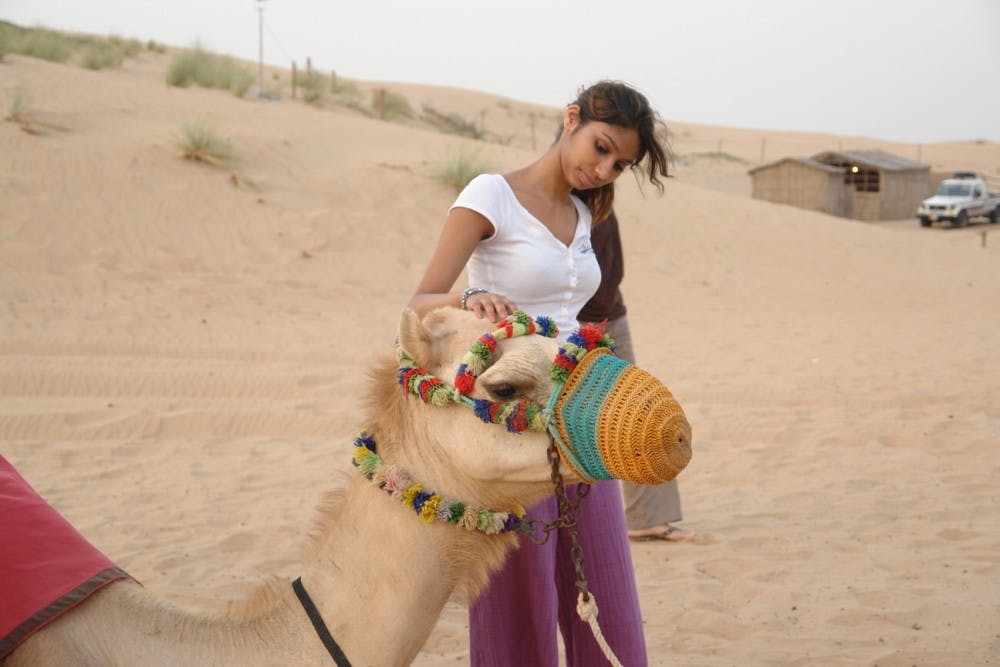
Some of the activities I attempted were camel riding and sand boarding. I relished the Arabic food with my wine and enjoyed a belly dancer’s performance.
It was an eye-opening experience. Just think! People who once traveled on camels are now driving some of the most expensive cars in the world. The sandy terrain is currently flowing with man-made canals and has a skyline.
I believe that we as college students and aspiring professionals can learn a thing or two from Dubai. The driving force behind the rapid development of this city is the idea of “bigger and better”: constantly setting high standards for oneself.
At the same time, in a world plagued with greed, we do not have to forget our identity to grow and gain success.
Something to write home about
Get stories like this in your inbox
Subscribe