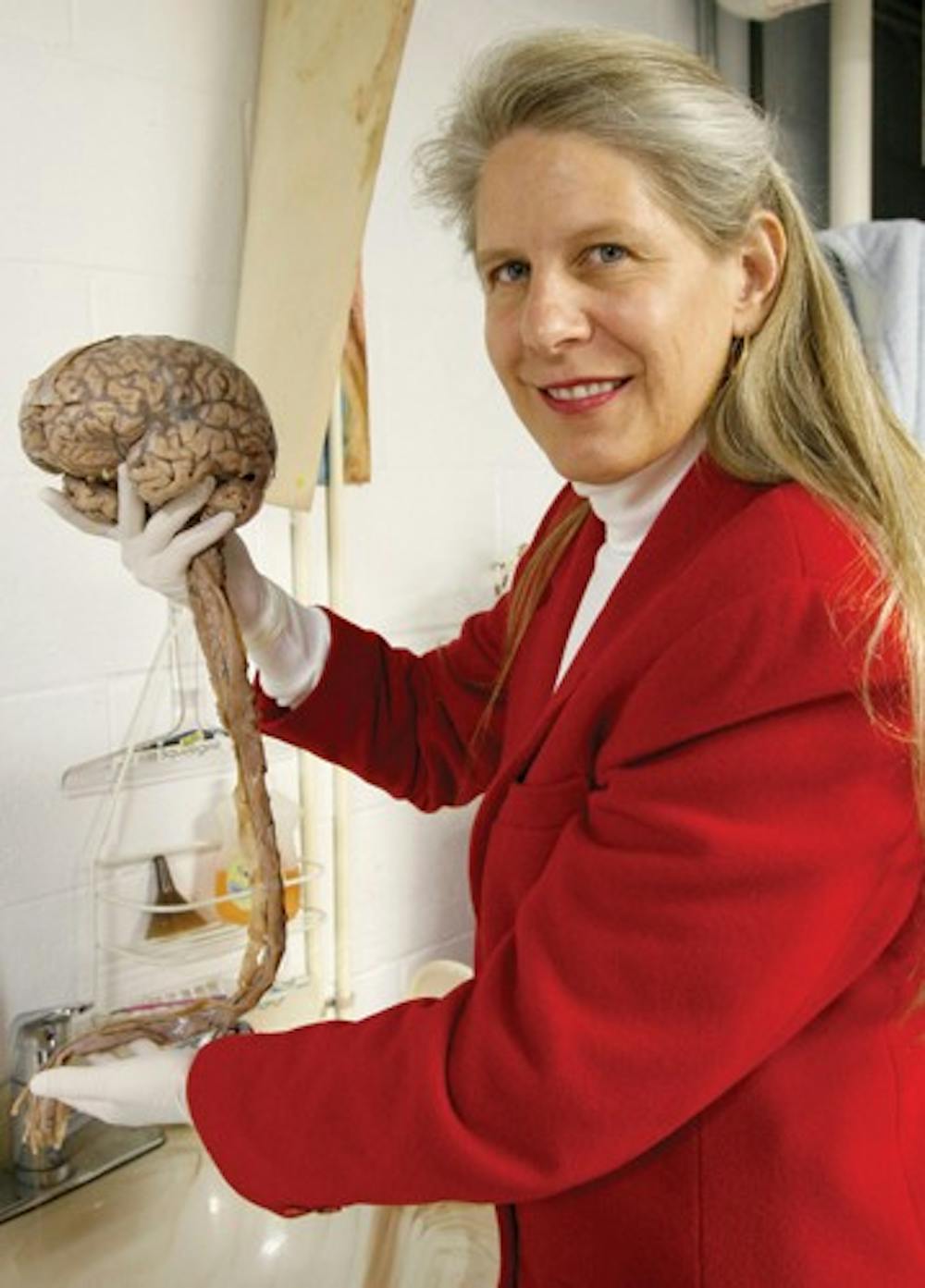
After devoting her life to studying the brain – others’ as well as her own after a stroke – IU neuroanatomy professor Jill Bolte Taylor’s influence in the mental health community is being noticed worldwide.\nTaylor is mentioned in the current issue of Time Magazine in its list of the top 100 most influential people in the world, according to an IU press release. \nTaylor will also make an appearance on Oprah’s Webcast Monday evening. To access the Webcast, go to Oprah’s Web site at www.oprah.com.\nTaylor, who is originally from Terre Haute, earned her undergraduate degree at IU and her Ph.D in life sciences at Indiana State University. She served as president of the National Alliance on Mental Illness in 1992 and served on the board from 1994 to 1997. She went on to continue her work at Harvard in 1996. \nThen, on the morning of December 10, 1996, Taylor experienced an explosion of blood vessels in the left side of her brain.\nShe tells her experience in a lecture for TED – an organization that sponsors inspirational speakers – featured on a YouTube video titled “How it feels to have a stroke.”\nIn the video, she recalls a gripping pain in her left eye. But Taylor said she decided to continue with her day, and began an exercise routine. She hopped on her cardio glider, only to experience extreme “primitive claw” grips in her hands. Her body slowed down after she got off the machine and walked across her living room.\nShe tried to phone for help, but she had difficulty remembering her work phone number, she said in the video. She looked for her business card, taking 45 minutes to tumble through an inch of cards.\nHer colleague answered when Taylor finally managed to dial the number, and he called an ambulance for her. \nIn the video, Taylor’s voice shakes with emotion as she recalls the surrender of her brain and spirit as she lay in the hospital bed.\nAfter her stroke, Taylor was physically and mentally incapacitated – unable to move, speak or think.\n“I didn’t even know what a mother was, let alone my mother’s name,” she said.\nAfter eight years of recovery, Taylor is a full-functioning adult once again. Although Taylor’s recovery took a long time, self-pity never replaced her determination.\n“It was my life, (and) it was all I had,” she said. “Why give up? I was grateful to be alive.”\nIU neurology professor Mark Ronan praised Taylor for her enthusiasm and strength.\n“Listening about (her stroke) and her gradual recovery process, it’s very powerful,” he said.\nHer stroke and recovery gave Taylor insight on her studies. She explained that the brain is divided into two sections, the left and right hemispheres. She said society only focuses on the left hemisphere, which only encourages judgment and linear thinking.\nThe right hemisphere, Taylor continued, is where people can find happiness. She said the right side of the brain is the side that stores creativity, but many people haven’t tapped into it.\n“I found deep inner peace in my right hemisphere,” she said. “Things like creativity requires you to be in the present. The left (hemisphere) puts you in the past and future. Our society rewards left-hemisphere performance. We don’t reward compassion.”\nTaylor continues to be an advocate for mental-illness awareness. She still travels and lectures, telling the story of her stroke and her discovery of her brain’s right side.\nHer influence is also strong in IU’s School of Medicine. Director of Medical Sciences John Watkins commended Taylor for her energy and dedication in \nthe field.\n“I think students very much appreciate her,” he said. “Not only for her science, but also for \nher example.”\nTaylor was always interested in working with mental illness and neuroanatomy. Her interest came from her brother, who is schizophrenic. She is supportive of her brother and spreads the same support to the mental-illness community as a whole.\n“(My brother) is something to be loved and supported,” she said.\nTaylor plans to use her publicity and influential status to spread her advocacy.\n“(I’m) helping people recognize that these are physical illnesses,” she said. “We can find peace. The mental health of our community takes one brain at \na time.”
IU professor honored in Time magazine
Scientist named in top 100 most influential, to appear with Oprah today
Get stories like this in your inbox
Subscribe