The only speck of light illuminating the otherwise pitch-black truck trailer is a soft green glow from Sgt. Michael Wheelock’s watch face. Tick, tick, tick – round its axle the second hand spins – seconds into minutes, into hours.
Thud. Potholes in the dirt road knock the soldiers into each other’s laps as the men scramble to regain their balance. The straight-backed metal benches are cold; the truck’s rumble is an unforgiving, turbo diesel baritone-roar. Faces of the half-dozen soldiers are indistinguishable as the truck lurches forward beneath the unusually frigid, star-cluttered Georgia sky. They chat casually, laughing often – enjoying the brotherly bonds of soldierhood.
A cast of characters, these soldiers dream for the future and fear for today. The veteran soldier who prepares for a second tour of duty in Iraq props himself against the seatback, recalling the nights he saw the destructive gleam of rockets sear across the sky. He is one of thousands of this war’s veterans diagnosed with Post-Traumatic Stress Disorder, yet like hundreds of other Indiana National Guardsmen, he will return to the region.
Nearby, a new father – boyish himself – chats with his fiancee as cell reception fades in and out the further into the swampy forest the truck hurtles. As in so many stories of young National Guard soldiers destined for battle, the couple hopes to marry before he deploys, reaping the thousands of extra dollars in yearly pay the Army gives to married soldiers. Others fret about unfaithful partners, tempted by the shrieking loneliness in a loved one’s absence. The sergeant’s watch continues to tick; a countdown to war, a countdown to life afterward.
On the eve of the arrival of about 1,500 Indiana soldiers at Fort Stewart, Ga., Col. Kenneth Newlin sits at the front of a conference room filled with the 76th Infantry Brigade’s core group of officers. These are men and women instructed to lead the largest deployment of Hoosier soldiers since World War II. Back home, the officers have civilian jobs, husbands, wives, kids, mortgages, lawn mowers, soccer practices, and PTA meetings. But for the next year, Web cams and care packages will be the only links to thousands of lives on hold.
Newlin slouches a bit in his chair, his long legs outstretched, ankles crossed. Graying hair ages him among other officers at this meeting but also signals superiority. As an IU student decades ago, the colonel fell in love with Bloomington – perhaps too much, being asked to leave following his first year.
It is already after 8 p.m., but a full night’s work awaits officers of the 76th. Thousands of weapons and other “sensitive materials” will arrive sometime in the middle of the night, and each piece will require inventory and organization before the first wave of soldiers arrive the next morning. It is a logistical nightmare. Twenty-eight soldiers had been mistakenly left behind at a ceremony in Indianapolis earlier that day, and Newlin takes this opportunity to remind the officers that carelessness in training translates onto the battlefield. Something needs to change because right now, “there’s a fucking accountability problem,” Newlin tells his men. The colonel’s eyes cast an exhausted, deathly stare; his voice reaches every corner of the conference room.
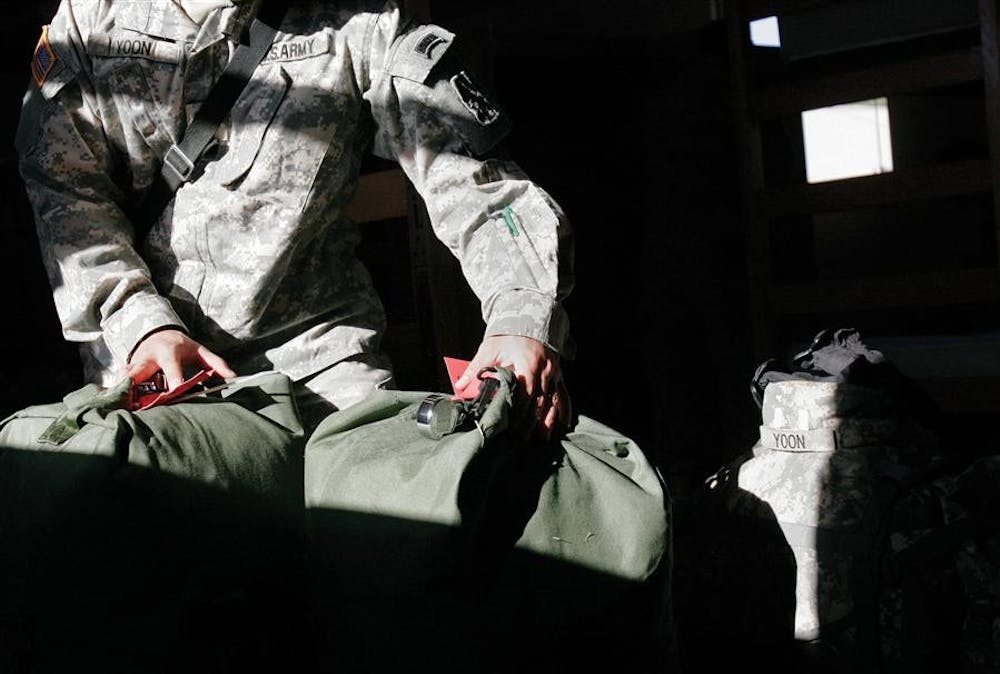
Meanwhile, IU senior and Spc. Paul Yoon sits among fellow soldiers on a charter bus heading south through Tennessee’s rolling Appalachia. These are often the most harrowing times for Yoon – the downtime, the hours left for his mind to ponder, “What-if?” Unlike some student soldiers deploying to Iraq, Yoon didn’t join the National Guard for the cash. Signing bonuses upwards of $15,000 coupled with free university tuition net dozens of IU students looking to avoid debt each year. In times of peace, many National Guardsmen never get called up, but ongoing battles in Iraq and Afghanistan have landed dozens of student soldiers in the region before they finish their degrees. For Yoon, a sense of civic duty drove him to join. He is a first-generation American whose father once served in the Korean army. Yoon understands his own mortality, the inherent risk of the Iraq war.
A rumbling reveille, the brigade of 29 buses zigzags south, then east, leaving behind Indiana’s familiar landscape. Just outside Savannah, Ga., the sea’s brisk breeze whistles through the pine trees within the sprawling, 280,000-acre Fort Stewart. This is the final stop for soldiers of the 76th before deployment in March. Some soldiers will live in barracks, but for most, makeshift tent neighborhoods and portable toilets are the norm. If it is any relief, living conditions in Iraq’s established posts are modern – even comfortable. Warm showers, Internet, and Taco Bell are enough for some soldiers to look forward to deployment. The time “in theater” is where soldiers thrive - the counterstroke for training’s throbbing monotony.
Everything about 151 Bravo Company’s white, vinyl tent is symmetrical. Two flaps face each other at opposite ends of the giant room, while dozens of green canvas cots line up like a board game. Neither near to the exit nor the temperamental heater, the cots of Spc. Martin Del Rio, Spc. Trevor Winston, and Sgt. Jeffrey O’Hart are three in a row. It’s not coincidental, of course. In Iraq, the three will man a Humvee together, and closeness now could mean survival later.
O’Hart gives the orders and Winston drives, while Del Rio, an IU senior, perches on the gun turret, his torso exposed to enemy snipers and roadside bombs. It’s a life he chose - a life that could not come soon enough. At 16, Del Rio nearly managed to join the Marines, until last-minute checks of his record found he had lied about his age. He and Yoon are among the few minorities in the Martinsville, Ind.-based unit but also are among its best soldiers.
A group of soldiers joke one lazy afternoon that Del Rio’s surname is the same as the river his family hopes to cross. “They’re already in this country!” he retorts. “They’re here taking your jobs.” Soldiers’ banter is a saving grace.
While Del Rio grew up in the ghettos of East Chicago, Ind., academic scholarships landed him in Bloomington. A Kelley School of Business student, Del Rio has become both a leader at the Latino Cultural Center –“It’s just because I talk a lot,” he reasons – while honing his true passion: art. Del Rio plans to open a tattoo shop in California once he graduates. One look at fellow soldier Spc. Charles Christofferson’s inked back is proof of Del Rio’s aspirations. The massive design is a work in progress – the depiction of the huge waving American flag is not yet perfect – a project saved for downtime in Iraq.
Months of training are an unbearable thought for many soldiers in the 76th, but O’Hart’s team worries that the time for preparations will run short. “Bullet time” will approach quicker than ever, and rumors of disorganization among ranking officers takes a toll on soldier morale almost immediately.
Winston and Del Rio already look up to O’Hart like a father. Del Rio says he trusts the sergeant with his life. It is a tight rope for O’Hart to walk – the blurring lines between commander, father, and friend. O’Hart is the sounding board for the soldiers’ concerns, but soon, he will also bear the responsibility of leading these rookie warriors into their first real test. Like many of the 76th’s team leaders, O’Hart has been deployed to Iraq before. Providing convoys with security and support is a job he knows well. And with soldiers like Winston and Del Rio by his side, O’Hart understands just how lucky he is.
One after another a convoy in training rumbles along the dirt road, dodging potholes as dust churns under the tires of vehicles ahead. Wrong turns elicit over the radio a storm of swearing, drawn out sighs and the occasional “this is the kind of thing that’s going to get us killed ‘in country.’” O’Hart is not worried. This is why they train.
Two days before Christmas and 10 days before reporting for duty, IU senior and Spc. Tara Virgil soaks up civilian life at home in Newburgh, Ind. She is dressed in a baby blue turtleneck sweater and jeans, her eyebrows plucked in a perfect arch. In a few days, her longtime boyfriend Jared Morrow will travel from Alabama to cherish with Tara a bittersweet New Year’s Eve. The couple met while training in the Army, but Morrow’s unit has not been deployed. Virgil is pretty; her cheery personality and small build suggest anything but destined-for-war soldier. But, the weathered combat boots on the floor of her Jeep serve as a reminder of the year ahead.
For what she has sacrificed, Virgil is not bitter. She is not resentful toward the Army for ripping her away from her senior year at IU – the bars on Kirkwood, friends of four years. She’s not bitter for leaving Jared, her parents, or her kid sister Alexandria, who beams at Tara proudly. For even as the Army asks much, Virgil, too, has already taken a great deal. Had it not been for the National Guard’s tuition assistance, Virgil says an IU education would have been otherwise impossible. And Jared, every time she mentions him, she smiles like they’ve just met.
The family’s home is modest and lovely. A frigid wind gusts off the Ohio River just a few blocks away, while inside the living room, a warm, scented candle flickers among trinkets and decorations for the approaching Christmas holiday.
“Why worry about something you can’t control?” questions Mike Virgil, Tara’s father, who works at a local car dealership. His wife, Kim, worked for years at Toyota’s nearby factory. The mother’s eyes begin to water as she talks about Tara. Kim was still a teenager living in Wisconsin when her daughter was born. While Tara explains that her choice to join the National Guard at 17 helped ease the financial burden of paying for IU, the vines of the Iraq war produce sour grapes for the anxious mother, father, and kid sister left at home. Mike and Kim are proud, the Army has made their daughter stronger, but as Tara admits herself: “There’s no way I’ll come back the same person.”
Ongoing battles in Iraq are no longer attempts to win the war – officers declare that mission accomplished – rather, soldiers fight for the hearts and minds of the people. While bloodshed has decreased in recent months, the threat of attack lingers in the minds of many within Bravo Company. About 4,000 American soldiers have been killed in Iraq to date and for troops arriving there, Army medics and Jesus find similar footing.
Sgt. Bradley Claypool is the first to acknowledge that soldiers within Bravo Company hardly know his name. Most affectionately, he is simply called Doc. He’s not a real doctor – not yet at least. Still an IU student, Doc has already spent a year in Afghanistan. Following this tour, Doc likely will not move back to Bloomington. Fellow fraternity brothers will seem younger. They have not experienced what he has, and in all likelihood, they could never understand.
Not long after the soldiers arrived at Fort Stewart, word got out of Doc’s birthday. Twenty-three belt-lashings awaited him, one for each year. Some soldiers struck softly, cognizant that Doc shoulders the responsibility of saving their lives during battle. Others struck the belt with a loud crack to the tune of encouraging whoops and cheers.
“Man, if I go down in Iraq, he’s going to let me bleed,” one soldier jokes. Doc makes the short list of people not to anger before battle.
For any battlefield magic Doc cannot conjure, many soldiers pray God will step in. A Christian piety resounds through Bravo Company’s ranks and reassures apprehensive soldiers. For Yoon, faith is ingrained deep within him, something he is not afraid to share. In Bloomington, he is a Sunday School teacher for young children at a Korean church. And while Yoon admits nervousness about a tour in Iraq, those fears are not for himself.
“If I die, I know I’m going to Heaven,” Yoon explains simply. Rather, he frets about the pain his death would cause his family. Yoon’s parents never encouraged their son to join. Why the risk? Just finish your education, concentrate on applying to dental school. He has been an accomplished pianist since childhood, a good son. His conflict is one of duty and family.
For Yoon, it is tough to play some of the video games his parents once gave him as gifts. The virtual reality hits too close to home. Before finding out about their deployment, some soldiers searched for videos on YouTube, hoping to catch a glimpse of the war they were not yet a part of. Now, it can be tough even to stomach the films and games they once cherished.
“You die like 20 times in the video games, then you realize, in Iraq there are no second chances,” Yoon says.
Any given day starts in a flurry of panic for Yoon and others at Fort Stewart. Long before the sun peeks its anxious rays over the eastern horizon, sergeants begin walking up and down the rows of green canvas cots, demanding the bleary-eyed soldiers awake. Inside the tent is cold – outside frigid – and the soldiers are exhausted after only about five hours of sleep the night before. By this point in their training, soldiers know better than to complain.
“I’ll flip your fucking racks,” the sergeant bellows at the stragglers. Dozens of soldiers, including Yoon and Del Rio, fiddle with their combat bootlaces while the fluorescent lighting overhead casts little warmth.
No sunlight yet, but the line for chow already snakes hundreds of feet. Soldiers wait idly, exhaling through their mouths, only to see their breaths waft like cigarette smoke.
On this particularly cold morning, someone begins discussing military chaplains and the soldiers assigned to protect them. “That’s the best job because if you go down you have the chaplain right there to pray over you,” Yoon says. He has fancied the idea of one day becoming a military chaplain. It is the lure of serving God while serving America. “The power of prayer is crazy – it’s like calling in artillery all the time.”
Sunday morning after breakfast, a quick glance around Bravo Company’s tent finds soldiers lying in their cots – some writing letters home, others leafing through Bibles and prayer books. Del Rio sits undisturbed, alone, studying passages from the Book of John. Yoon sits nearby, flipping through a copy of a prayer book. Either one can only guess the rigors, the adventures, the sorrow awaiting them during their year in the desert. It’s a leap of faith: faith in the Army, faith in God, faith in themselves, and faith in each other.
Still inside the truck trailer, Sgt. Michael Wheelock’s green-glowing wristwatch continues to tick, tick, tick as the troop’s truck rumbles forward. Seconds pass, immediacy looms. For each soldier, the countdown is personal. An infant daughter back home awaits the boyish fiance. He is a father she does not yet know. He is a love her mother waits for every day. Survive the monotony, survive the battle, and survive the countdown to life after Iraq.
The ripples of this war stream far beyond any teenage private, standing post at a barbed-wire gate. A year lost for one solider is year’s adventure for another - Del Rio, Virgil, Yoon, anyone, really. The troop’s truck finally begins to slow. Everyone inside leans backward, bracing for the abrupt halt. The truck’s driver swings open a vinyl flap at the trailer’s rear as cold, fresh air mixes with the soldier’s stale stench. They clamber out, not knowing what to do next. Just wait for the orders.
Students of war
Get stories like this in your inbox
Subscribe