
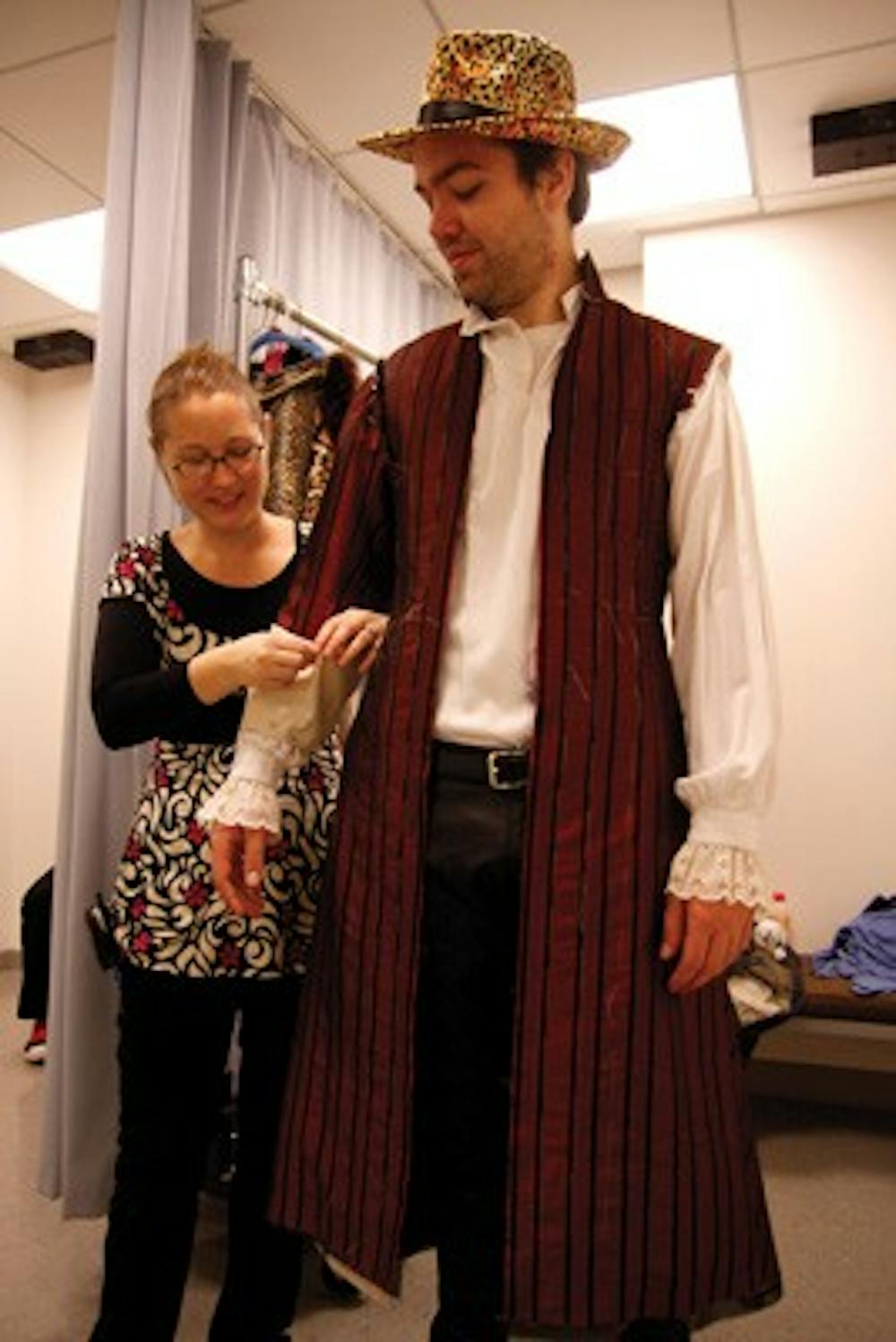
Part of assistant professor of costume design Linda Pisano’s research material is “Harris’s List of Covent Garden Ladies: Sex in the City in Georgian Britain.” The risqué, 160-page book by Hallie Rubenhold is a guide to picking up prostitutes in the 18th century. For Pisano, however, it is more than a quirky handbook; the commentary and annotated features are important resources.\n“I keep all kinds of interesting books around,” she said. “‘Harris’s List’ is kind of a scandalous book, but what it does is actually describe what prostitutes look like and what they were wearing. ... How hard is it to find that information? It’s really hard.”\nPisano heads the intensive, three-year Master of Fine Arts in Costume Design Program within the Department of Theatre and Drama. This year, the program has three students from the United States and one from Serbia.\nStudents are recruited from all over the United States and interview with Pisano in Chicago or New York. \n“I look for students who really love artwork and people,” Pisano said. “It’s important that they have a love of people because that’s what we’re designing. We’re designing people, characters.”\nWhile the entire theater department has more than 250 undergraduate students, the M.F.A. costume design program never has more than four. Pisano said this allows her to mentor her students one-on-one and give them every professional opportunity available, including a study abroad program in London or assistantships.\nScott Anderson, a second year M.F.A. student in costume design, has been Pisano’s assistant since last January and spends 20 hours each week helping her. He even went to New York for three days to help Pisano fabric shop for one of her professional projects, designing a ballet of “Aladdin.”\n“It’s a lot of juggling,” Anderson said. “As an assistant, you are always there to help. You do everything from keeping a schedule to helping choose fabrics to just being able to help carry things.”\nStudents take classes in costume history, tailoring, costume design, rendering, millinery (or hat-making) and dramatic literature. In the design courses, students are responsible for designing entire operas, about 200 costumes; dramas, 60 to 70 costumes; and musical theaters, 120 costumes.\nAnother component of the curriculum is designing for shows at IU. \n“Students leave the program having designed at least four or five IU productions,” Pisano said. “That’s a tremendous amount for someone leaving a graduate program so their resume is actually quite good. It might seem like ‘oh, four or five shows,’ but that’s an annual income for a professional designer.”\nDesigners are involved in initial creative meetings with the director and other designers six to seven months before the show. Then they research, draw rough sketches, produce final renderings and create a research packet for the director.\nAnderson has designed three productions, including the October production of “The Real Thing.” Third year M.F.A. student Angie Burkhardt is working on her thesis show, “Measure for Measure,” which opens Nov. 9 in the Ruth N. Halls Theatre.\n“(‘Measure for Measure’ has) been a great experience,” she said. “It’s a huge time commitment. I work in the shop 20 hours a week and I’ve been here all day, every day this weekend. But it’s your life so you love it.”\nThough student designers are responsible for working in the shop, they do not typically construct the garments they design.\n“My role as a designer is not to build anything, but to collaborate with the director and the other designers to choose the fabric, to research it, to render it and to create the world of the play that these actors live in,” Pisano said. “When the curtain opens and the first characters walk out in their costumes, it is something very exciting to see this world that you’ve come up with. The colors and the ideas and the script come to life.”\nStudents typically begin their days with 8 a.m. classes and are done with rehearsals and other production related activities around midnight. During the day, they have to find time to design a production, go to creative meetings, do homework and have a personal life, Pisano said.\n“Not everything gets done,” Anderson said. “I have a list of things I need to do and I prioritize. I have a lot of late nights. It’s not unusual to run on four hours of sleep for two to three months.”\nPisano said despite the gruelling schedule, she encourages healthy living and teaches time management.\n“The hours are long, but they wouldn’t do it if they didn’t love it,” she said. \n“We try to give them as much support as we can. My hope is that if I can balance my life professionally, academically and my personal life with my family, I can show them that you can actually have a career and a life. You have to live to be able to create life.”
Gain a sense of style
Intense work and long hours are helping costume design graduate students
Get stories like this in your inbox
Subscribe



