
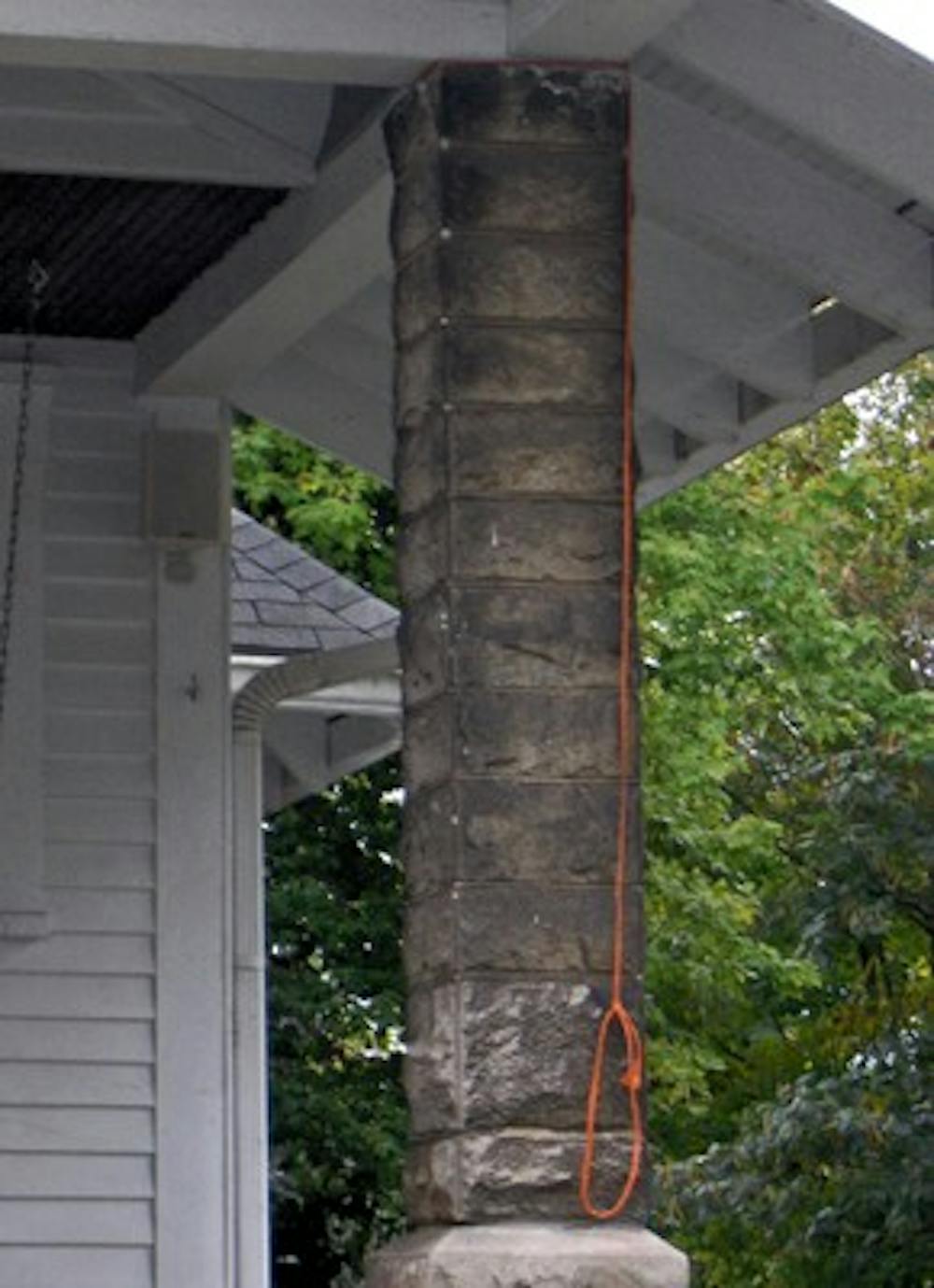
Driving home from work last week, senior Heather Barchet said she was stunned by what looked like a noose hanging from a porch at the intersection of Second and Henderson Streets.\n“My immediate first impression was that it was a noose,” Barchet said.\nBarchet’s observation of what she took to be a noose is prompting discussion in a large sociology class on the social implications of such images in light of the high number of nationwide incidents surrounding the noose as a symbol of racism.\nBarchet said she looked for several minutes, trying to understand what the orange rope dangling from a limestone pillar in a house on the 600 block of East Second Street was. She then drove home, picked up her roommate, senior Ashley McPherson, and went back to take a closer look at the rope.\n“My roommate and I were going to go up and knock on their door, but I didn’t know how I’d react,” Barchet said. \nInstead she took pictures, which she then showed to her black boyfriend, Steven Powell, work friends and her instructor for SOC-S335, Race and Ethnic Relations. Everyone agreed that it resembled a noose, and her instructor, Rashawn Ray, is basing today’s class discussion on the rope, the photos and how these fears affect student-race relations.\nBen Hanner, a senior and tenant at the house, said it’s definitely not a noose. Hanner said the rope was there when he and his roommates moved in, and he’s been using it to hang his hammock.\n“To be honest, that’s the first time I’ve even noticed (the loop),” Hanner said. “I’m a little upset. I don’t want to project a racist image. I don’t have a prejudiced bone in my body.”\nHanner cut down the end of the rope that looked like a noose to Barchet and her friends during the interview.\nHowever, whether the rope was a noose or not isn’t really the point, Ray said. Recent events changed the climate of race relations and both white and black students are reacting.\nSince people hung nooses in Jena, La., known in headlines as the “Jena Six” incident, there have been a number high profile reports of nooses. It was reported that a noose was hung on the office door of a black professor at Columbia University in New York. Most recently, a noose and racially charged letter was mailed to the black principal of a high school in Brooklyn.\nThese events create sensitivity to perceived discrimination because the country is still largely structured by race, Ray said. In the sociology world, this is explained by covert and overt forms of racism. Overt forms of racism, like hanging nooses or other forms of “ethnoviolence,” change the emotional climate between races. Covert racism can be represented by group perception.\nIn the majority of cases, groups react by emotionally identifying with the status quo, Ray said. Blacks feel discriminated against and scared while whites feel accused.\nNone of which contributes to a positive student climate, he said. Ray said that’s why the discussion must be raised.\n“I really believe that change can occur,” Ray said. “When individuals have a nice or fair dialogue, it leads to a productive ending or progression.”\nBarchet said it’s possible that she would have never thought the rope was a noose before the recent events. Both Barchet and Hanner said they hope today’s discussion has positive effects on any racial tensions or fear between students.
‘Noose’ sparks class discussions
Racial climate changed by recent national events
Get stories like this in your inbox
Subscribe



