
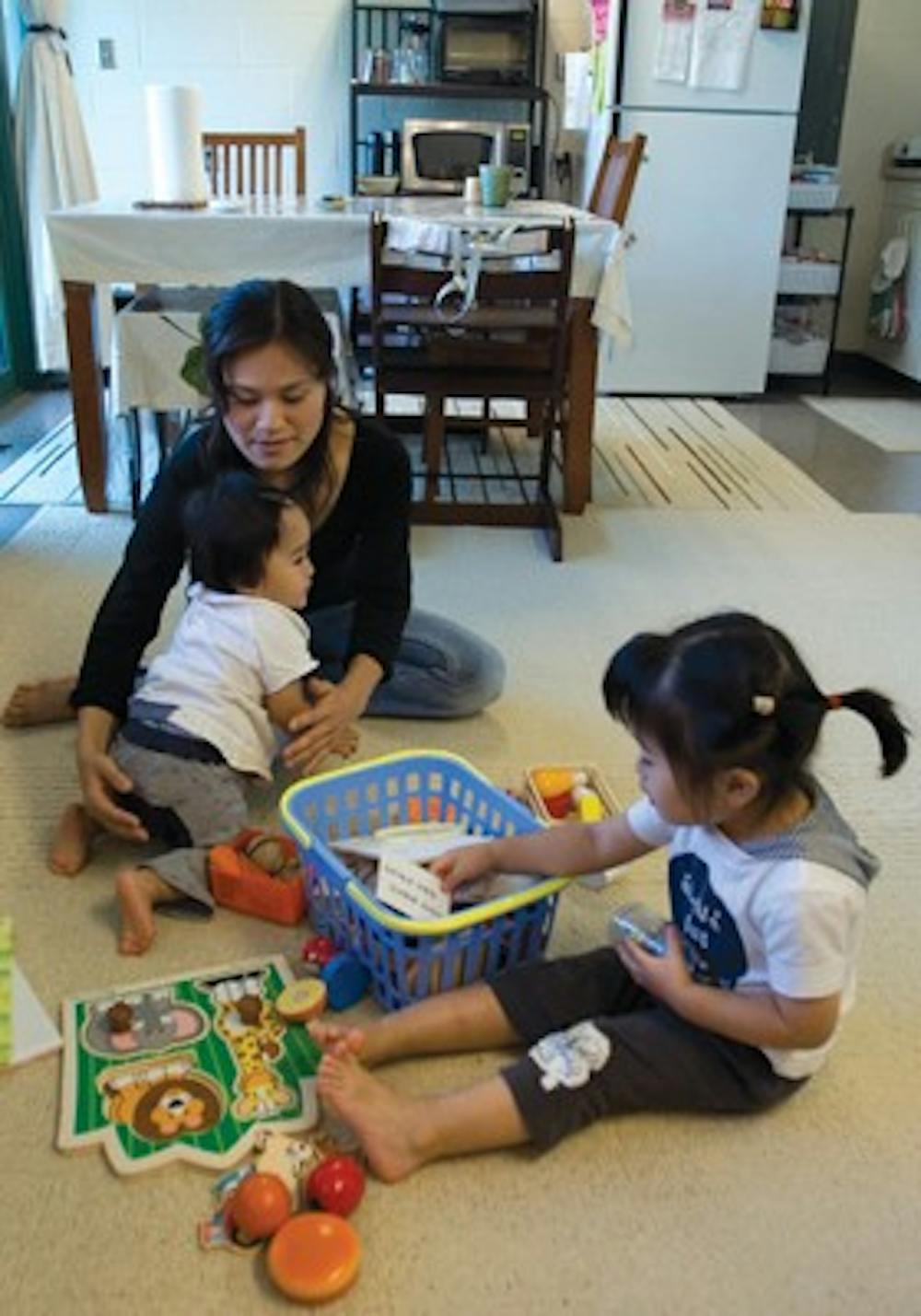
As she recounts her trip to the U.S. from Japan with her husband, Chie Terada plays with her two children in the family’s apartment at Campus View, periodically pausing to speak to them in Japanese. While Terada stays at home to take care of her children, her husband attends classes in the School of Public and Environmental Affairs graduate program. \nSandy Britton, coordinator of the Leo R. Dowling International Center, said Terada’s experience as an international graduate student’s spouse is not uncommon at IU. Britton created a free class for these spouses in 2005, called the International Spouses Circle. Cooking classes, museum trips and guest speakers are typical events for the circle, which lets members choose when they want to meet and what they want to do. The group’s first meeting of the year \nwas Wednesday.\n“There’s a large number of women in that situation ... women whose husbands (are) studying here,” Britton said. “What I wanted to create was a group that had members taking ownership and making it into what they want it to be.”\nScholarship opportunities and government-sponsored study abroad programs are two of the reasons these students choose IU. Terada’s husband is a government official in Japan who is in a program that sends officials abroad to study. Rendy Schrader, associate director of International Student and Scholar Services, said only a small amount of international students actually receive financial aid from IU. She added that although students take advantage of scholarships and study abroad programs, many students simply save up money to pay for their studies.\nSpain natives Tamara Diez and her husband, an assistant economics professor, have lived in Bloomington for a year. This is their second time here, since her husband taught for a year at IU a couple of years ago. After moving back to Spain, he saw a job offer as an assistant professor, and the couple moved back to Bloomington.\nDiez is used to traveling. Aside from IU, the couple spent five months at Yale University and four months at Cornell University. She said because of the traveling, her husband is anxious to make sure she’s all right. \n“My husband is always asking me, ‘Do you feel okay? Are you happy?’” she said. “He kind of worries.” \nDiez, who is expecting a child, has a degree in accounting from Spain but said she can’t work because it would take her two years to obtain a green card. She added that because her husband is always studying, she has to find activities to occupy her time. She attends an English Conversation Club at the International Center to practice her English and meet other international spouses and students. \n“Classes are a way to meet many people from different countries ... (and) become more open-minded,” she said.\nSpouses take advantage of volunteer opportunities as well. Terada wanted to attend SPEA and study public policy like her husband, but she decided to stay home and care for the children. She does, however, volunteer at Table for Two, an organization that works to provide healthy meals for companies and schools in the U.S. by translating its Web site into Japanese. The organization provides 20 cents from every meal to go toward school meals in developing countries, according to Table for Two’s Web site.\n“I involve myself in that way,” Terada said. “We’re hoping IU could participate in this, too.”\nWhile Terada said she’s met a couple of men who have come to IU with their graduate student wives, one reason women are doing this more often is the “children factor.” One of Terada’s friends, who has a child, came to study at IU while her husband stayed in their native country. So while there might be a lot of women coming as students to IU, they might not be bringing any husbands along because they’re putting marriage and children off while they come here to study.\n“If it were me, I would come abroad before having kids,” Terada said, adding that it’s normal in Japan for women to leave jobs and, sometimes, follow their husbands to the U.S. so they can study.\nA typical day sounds similar for the non-student spouses. Terada’s hours are spent between trips to the library or Borders, nap time, play time, meals and – when she has a chance – a couple of hours of free time. Like Terada, Diez frequents the library. However, although Diez is expecting her first child soon, she spends a lot of time at the English Conversation Club, something Terada doesn’t have time for with a toddler and baby. \nMauritius native Zainab Chuttur moved to Bloomington a month and a half ago with her husband. She said the couple is fairly settled in to their new life after a whirlwind move: They finished their studies in Maritius in May and the couple married in June. Chuttur said she and her husband came to IU through a scholarship program specifically designed for studying information science at the School of Library and Information Science. This made it cheaper for Chuttur’s husband to study here than at home.\nBesides the usual challenge of having to adapt to a new way of life, Chuttur said her main struggle has been leaving her parents and siblings behind. Nonetheless, she points out that while her husband is going to school, she has no choice but to get used to her new life.\nChuttur said she’s met a few spouses like herself in the short time she’s been here, and said some women she’s met struggle with the stress of learning English, leaving their home countries and trying to raise children in a foreign country.\n“There are some other women who don’t like it here who would rather be back home,” she said, adding that this isn’t the experience of most of the women she’s met.\nDespite her struggles, Diez enjoys the change of pace.\n“Always, to live in a different culture is interesting. ... (You can) enjoy another way of life,” she said.\nTerada said her neighbors in Campus View and a couple of women, called doulas, who she hired to help with the birth of her second child, Yui, have given her a sense of a home away from home. When Yui was born, the doulas and neighbors brought over dinner, and took Terada’s older daughter, Nanami, 3, out to play.\n“The new experience and challenges make family ties stronger,” she said. “We’re more thankful for the people around ourselves.”
International spouses combat challenges
Many women move to IU while husbands study, get degrees
Get stories like this in your inbox
Subscribe



