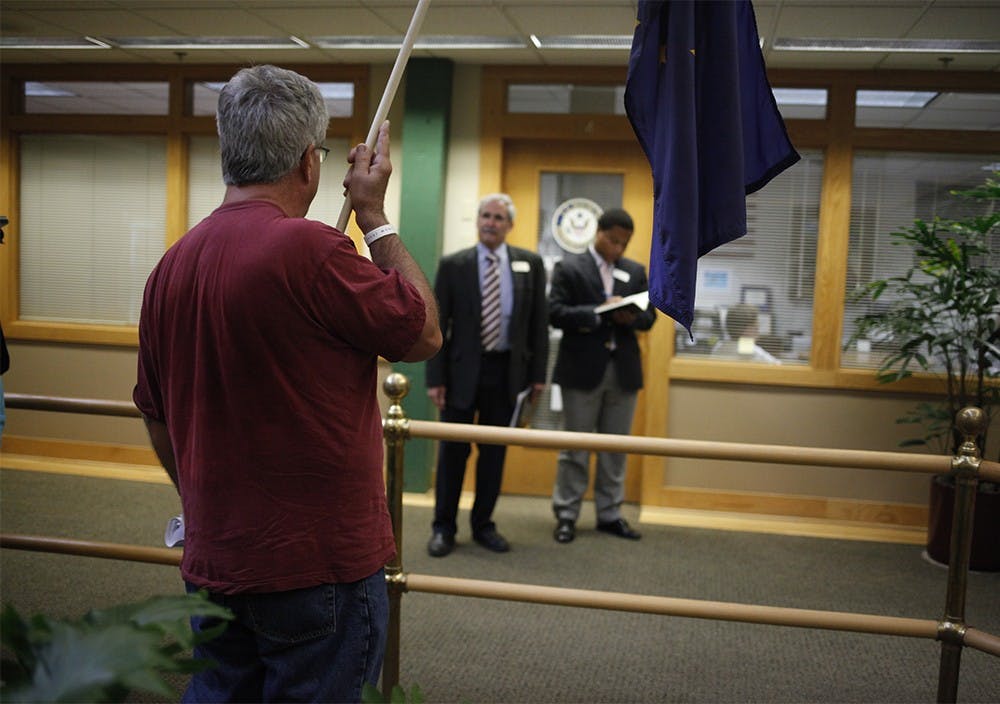
“I would like to remind Representative Young about the importance of living up to the Constitution,” one protester said to members of the congressman’s staff, who stood outside the office listening to the complaints. “Obamacare is a travesty.”
Most of the protesters were elderly and affiliated with the Tea Party or Bloomington’s Grassroots Conservatives group.
“Obamacare should not be allowed under the Constitution,” Janice Rodgers, a protester, said. “If you want to be seen by a doctor, that’s between you and your doctor. I am ashamed of my country for ridiculing the Tea Party instead of applauding them for standing for something.”
Though it seemed as though most of those gathered were opposed to the Affordable Care Act overall, they assembled this week to address a more specific grievance: Members of Congress are not subject to the same healthcare regulations as everyone else, they said.
An important piece of the controversial Patient Protection and Affordable Care Act, which was passed in 2010, stipulated members of Congress must follow the law and buy their health insurance on the exchanges.
“Congress did not like this,” Robert Hall, the leader of Bloomington’s Grassroots Conservatives, said. “It meant that they would lose the subsidy that they had previously been getting from the personnel program.”
Hall said congressmen were later re-classified as small businesses and therefore eligible to receive $5,000 subsidies from the Washington D.C. Small Business Exchange. They can receive up to $11,000 if they have families, Hall said.
“Congress is not a business, and it does not have under 50 employees, so that’s a fraud, and that’s illegal,” he said. “They’re using Obamacare, but they’re getting a subsidy that the average person does not.”
Young’s communications director, Trevor Foughty, said the notion members of Congress and their staff are exempt from ObamaCare is a ?misconception.
He noted that the only way to avoid putting staff into the exchange is by classifying them as ‘non-official’ staff, adding that all staff-members for the district are not classified in this way and are thus subject to the health care regulations.
“When most Americans get insurance through their job, their employer makes a contribution to their plan,” Foughty said in an email. “The exchange that we’re in is a small business exchange, which is a type of Obamacare exchange that allows employers to continue making such a contribution. This is not a special benefit for members of Congress or their staff. And unlike most Americans on the individual exchanges, we don’t qualify for tax credits to purchase insurance. ”
The protesters gathered said they hope Young will co-sponsor House Resolution 1953, a bill which would prevent exemptions from the ACA for members of the federal government. A similar bill, Senate Bill 16, is currently making its way through the Senate.
The representatives for Young who were available to speak with the protesters said Young is unable to comment on whether he will support that bill because it is still in committee, and thus its specific contents are unknown.
However Foughty noted that when the issue did come up in the House, Young did vote to end the employer contribution.
The members of Young’s staff who the protesters were addressing wrote down most of the protester’s complaints and promised they would be shared with Young soon.