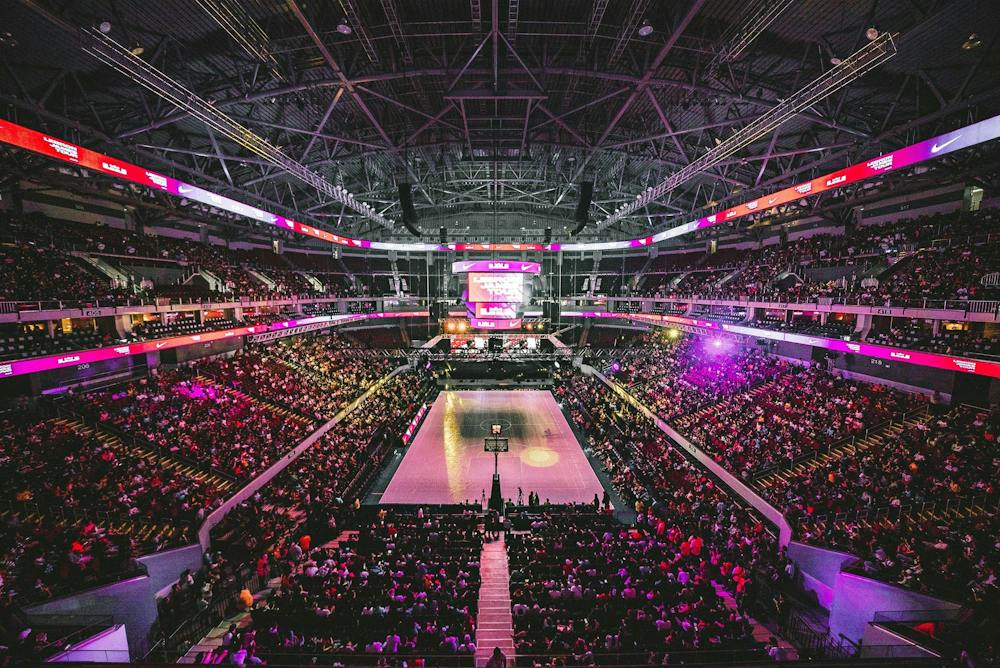
Home-Court Advantage in College Basketball: How Much Does It Really Matter? It's easy to assume playing at home guarantees an edge, but in college basketball, things aren't always that straightforward.
Look closely, and a lot of factors come into play, which raises a real question: how much do the venue, the crowd, and even where a team stands on the court actually influence the home advantage?
Key Takeaways
- Home-court advantage in college basketball is real, but its impact varies significantly for many reasons.
- A familiar college basketball court can influence shooting, communication, confidence, and late-game execution.
- The loudest arenas can create an intimidating environment.
- Home-court advantage can be reflected in point spreads and moneylines.
- Indiana Hoosiers provide a useful case study.
What Is Home-Court Advantage in College Basketball?
In simple terms, home-court advantage means playing on your own court, in front of your own fans, in an environment you know and feel safe in.
Several studies suggest college basketball home advantage runs stronger and more obviously than in other sports, which tracks, since college fans tend to be more emotionally invested, pride is on the line, and players want to look good in front of their classmates.
One analysis of more than 100,000 NCAA basketball games found home teams performed better in nearly every statistical category studied.
More Than Just the Crowd
It's tempting to assume home-court advantage comes down mostly to fan support. That's part of it, but other pieces matter too.
The team is playing on a college basketball court it knows well, often the same one it practices on every day, and while all courts can look alike, small differences add up. Players know the rims, the sightlines, the lighting, and the visual backdrop behind each basket.
Familiarity extends to everything around the game too. Players use their usual locker room, follow their normal pregame routine, and know the layout of the facility inside and out.
For the visiting team, a lot of that is different, and combined with the tension of the game, it tends to leave the brain a bit more on edge.
On top of that, the home team traveled less and rested better going into the game, and that ended up mattering more than people give it credit for.
Why College Arenas Can Feel Different
College basketball amplifies a lot of these factors because the arena is part of the program's identity. Student sections stay on their feet for long stretches, coordinate chants, and react to every single possession.
Simon Skjodt Assembly Hall, home of Indiana, is a good example. It holds more than 17,000 fans and has traditionally produced one of the most recognizable atmospheres in college basketball.
The university has even worked to bring students closer to the court to make that atmosphere even stronger on game nights.
That effect was visible when Indiana hosted Purdue on January 27, 2026. The Hoosiers came in at 14-7 while Purdue sat at 17-4, and Indiana still pulled out a 72-67 win in Bloomington.
Afterward, coach Darian DeVries pointed to the crowd's energy as one of the factors that helped his team get it done.
How Much Does Playing at Home Actually Help?
A study by Cabarkapa et al., published in 2023 in the Journal of Human Sport and Exercise, used official NCAA statistics to compare 2,181 home box scores against 2,205 road box scores across the 2018-19 season, covering 353 Division I programs.
It's one of the clearer data points behind home-court advantage college basketball research keeps circling back to.
Looking at a team's college basketball home vs. away record side by side is really the whole exercise in one table.
|
Metric |
Home Games |
Road Games |
What It Shows |
|
Winning percentage |
66.61% |
33.39% |
Home advantage is real |
|
Fouls |
16.7 |
18.8 |
Visitors picked up about 2.1 extra fouls |
|
Field-goal percentage |
45.5% |
42.9% |
Shooting improves in a familiar environment |
|
Turnovers per game |
12.6 |
13.4 |
Visiting teams are more prone to mistakes |
|
Free-throw attempts |
20.5 |
17.8 |
Home teams got to the line about 2.7 more times per game |
Separately, Harville and Smith analyzed 1,678 Division I games from the 1991-92 season using linear models and estimated that playing at home was worth 4.68 ± .28 points compared to a neutral court.
That figure shouldn't be read as a pure causal effect, since opponent quality and how schedules get built also play a role, but other stats show the difference shows up throughout the game itself, not just in the final score.
The College Basketball Court Matters — But Not Equally Everywhere
Home-court advantage doesn't mean the home team automatically wins, but the data shows home court shifts enough small margins- shooting efficiency, ball security, assists, fouls, free-throw chances- to move the odds over the course of a season. Still, not every college basketball arena creates the same conditions for its home team.
The Loudest Arenas
Noise is probably the clearest expression of home-court advantage. A student section can crank up the volume right as an opponent tries to set up a possession, communicate on defense, or shoot a free throw.
Measurements taken during college games have confirmed that these arenas can reach sound levels high enough to produce temporary changes in some spectators' hearing thresholds.
Allen Fieldhouse, home of the Kansas Jayhawks, is famous for its acoustics and its fans' devotion, historically hitting deafening marks north of 130 decibels. Cameron Indoor Stadium, Duke's relatively small gym at 9,314 seats, packs its student section right up against the court, pressing on the visiting team without a break.
Familiarity and Routine
A systematic review published in 2024 analyzed 39 studies on home-court advantage in basketball and found that court familiarity kept showing up as one of the factors tied to the advantage.
Some of the studies even found the usual environment kept offering benefits when no spectators were present at all.
The rim sits at the same height and the court follows the same regulation dimensions everywhere, but visual perception isn't identical from one building to the next.
Routine adds to this.
The home team uses its usual locker room, knows the building's layout, and can follow more familiar training, rest, and prep procedures. Even the small pregame rituals some players and fans keep can add to that sense of comfort.
Rivalries Turn Up the Pressure
Rivalries intensify all of this because they change how the crowd experiences the game. There's more at stake, pride gets involved, and everyone's more emotionally locked into every play.
The Indiana-Purdue rivalry, for instance, draws a lot of its weight from sheer history, the two have met roughly 221 times, and Assembly Hall typically sells out its full 17,222 seats whenever Purdue comes to town.
In a rivalry like this one, home-court advantage doesn't replace talent or execution, but it does make things more personal and the atmosphere tougher on the visiting team.
When Home-Court Advantage Isn't Enough
Home-court advantage is real and can shift how a team performs, but it isn't foolproof, and it can't replace talent, strategy, or execution. It works better as a factor that nudges a game's margins than as a guarantee of victory.
A weaker team stays weaker just by walking into its own arena, while injuries, poor recent form, or tactical mismatches can outweigh the crowd and the familiar court.
One of the clearest examples came in February 2025. Auburn entered its game against Florida as the No. 1 team in the country, at 21-1 and unbeaten at home.
Neville Arena was packed with 9,121 fans, and the Tigers had won 14 games in a row. On paper, nearly every ingredient for a strong home advantage was in place. Florida still won, 90-81.
March Madness itself shows how fast the hierarchy can shift once teams leave their usual environments.
In the 2026 tournament, No. 12 High Point beat No. 5 Wisconsin 83-82, No. 11 VCU knocked out No. 6 North Carolina, and No. 11 Texas beat No. 6 BYU, all in the first round.
None of that can be pinned entirely on the neutral site, but it shows how removing true home-court advantage leaves the day's actual performance as one of the deciding factors.
In any single game, a deeper roster, a major injury, the right strategy, or a team simply playing better in that moment can matter far more than the building it's played in.
The court helps. It can't win the game on its own.
What Home Court Means for College Basketball Betting
Sportsbooks already know college teams tend to perform better at home, and they try to build that effect into their lines before a game is even scheduled. For anyone serious about college basketball betting, that's exactly where the real research pays off.
BetUS explains that playing at home can shift both the point spread and the moneyline price. In simple terms, a team that would be considered roughly even with its opponent on a neutral court can show up as the favorite once it's playing in its own building.
That changes the question worth asking. It's not enough to figure out whether a team is good at home. The relevant question is whether that strength is bigger or smaller than what the market already seems to assume.
A program can have an excellent home record and still not offer real value against the spread, if the line already accounts for it.
That's why checking college basketball betting trends should work as an extension of the statistical picture, not a replacement for it. The goal is comparing what the data actually shows about a team against what the market already seems to be pricing in.
What Bettors Should Look At
Knowing where to look, and which numbers actually matter, is most of the work. The main things worth checking:
- Compare home and road performance and efficiency.
- Weigh the quality of the opponents in that sample.
- Check whether the opponent shows real differences when playing away from home.
- Factor in recent form, injuries, and rotation changes.
- Look at travel and rest, especially during congested stretches of the schedule.
- Give extra context to rivalries and conference games.
- Compare the point spread, not just the moneyline.
- Track how the line has moved since it opened.
- Avoid assuming an exceptional historical home record will just keep going.
- Check the sample size before drawing any conclusions.
Line movement deserves particular attention, since odds aren't static. New information, an injury to a key player, for example, or a shift in how the market is reading a matchup, can move spreads and moneylines before tip-off.
Indiana's Assembly Hall as a Case Study
Simon Skjodt Assembly Hall is a solid example of how a court can become more than just the building where a team plays its home games. Since opening in 1971, Assembly Hall basketball has been closely tied to Indiana's identity on the court. It holds 17,222 fans and has been home to three of the five Indiana teams that won a national championship.
During the 2025-26 season, that familiarity initially looked like a real advantage. Heading into a matchup with No. 10 Nebraska on January 10, Indiana carried a perfect 10- record inside Assembly Hall. Per Indiana Daily Student, the Hoosiers were scoring 88.9 points per game at home and winning by an average margin of 25.9 points.
That's a striking number, but it also shows why home stats need context. Nebraska ended that exact streak, beating Indiana 83-77. The Hoosiers had led by 16 points at one point, but the Cornhuskers rallied in the second half and stretched their own winning streak to 20 games.
At its best, the venue combines several ingredients tied to home-court advantage: familiarity, a large student section, room for more than 17,000 fans, and rivalries capable of pushing crowd intensity even higher. None of that guarantees a win on its own.
Together, they can create conditions that favor the team that already knows how to use them, and that includes the current roster too. Forward Sam Alexis, a returning Hoosiers basketball player for the 2026-27 season, was actually part of the Florida team that ended Auburn's perfect home record back in February 2025, the same upset covered earlier in this piece.
So, How Much Does Home Court Really Matter?
The evidence points to a fairly clear conclusion: it matters, but not always in the same way or to the same degree.
How big the advantage actually is depends on who's playing and under what circumstances, and the quality of both teams still matters most. In the end, home-court advantage shouldn't be treated as an automatic reason to back the home team.
FAQs
Does home-court advantage matter in college basketball?
Generally, yes, but the size of the effect changes depending on the team, the venue, and the specific matchup.
Why is home-court advantage so important in college basketball?
Crowd noise, familiarity with the court, routine, less travel, and easier communication on both ends of the floor all add up, and college programs tend to lean on these factors more than pro teams do.
Is every college basketball arena equally difficult for road teams?
No. Crowd intensity, arena design, travel distance, team quality, and local culture all vary from building to building, so the actual difficulty of playing on the road changes a lot depending on where a team is headed.