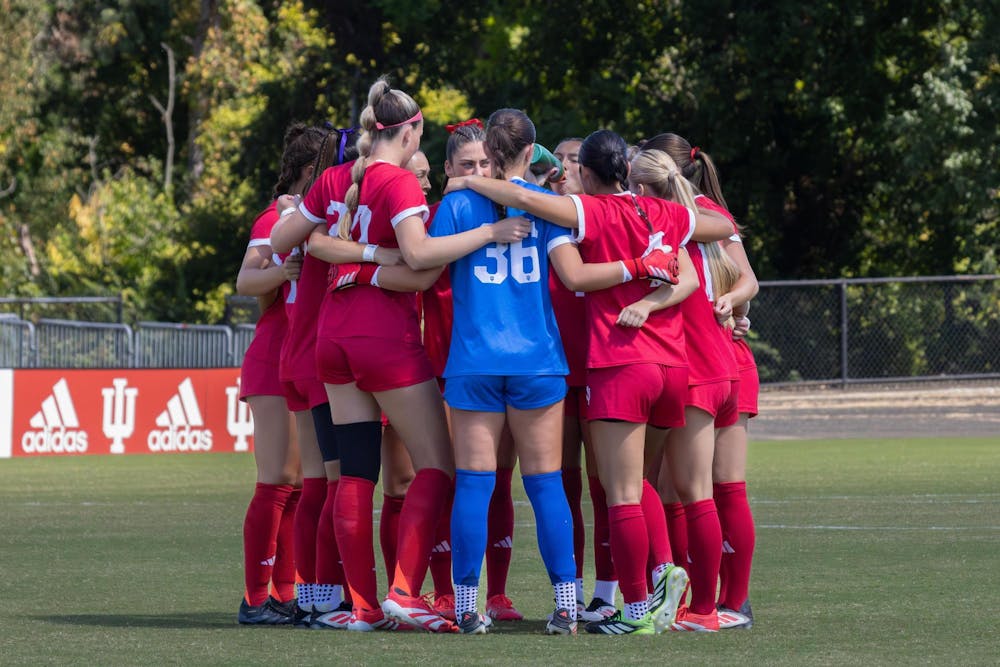
Sixteen days. That was once all Indiana women’s soccer had between reporting for preseason and playing its first match. Now, the Hoosiers and women’s soccer players across the country have something college athletes rarely get more of: time.
Beginning with the 2026 season, a new NCAA Division I women’s soccer calendar is changing how teams prepare for and navigate the fall. Division I Proposal 2024-62 created a 14-day transition period before preseason and moved the first permissible competition date earlier, effectively spreading the season across two additional weeks.
The NCAA Division I Council’s Student-Athlete Experience Committee sponsored the proposal, which entered the legislative process in October 2024. The Division I Council adopted it Jan. 15, 2025, and it became finalized a month later, taking effect July 1, 2026. The NCAA said the changes were designed to alleviate match compression, reduce missed class time and mitigate injury risk.
For Indiana captain and senior defender Piper Coffield, the difference is already noticeable.
“I do like that there’s not as many times where you’re somewhere on Thursday and then you’re flying somewhere else on Sunday,” Coffield said in an interview Aug. 29, “That’s super hard to keep up with.”
Under the previous schedule, Rife said teams could report and play their first match just 16 days later. That left little time to gradually prepare players for the physical demands of Division I soccer before the games began piling up.
“The intent behind the extended season is really meant to minimize injuries because you’re trying to decompress number of games,” Rife said Aug. 29.
The NCAA’s new transition period allows a maximum 10 hours of countable athletic activity each week, including no more than five hours of skill-related workouts. Players are limited to one on-field practice of no more than two hours per day and must receive two days a week without countable athletic activities. Outside competition is prohibited during the period.
The legislation also regulates recovery once preseason begins, including prohibiting consecutive days of multiple on-field sessions and requiring at least three continuous hours of recovery between an on-field practice and a walkthrough.
For Coffield, that additional preparation has allowed Indiana to work on details that previously could be sacrificed to the approaching opening match.
“It gave us more time to focus on, like, the small things that sometimes historically we haven’t had time to focus on,” Coffield said.
Instead of immediately jumping into 11-on-11 work and assembling a game roster, Coffield said the Hoosiers could spend more time on passing patterns, small-sided drills, technical work and competition.
But the benefits have extended beyond the soccer pitch.
Captain and senior midfielder Kennedy Neighbors said the additional time before the season helped the Hoosiers settle into a rhythm while giving the players more opportunities to develop relationships with one another.
“That extra time also just gave us more time to all be together in kind of like the soccer setting of things and build together just our culture and get everyone on the same page,” Neighbors said.
Rife has noticed it, too.
He compared the weeks before classes begin to an “extended camp,” with players practicing together but also spending time away from the field at cookouts, potlucks and other activities. Ultimately, Rife said, coaches can create opportunities for players to bond, but the players themselves determine whether those opportunities translate into a stronger team.
The benefits continue once matches begin.
With fewer two-game weeks, Rife said his staff can spend more time developing players instead of constantly alternating between match preparation and recovery. Coffield also pointed to the reduced strain of playing multiple road matches in short stretches.
But there is still one question the new calendar cannot answer yet.
While spreading matches out may reduce physical strain, extending the season also lengthens its mental demands. Rife said the real test will arrive in October, when coaches can evaluate whether players remain energized or whether the longer calendar begins to drag.
For now, Rife sees the additional time as a valuable opportunity to keep his players healthy.
“It’s not going to solve all the problems,” Rife said. “But it definitely helps minimize injury risk.”
For the Hoosiers, the extra time means more opportunities to grow physically, mentally and emotionally. As the season unfolds, they hope that extra time translates into a stronger team when it matters most.
Follow reporters Will Kwiatkowski (@WKwiatkowski_15 and wdkwiatk@iu.edu) and Leonardo Vesperini (@leovmedia and lvesperi@iu.edu) for updates throughout the Indiana women’s soccer season.