
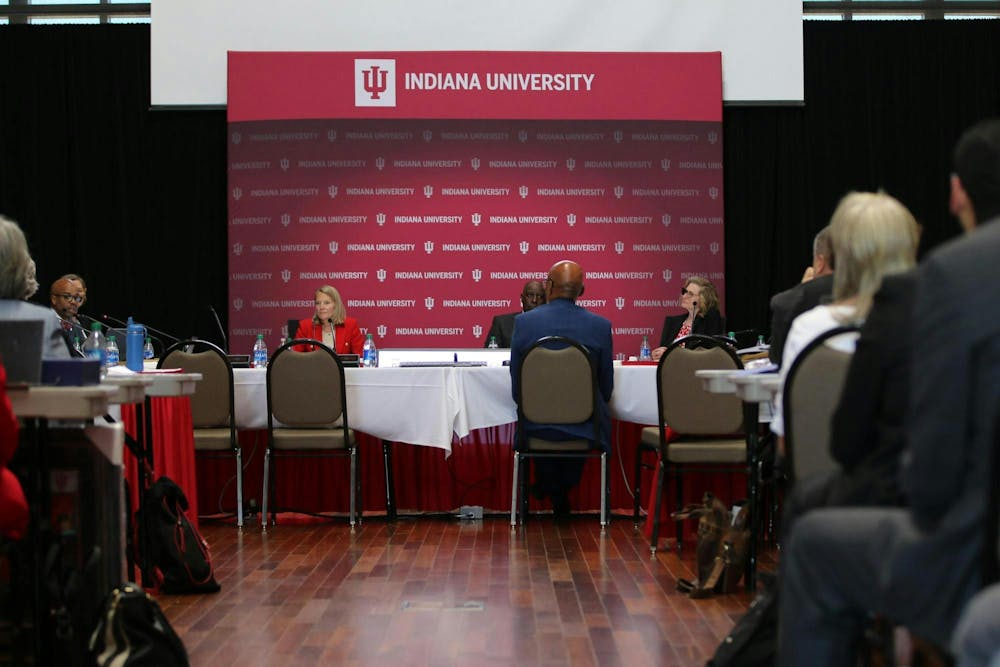
The Indiana University Board of Trustees approved the operating budget for the 2027 fiscal year, academic policy revisions, faculty promotions and tenure, among other changes at a June 12 business meeting. Here are some key takeaways from the meeting:
Operating budget
Announced in a June 12 IU Today release, the board signed off on a $4.7 billion operating budget for 2026-27, which takes effect July 1. The budget aims to prioritize instruction and academic support spending, which grew nearly 30% since 2021, according to the release.
The budget is an increase from the current $4.5 billion budget, with the rise being credited to growth in tuition and fees, rising athletic revenue and a greater use of gift funds.
IU Chief Financial Officer Jason Dudich said in the release that the budget reflects an effort to manage financial pressures while still investing in “the core of the university.”
“Maintaining a strong financial position allows Indiana University to support faculty, research and academic programs today, while creating the financial foundation critical to sustaining continued investment in the years to come,” Dudich said.
The budget carries over $60 million in state funding cuts from the 2025 legislative session, part of a larger $100 million in reductions made in the 2026 fiscal year. It also adds a $20 million general fund reduction, with all campuses and units required to cover a 3% salary increase within their own existing budgets.
All employees who receive a raise are guaranteed at least a 1.5% increase.
Undergraduate resident tuition will remain flat next year, while some nonresident undergraduate and graduate programs will see “modest increases.” The specifics on the increases is not immediately known.
The budget utilizes a new budget model made by the Budget Model Redesign Initiative, which began in 2024 and aimed to replace the Responsibility Center Management, IU’s longtime budget model.
The goal of the new budget is for each campus to receive a budget structure built around its own priorities, culture and financial needs.
According to the release, detailed information about the new operating budget will be released in early August.
Academic policy changes
Trustees followed the budget vote with a separate set of academic policy changes, detailed in a second June 12 IU Today release.
Faculty, staff and administrators worked on the revisions since September 2025 alongside up to 700 public comments received. These revisions are apart of the Policy Alignment initiative that aims to update university policies to improve clarity.
After almost a year of work, the revisions are now in effect. The changes focus on processes like how senior administrators are hired, how tenure and promotion decisions are made and how faculty conduct is reviewed.
In the release, Chair of the Academic Leadership Council and IU Indianapolis Chancellor, Latha Ramchand, credited the faculty groups for shaping the final product.
“The goal was to clarify and align policies with shared expectations,” Ramchand said. “The result is clearer, more consistent policies that reflect the university’s commitment to academic freedom and shared governance.”
One of the bigger changes was to BOT-11, which consolidated tenure and promotion rules for faculty and librarians into a single policy. Peer review stays intact, but expectations are now defined and standardized across campuses.
A second policy change to BOT-15 spells out how the university handles misconduct concerns among faculty, including how evidence is weighed. The revision also draws a clearer line between protected academic speech and conduct that could trigger review.
The policy spells out specific examples of misconduct, including harassment, retaliation, misuse of university resources and possessing weapons on campus without authorization. Depending on the severity, sanctions can range from common, corrective measures up to severe sanctions like termination.
BOT-20 was also revised, with a new set of ground rules for hiring top administrators, including presidents, vice presidents, chancellors, deans and others. Search committees will now be required toinclude a broader mix of stakeholder groups.
The last major revision was to BOT-24, which reworked how faculty performances are reviewed. All academic appointees must do annual performance reviews, with tenured professors now facing full post-tenure reviews every five years, a requirement tied to state law, with formal improvement plans for those who fall short.
The policy measures productivity across new teaching, research and service criteria, weighted differently depending on the faculty role and campus.
University housing expansion
Trustees also approved two major housing projects, announced in a June 12 IU Today release.
One at IU Indy, which will build and operate a 448-bed residence hall at 441 W. Michigan St., and the other at IU Bloomington, where the university will invest $60 million to renovate Willkie Quadrangle, a 752-bed residence hall built in 1965. In the renovation, Willkie Quad will get a “full interior renewal,” including upgrades to student rooms, shared spaces, elevators, mechanical systems and life-safety infrastructure.
In the release, IU President Pamela Whitten said the projects “reflect disciplined stewardship of university resources” with a clear focus on student success.
“By expanding housing options in Indianapolis, where student demand is growing, and modernizing existing facilities at IU Bloomington, we are creating spaces that foster community, support learning and meet the needs and expectations of today’s students,” Whitten said.
New degree programs
The board also approved several new degree and certificate programs, according to a third June 12 IU Today release. The programs target high-demand fields including health care, biomedical engineering, data science, global finance and laboratory science.
These added degree programs come after IU Bloomington eliminated or suspended 249 degree programs across all IU campuses July 1, 2025 in response to House Enrolled Bill 1001-2025. The new additions still await final approval from the Indiana Commission for Higher Education.
Bloomington received three new degree offerings, including a Bachelor of Science in international financial government, trade and development, a Bachelor of Science in mathematics and data science and a Bachelor of Science in biomedical engineering.
Other campuses, like IU Indy and IU South Bend, will also receive new programs. In the release, Whitten said the changes are part of preparing students for the future while meeting the requirements for Indiana’s workforce today.
“These new programs reflect IU’s commitment to student success and our ongoing work to align our academic strengths with areas of critical economic demand so we can continue to deliver lasting value for students and Indiana,” Whitten said.
Faculty promotions and tenure
Trustees closed the meeting by approving a long list of faculty promotions and tenure decisions across IU’s campuses, according to a June 12 IU Today release.
Most changes will take effect either July 1 or Aug. 1, depending on the IU campus. IU faculty can look at the list of names in the release.
The trustees will next meet Aug. 13 and 14 for an annual organizational meeting, date to be determined.


