
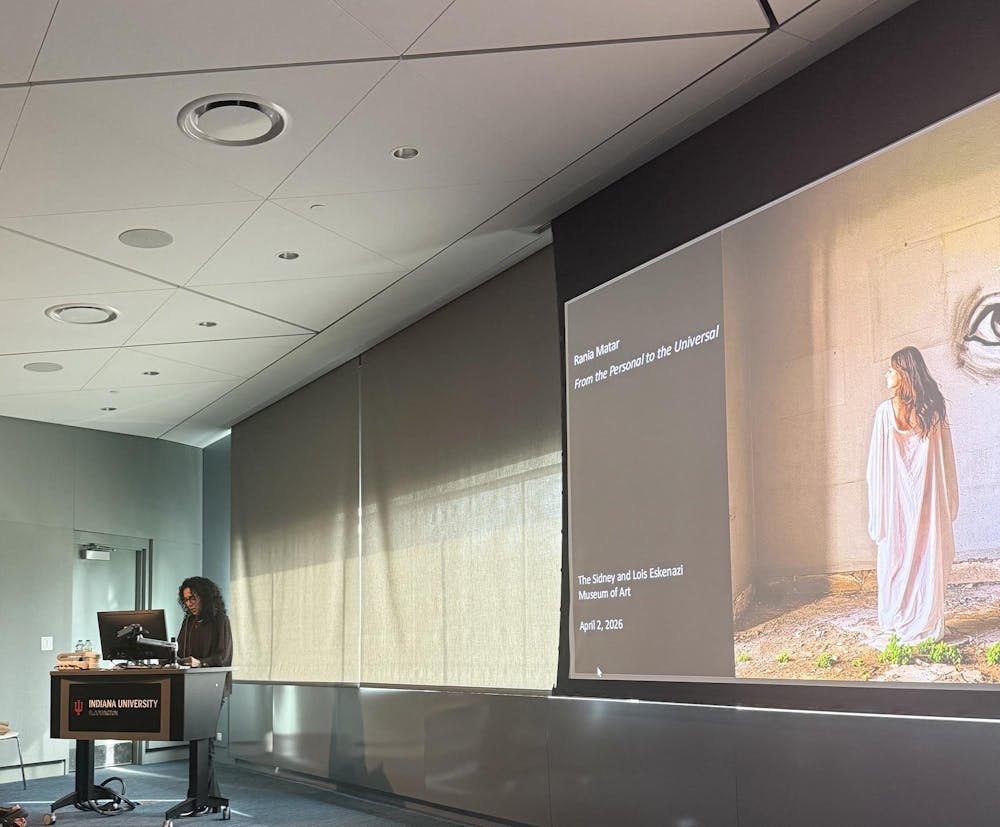
On the second floor of the Sidney and Lois Eskenazi Museum of Art, a darkened room filled with 50 attendees. At its center hung a striking black-and-white photograph of a child standing in front of buildings torn down by a wrecking ball. The child smiles as her aunt looks on from the background.
The Eskenazi Museum hosted an artist talk Thursday with Rania Matar about her latest project, “Where Do I Go?,” moderated by Leila Reichert, curator of contemporary art at the Eskenazi Museum.
“Where Do I Go?” is a deeply personal collection of photographs that began in 2020. In the series, Matar captures young women in Lebanon and highlights their resilience as they navigate the present and future amid the country’s long history of conflict.
Matar is a Lebanese, American and Palestinian photographer whose background and experiences inform her work. Her photography has been exhibited in museums around the world, and she has received awards and honors, including a Guggenheim Fellowship in 2018, an award recognizing exceptional achievement in scholarship and the arts.
In 2017, Matar was invited to an artist residency in Ohio, where she fell in love with the landscape and began photographing young women outdoors rather than in domestic spaces. She later brought that work back to Lebanon, where the landscape carries layers of history, conflict and memory. That work eventually evolved into “Where Do I Go?”
After the Beirut port explosion in 2020, Matar returned to Lebanon intending to photograph destruction, but she said she found herself drawn instead to women “rebuilding, cleaning debris and trying to hold their lives together.” That realization became the basis of the project.
Matar said many of the women she photographed were grappling with whether to stay or leave, a question she understood personally after leaving Lebanon in 1984 because of the Lebanese Civil War.
Reichert collaborated with Matar throughout the project and said Matar first visited the museum for a one-time talk in 2020, but the two stayed in touch over the years as Reichert followed her projects.
As Matar developed the work that would become the exhibition, Reichert said they began communicating more frequently and eventually shaped the concept for the show together. By the time they began putting together the book and exhibition, Reichert said she had spent four years discussing the project with Matar and knew the material well.
“I think Rania is very good at putting her subjects in these incredibly captivating visual spaces and creating a relationship between the figure and the setting that is just really compelling,” Reichert said. “So, I think her work really speaks to both the beauty of the country and the resilience of the people through the subject matter.”
After the artist talk, attendees viewed the photo series at the museum.
Aleida Sanchez, a studio art major, said it was interesting to hear about Matar’s thought process behind the photographs.
“It all has such deep meaning, and there is so much thought behind every little detail in the natural imagery,” Sanchez said.
Alison Irace, a senior studying media advertising, also attended the talk and said she was drawn to a photograph of a woman named Samira.
“In the image, she is standing in what looked like a field, with the sky behind her,” Irace said. “What stood out to me was the contrast between the flowers in the background and the barbed wire. I thought that juxtaposition was really powerful, and reading about it made it even more meaningful.”
The exhibit will run until Aug. 2.

