
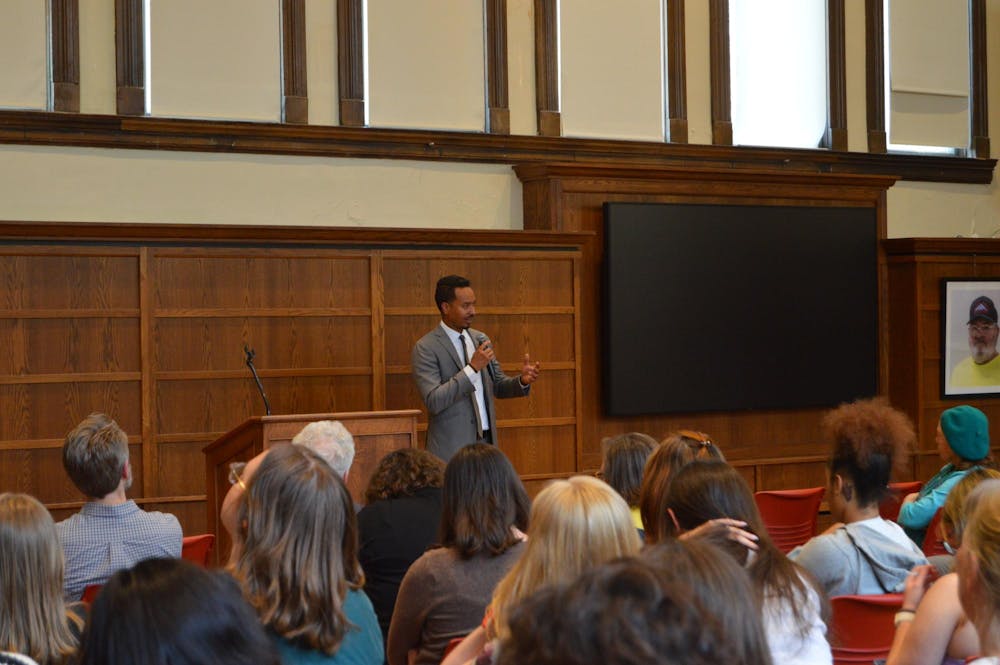
Applause echoed throughout Maxwell Hall when John Wood Jr., national ambassador for the cross-partisan organization Braver Angels, finished speaking Tuesday evening.
Wood had just wrapped a 45-minute discussion of American political polarization, ending with an appeal to celebrate the United States’ upcoming 250th anniversary by loving one’s political opponents.
IU’s Political and Civic Engagement program hosted Wood for “Reforging American Identity Across the American Divide: A Talk with John Wood, Jr., National Ambassador of Braver Angels.” Approximately 50 people attended the event.
Wood described Braver Angels as “marriage counseling for Democrats and Republicans,” calling cross-partisan conversations as important as casting a ballot. The organization seeks to bridge the divide between political ideologies by facilitating conversations across the aisle.
“What we’re really about is reviving the communal fabric of American democracy,” Wood said.
In his talk, Wood discussed the history of an increase in political polarization, the trajectory of progressive and conservative political movements and what a future of more united politics might look like.
Wood’s talk comes as the country approaches its semiquincentennial, or 250th anniversary. IU has been hosting events such as curator talks about the Declaration of Independence — the Lilly Library has one of the 26 copies printed July 4, 1776 — and will continue programming, like tours of the American art collection at the Eskenazi Museum of Art, throughout the year.
Genevieve Oakley, an IU senior studying political science and international studies, said Wood’s speech was inspiring. Oakley has a personal connection to the topic, saying she grew up in a very conservative family she no longer agrees with.
“I have a lot of respect for my family and their views,” Oakley said. “We don't see eye-to-eye on anything anymore, but I do know they're amazing people, so I'm really curious how we can try and find common sense solutions and work with our fellow Americans because different beliefs don't mean bad people. It's just, you know, different beliefs.”
The difference between disagreeing with someone’s opinions and attacking their identity came up as Wood talked about the culture wars of the current political landscape. He said the early 21st century saw an increase in partisan enmity, which he contrasted with the election of 1960, in which Richard Nixon and John F. Kennedy honored their shared commitment to American wellbeing even if they disagreed on how to achieve it.
To address this, Wood advocated for the politics of agape love, which he described as honoring the inherent value of every person, even if you don’t love their actions and even if they never love you back.
Oakley, a Democrat, found common ground with Wood, the former vice chairman of the Los Angeles County Republican Party, in thinking of love as the solution to political polarization.
“I think it's a great opportunity to see that, you know, love is the only thing stronger than hate,” Oakley said.
Braver Angels state coordinator for Indiana Vanessa Roberts said she loved that Tuesday’s talk was cross-generational, including both students and people like herself and fellow state coordinator Miles Eddy “with our gray hair.”
“Oh, I think it's wonderful that opportunities like this exist for people to realize there really are folks out there who want to get along, who are not trying to argue,” Roberts said. “They're trying to make civil engagement within our community.”
Wood grounded his appeal for “agape love” politics in the ideals and history of American politics — in values of equality, in Dr. Martin Luther King Jr.’s philosophy of non-violence and in the Enlightenment ideals that shaped the Founding Fathers’ views of what the country could be.
Oakley found the reminder helpful.
“I think being called back to that, learning our history, was really important,” Oakley said. “And so not only was it inspiring, but it was grounding. And also a good reminder of what the big picture is and why we're all here in the first place.”


