Editor's note: All opinions, columns and letters reflect the views of the individual writer and not necessarily those of the IDS or its staffers
Last week, my mom sent me a Facebook Reel of a priest who shared a prayer for daughters. A sweet thought — except the priest wasn’t real.
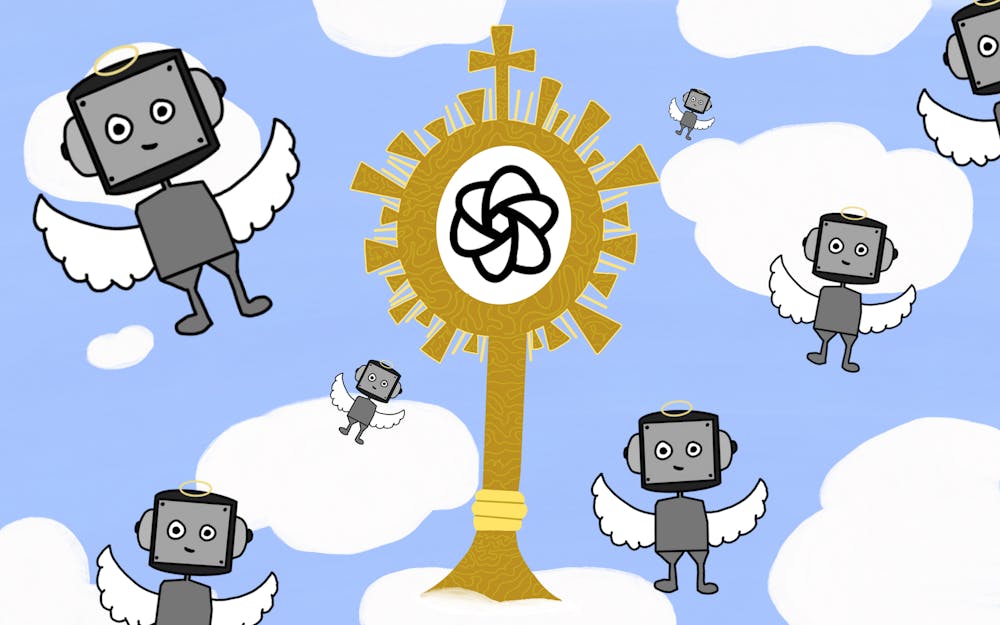
The robotic voice, blank face and conveniently small caption hinted that generative AI clearly churned out the clip, along with the priest. The video’s distributor, Light of Mercy Catholic, is a Facebook page built on posting religious AI content. Posting several times a day, its videos range from simple prayers to comically absurd depictions of angels that swoop from the sky with an inspirational message.
Despite how inauthentic the page appeared to me, its content has garnered thousands of views, likes and shares.
But when I think of religion, my mind goes to a more organic, human experience. The Sundays of my childhood meant the chill of holy water on my forehead, the communion wafer sticking to the roof of my mouth and the smell of incense that clouded under fluorescent lights. What made these experiences so memorable was the people who performed their duties with true conviction, like my priest, Fr. Kevin McCarthy. He built our humble parish into what it is today.
When mass ended with the clamor of a tambourine, kids would line up at the end of their pews for a high-five. During Lent, he liberally sprayed holy water through the aisles, drenching the congregation. Somewhere among many family tapes of my childhood is a video of him raising me up “Lion King”-style at my baptism.
Fr. Kevin gifted our parish with the humanity that reminds us why we give thanks each week. Rather than merely going through the motions of his religious duties, he made valuable connections with each of us.
High-tech alternatives to traditional practices are stripping religion of all its meaning. AI proselytizing kills the small moments of love, history and humanity behind those customs.
My descent into the religious AI rabbit hole I found led me to other accounts like Light of Mercy Catholic that exploit religion for content farming. Their clips frequently open with a warning to the effect of “don’t scroll past this video.” They guilt viewers, primarily older audiences, into engaging. Misleading viewers who might not be able to discern generative AI, these videos cannot strengthen one’s faith in a higher power. Instead, the algorithms splice together what they know about religion based on existing works by humans.
This February, Pope Leo XIV urged clergy to avoid using artificial intelligence for homilies.
“To give a true homily is to share faith,” the pope said. AI “will never be able to share faith.”
Digging into the concept of AI homilies, Google’s first search result was none other than HomilyWriterAI, a program created to generate homilies for Catholic priests. Advertising itself as a “co-creator, not a substitute,” the system lets users put in scripture passages, personal stories and general themes that it will use to construct the text.
How could a robot be a co-creator to someone who has, in theory, dedicated their entire life to the church? A chatbot lacks the personal experience that informs word choice, tone and message. Religion of any kind stems from humanity’s pursuit of meaning: Why are we here? Around the world, serving a higher power has given purpose to millions. AI, on the other hand, has no need to make those personal discoveries, as its own existence is no mystery. Any commentary it could provide on faith is redundant, solely built off what humans have already expressed.
The pope’s statement is recent, but AI usage among Catholics seems to be nothing new. Two years ago, a Swiss church installed an AI rendering of Jesus in a confessional booth, dubbed “Deus in Machina.” While the church stated the installation was not meant as a substitute for the traditional sacrament of reconciliation, the bot, still in operation today, poses as Jesus, and guests are encouraged to speak to it from the heart. Since its installation, thousands of visitors have solicited advice from the bizarre figure.
Of course, any counsel sought from generative AI should be discouraged, as its Large Language Models can only regurgitate back what it believes the user wants to hear, rather than the solid advice they may need. The entire concept of an “AI Jesus” advising Christians is defeats the purpose of Christianity itself, mimicking the divine with man-made coding. With this system, visitors are not receiving revelations from above, but outputs from a computer programed to respond like a human to various prompts.
This Holy Week I’m reflecting on the humanity behind not just Catholicism, but all religions. Religion itself is a system of beliefs that guide how we live on Earth. As humans, we look to a higher power to give us purpose. And while this is a widely contested idea, I think that the idea itself, whether you agree or disagree, is uniquely human.
When we hold beliefs we are attempting to make sense of the human experience. AI has no business partaking in that process. A homily or a prayer should come from a place of faith, and faith is exclusively human. And a chatbot could never replicate the beautiful moments of humanity we experience in our own communities from members and clergy who live the word of God in their actions towards other people.
As Lent ends and we prepare to celebrate Easter, I think that the best way to honor our faith is to practice tradition as our authentic selves, and in doing so acknowledge the earthly limits of our technology.
Emma Howard (she/her) is a sophomore studying journalism.