
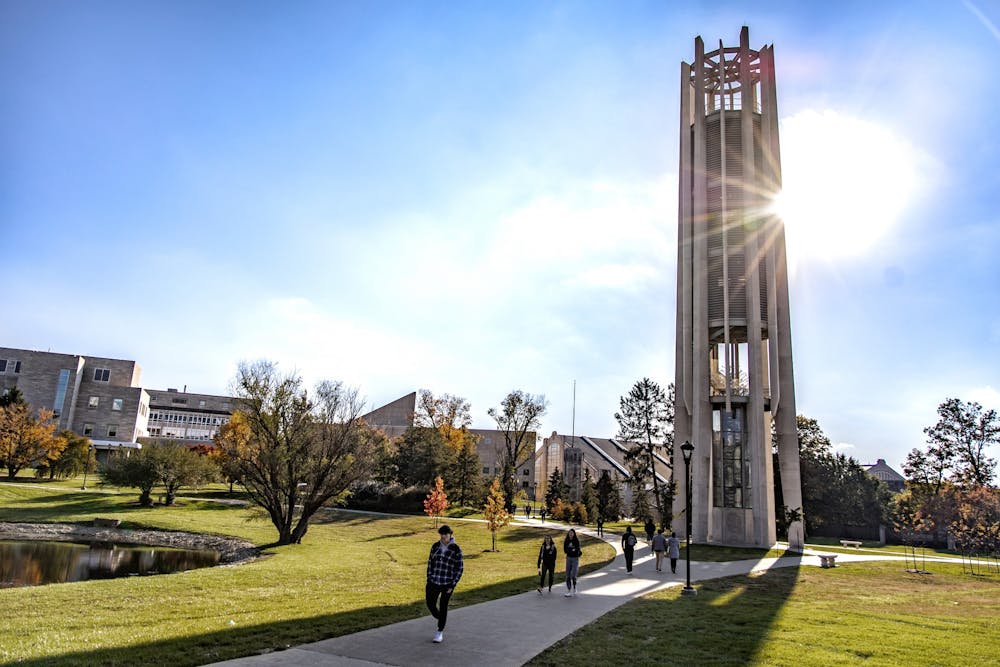
Indiana University researchers and alumni have been at the frontlines of innovation since the early 20th century, with Nobel laureates like geneticist James Watson and physicist J. Hans Jensen among their ranks. Flashing forward to the 21st century, the passion and ingenuity of IU academics endure. For example, in just the past 15 years, the IU Innovation and Commercialization Office has issued 1,340 patents, affirming IU’s historical commitment to discovery and invention.
One of the earliest strides the university made in medicine was facilitated by American biochemist Rolla Harger, who invented the “drunkometer,” a precursor to the breathalyzer.
Harger’s 1931 invention — developed during his time as a faculty member at the IU School of Medicine — measured a suspect’s blood-alcohol content by way of balloon. Yes, really. The mechanism worked similarly to a pH test strip. The suspected alcohol consumer would breathe into a balloon containing a chemical solution that changed color based on presence of alcohol, darkening as concentration increased.
By 1936, Harger had patented his drunkometer, perfectly timed to curb rising drunk driving at the tail end of Prohibition. In 1948, he taught breath alcohol testing at IU with Robert Borkenstein, the eventual 1954 inventor of the modern breathalyzer.
IU researchers have contributed to other public health advances, too. Faculty members Harry Day, Josephy Muhler and William Nebergall invented fluoride toothpaste in the 1950s. Muhler found stannous fluoride was the best compound for remineralization, or the reinforcement of weakened tooth enamel. Once refined and tested with his team, Muhler patented the invention, which Proctor & Gamble then bought. In 1955, the world was introduced to its first fluoride toothpaste: Crest.
I’m not chomping at the bit to sport a set of dentures made of ivory, metal or stolen human teeth dentures like George Washington. Others must feel similarly, because IU commemorated fluoride toothpaste with a historical marker in 2020 and the American Chemical Society presented a permanent plaque — but not the dental kind — through its National Historic Chemical Landmark program in 2024.
The accolades don’t stop there, though. Around the same time Muhler developed his invention, American geneticist James Dewey Watson completed a doctorate in virus research at IU. He subsequently toiled away at the question of DNA structure with Francis Crick, leading to their 1953 discovery that the building blocks of DNA — four organic bases, adenine and thymine, guanine and cytosine — were linked in definite pairs. This discovery enabled Watson and Crick to determine the model for DNA we’re so familiar with today: the double helix, a twisting ladder structure with two sugar-phosphate chains for rails and the base pairs for rungs. By using X-ray diffraction to visualize the crystalline structure, as did Rosalind Franklin, they solved the white whale of genetics’ central questions, explained how DNA is replicated and won the 1962 Nobel Prize for Physiology and Medicine in one fell swoop.
IU is no stranger to scientific discoveries of this scale. German physicist J. Hans D. Jensen, a former visiting professor, shared the Nobel Prize for Physics in 1963 with contemporary Maria Goeppert Mayer for their independent proposals of the shell nuclear model and Eugene P. Wigner for previous work. All together, the three determined the structure of atoms. Physicists had been searching for these answers since the 1930s, when researchers first suggested the possibility of protons and neutrons orbiting the atom’s nucleus. Jensen’s shell nuclear model provided this long-sought answer, proposing that pairs of protons and pairs of neutrons spun on their own axes in shells orbiting the nucleus. Seeing as atoms are the building blocks of the universe, Jensen essentially helped distill the structure of…. everything.
Contributions from professors, faculty and researchers at IU have had many profound impacts on science, and the discoveries and inventions are only continuing. At IU, life on the (cutting) edge is about “translating research to impact countless lives,” as IU President Pamela Whitten said at the National Historic Chemical Landmark's unveiling; or, “higher, further, faster, baby,” as Captain Marvel famously said.
This story was originally published in the Indiana Daily Student's spring 2026 Source Campus Visitor's Guide.


