Editor's note: All opinions, columns and letters reflect the views of the individual writer and not necessarily those of the IDS or its staffers.
There are two Trumps.
One has committed heinous acts of racism, sexual violence and fascism. Another is a balloon in a baby diaper that floats over a crowd of protest signs wise cracking about his orange complexion. Popular media depictions of Donald Trump over the last decade have overwhelmingly skewed toward the cartoon rather than the man. In this way, he has become a character more than a genuine threat.
To put it plainly, the jokes aren’t funny anymore.
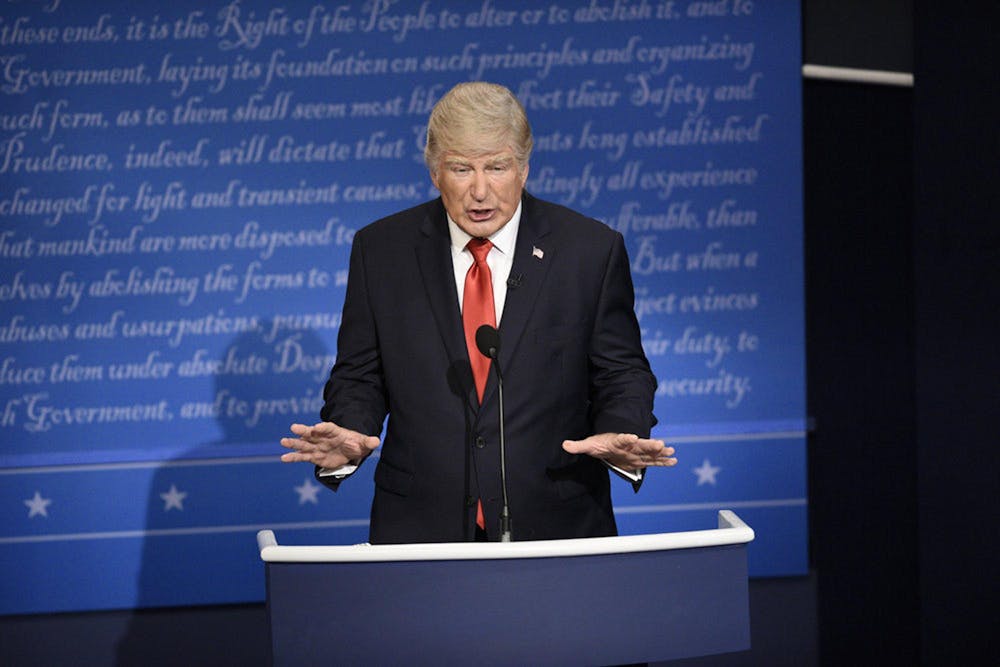
In Season 42 of NBC’s “‘Saturday Night Live,” Alec Baldwin set a season record by appearing as Trump 17 times. Current cast member James Austin Johnson is on track to beat that record, appearing as Trump in 10 out of the 12 episodes currently aired of Season 51.
Among a plethora of political parodies throughout the 27th season of “South Park,” Trump appears as the abuser in a toxic relationship between Satan and himself. If you have so much as opened social media in the past month, you’ve probably been subjected to the endless stream of memes surrounding the sitting president. And if you’ve been conscious at any time over the last decade, his reach has extended from late night shows to casual conversation.
I do think that entertainers mean well by speaking out. There is certainly something to be said for writers and artists using their talents for good. But when we focus on Trump’s absurd speech, mannerisms and physical appearance, especially in the comical depictions we see in the media, we create a benign caricature of a real person who is causing very real harm. In pursuit of soothing our own anxieties, we treat Trump as a piece of fiction. Cartoons, parodies and jokes have allowed him to succeed because in our minds he is a bogeyman we cannot take action against.
Comedy, after all, is recognized by some mental health experts as an outlet to tackle difficult subjects from a psychological distance. Cynthia Vejar, an associate professor of mental health counseling at Lebanon Valley College, writes for Psychology Today that humor can distract us from what we need to feel.
“When laughter becomes avoidance, it can delay grief, suppress vulnerability, or disconnect us from the emotional truth of a situation,” Vejar writes.
Because we’ve used humor to handle current crises, they feel more like fiction than reality. When you see an illustration of Trump with wacky hair, a bright orange face and a comically long tie, you are seeing a fake version of him we’ve conjured to distract ourselves from the vile atrocities the man himself has committed. His crusades against immigrants, people of color, women and the LGBTQ+ community are deplorable, to say the least. And I cannot begin to put into words how incredibly sickening his alleged violence against children is, detailed in claims made to the FBI released by the Department of Justice. Given what we know of Trump, I can no longer bring myself to laugh at him in good faith.
Still, the memes flow like water, reaching users on any social media platform you can think of. When our brains are in a state of automaticity as we scroll, it’s harder to know any better than to laugh, like and share. It’s reached a point where we have become desensitized to the gravest of situations. Memes of Jeffrey Epstein, for example, have also entered wide circulation. Even the official Democratic Party Instagram account has stooped to the level of lazy short-form edits that make light of Trump’s relationship with Epstein. Normalizing seeing the perpetrators of such crimes in a humorous light semi-fictionalizes them, and in doing so, diminishes the crimes themselves.
We have subconsciously allowed Trump to be a caricature instead of the predator he is. His impact has not only caused devastation on home soil, but throughout the world. But those impacts are lost to our laughter if we continue to distance ourselves from the fact that he is a real person — a real person we can protest and vote against.
Emma Howard (she/her) is a sophomore studying cinematic arts.