
IU doctoral student Ladan Shojaei knows her family is alive — something she knows makes her lucky. “It’s complicated,” she said, because they still live in Iran and she knows that while they are alive, she has no idea if they are safe.
Nationwide protests began in Iran almost a month ago. It was Dec. 28 when the rial, Iran's currency, hit an all-time low against the U.S. dollar after months of a worsening economic crisis. When the rial’s value collapsed, shopkeepers in Tehran organized a strike the same day in the city’s grand bazaar — the historic center of the country’s economy.
In the weeks since, protests spread through the country. The Iranian government began a near-total Internet blackout Jan. 8 — 12 days after the protests began. The blackout is still in effect, but some Iranians have been able to place calls outside of the country since and some have accessed Iranian websites.
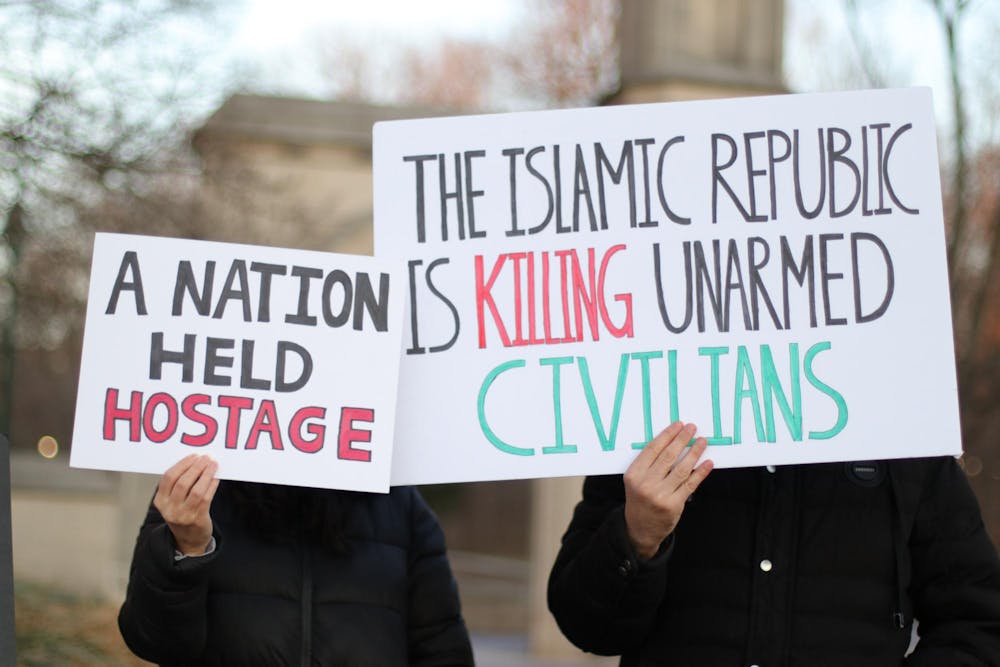
IU Bloomington has 87 students who marked Iran as their country of origin at the start of the Spring 2026 semester. Shojaei and a few others organized a vigil Thursday night outside of the Sample Gates to honor the thousands of Iranians killed by Iranian government security forces since the protests started.
Shojaei is a math education doctoral student from Iran. She and other Iranian students felt like it was their duty to speak out for Iran in whatever way possible, she said.
“Those people in Iran don't have a voice anymore because of digital blackout,” Shojaei said. “We were like ‘It's our job, it's our responsibility to just be their voice.’”
The vigil started at 5:30 p.m. and lasted about an hour. Demonstrators held signs, one saying, “IF YOUR ACTIVISM SKIPS IRAN IT’S NOT ACTIVISM,” and listened to Iranian songs playing from a speaker, with a few demonstrators singing along. A poster board was set up with deceased Iranians on it, surrounded by candles. Around 20 people attended. IU Physics professor Babak Seradjeh, who left Iran in 2000, said the low turnout was OK.
“We've had rallies where 50 or 60 people showed up,” he said. “It's not a great time of the day. It's during the week time, work week. But still, we wanted to come and have this vigil to commemorate the people who have lost their lives.”
The Iranian government announced the first official death toll on Wednesday, after weeks of speculation from human rights groups. The government said 3,117 Iranians have been killed while protesting or as bystanders. That death toll reflects about a quarter of estimates from sources within Iran.
Shojaei said her family is still in Iran. She moved to the United States a little over two years ago to attend IU. She said that she knows her family is alive in Iran after she got in contact with them but still worries for their safety.
The most extreme Internet crackdown lasted for a week. Connection is still poor, Seradjeh said, but some Iranians can make calls to people outside of the country for a few minutes. He said his father still lives in Iran, along with extended family.
The vigil happened hours before President Donald Trump announced the U.S. sent an armada toward Iran. The president formerly said the United States would intervene if the Iranian government killed any protesters. Seradjeh hopes the United States, if it acts more directly like Trump has said, will support Iranian protestors in whatever actions it takes.
“U.S. has a great influence. whatever they do or whatever the government decides to do,” he said. “I just hope that it's something that would be upholding the freedoms of the people and human rights of the people in Iran. Because without that, nothing else will eventually work.”
Shojaei hopes Iran is more free when she eventually returns. She hopes the authoritarian, theocratic government shifts to democracy for the sake of everyone she knows still in Iran.
“No nation deserves to have dictatorship, to experience it because we all are human,” Shojaei said. “We can have democracy. There is no need that someone be at the head and lead the other people and just let the people say, ‘I want you to do that. Other than that, I will kill you.’”


