
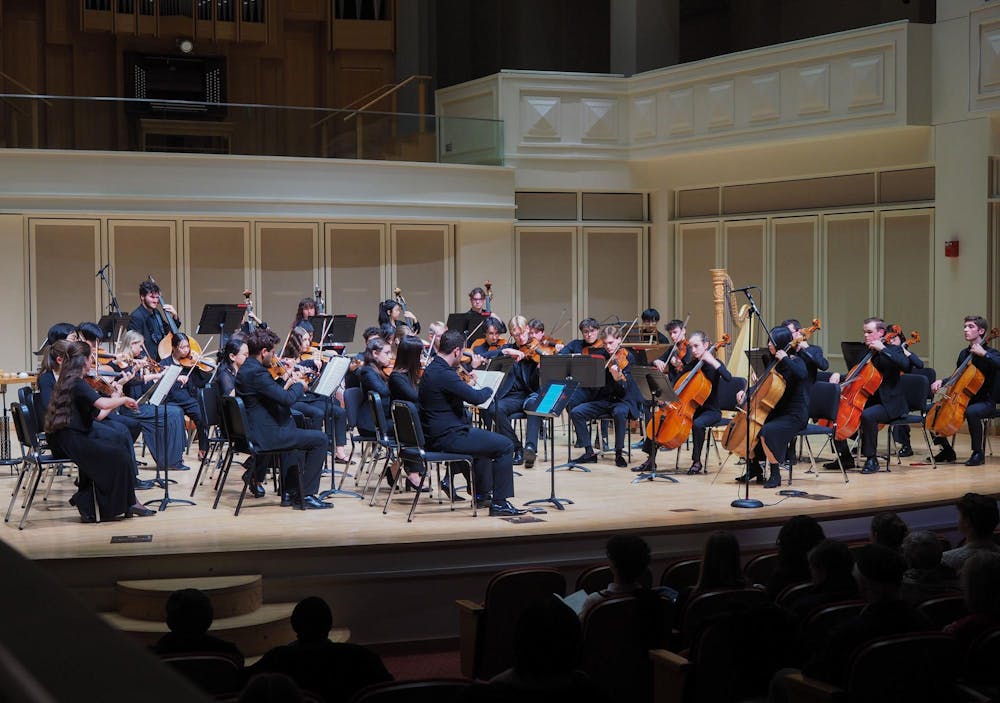
The strings of the University Orchestra hummed Friday night in Jacobs School of Music’s Auer Hall as Callum Smart, an IU alumnus and music professor at Carnegie Mellon University, took the stage with the students to perform.
Smart performed seven orchestral pieces with the students as guest artist and leader, all without a conductor. The repertoire featured Alan Shulman’s “Theme and Variations” (1940). The University Orchestra won the Shulman “Theme and Variations” Competition on Jan. 14 in Ford-Crawford Hall by performing this piece.
The University Orchestra began after Smart took his seat alongside the first-chair violins of the ensemble, taking a deep breath and making sure the entire group was ready to perform without a conductor keeping tempo.
Smart said it was unique to do an orchestral project without a conductor, with most ensembles featuring one. He said similar projects have been done numerous times at universities across the globe, and thought it was a great learning experience for the students.
Beginning the rehearsal process, he started with little to no conducting at the beginning, only stepping into specific areas that could use work on harmoniously playing together.
Collaboration and listening are the main points he emphasized to the orchestral students, claiming these are the key to performing without a conductor present.
“It’s a very different type of listening and ensemble playing, because you have to be incredibly collaborative with the other musicians,” Smart said. “You sort of have to take a lot of accountability and leadership within each and each of the parts that everyone is playing.”
So, as Smart began leading the ensemble whilst playing with them, an excerpt from Jean-Philippe Rameau’s “Les Indes galantes” (1735) titled “Danse du grand calumet de la paix” began the concert, featuring fast and short articulations.
Afterwards, the orchestra flipped their pages to present Heinrich Ignaz Franz Biber’s “Battalia” (1673). This piece featured eight movements, beginning with a fast “Sonata” and ending with a slower “Lamento der Verwundten.” The piece also featured a solo from Smart, who filled the silence of the room with hums of his violin midway through the song.
Next on the program was Jessie Montgomery’s “Strum” (2006), featuring different instruments plucking their strings throughout the lively piece. Originally for string quartet, the concert’s program said the piece was arranged for string orchestra in 2012.
Julia Crowe, a junior studying violin performance at Jacobs who played violin throughout the concert, credited “Strum” as the most rhythmically challenging piece on the program, especially without a conductor to indicate beats to the orchestra throughout the fast and lively song.
“For the principals, that means that we really have to know our parts and be able to show the rest of the section where we are, but it has a really nice groove when it all comes together,” Crowe said.
As the orchestra flipped their pages to perform “Theme and Variations,” Bryce Burgess strolled to the front of his stage, viola in hand. Burgess, a sophomore at Jacobs, is a member of the University Orchestra and was the soloist when the orchestra won the Shulman “Theme and Variations” Competition.
Burgess said performing the piece again with no adjudicators present was a different experience, having a more developed sense of the piece as he has played it a couple more times.
“I mean, a big part of learning a piece is performing it,” Burgess said. “Having gone through a couple performances of it already, it does change the way I kind of see the piece, and I think I have a more developed sense of what it is, in a way.”
As the orchestra’s strings slowly got quieter as the “Themes and Variations” came to an end, the lights of Auer Hall brightened gradually as intermission dwelled. After intermission, the orchestra and Smart performed three more pieces, Ayanna Witter-Johnson's “Dream City” (2021), Edward Elgar’s “Sospiri, Op. 70” (1914) and Antonín Dvořák’s “Serenade in E Major, Op. 22” (1875).
The next orchestral performance at Jacobs will be Jan. 31 at 8 p.m. in the Musical Arts Center with Joseph Young, an artistic director at the Peabody Conservatory at Johns Hopkins University, as a guest conductor for the Concert Orchestra.


