
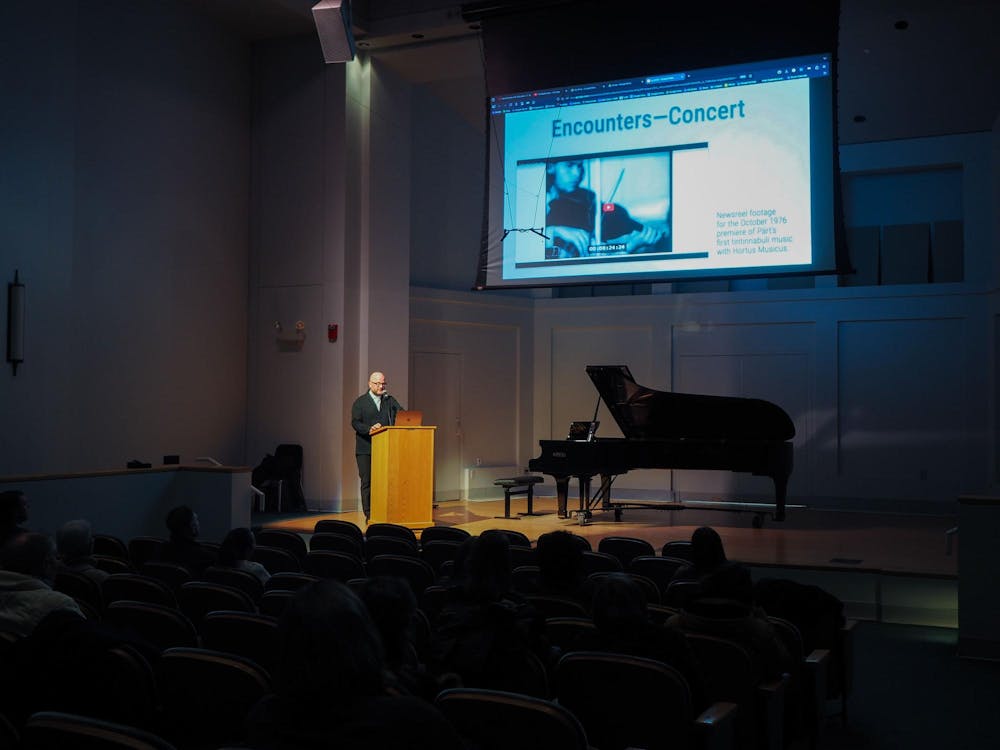
Indiana University joined a global tribute Friday night as the Byrnes Institute honored Arvo Pärt’s 90th birthday with a guest lecture from Amherst College ethnomusicologist Jeffers Engelhardt, a performance from IU’s NOTUS Contemporary Vocal Ensemble and an ambassadorial visit from Estonian ambassador Kristjan Prikk.
Pärt, born Sept. 11, 1935, in Paide, Estonia, has worked as a freelance composer since the late 1960s. He is best known for developing the tintinnabuli technique, in which two melodic voices alternate through scales creating consonant and dissonant sounds. His music is also widely associated with spiritual expression, often honoring his Orthodox Christian identity.
While Pärt has no official connection to IU, his impact has been felt through Jacobs School of Music and the Byrnes Institute, which is IU’s Russian and Eastern European areas institute. IU is the only college in the United States to teach the Estonian language at a proficient speaking level.
Piibi-Kai Kivik, an Estonian native and professor of the Estonian language at IU, credited Pärt as someone who made Estonia more known around the world. Kivik said Pärt’s music is not outright Estonian in nature but reflects her home country in a way that sparks national pride. She said she hopes others gain more insight on Pärt’s impact on Estonia and the composing community through celebrating his 90th birthday.
“The idea that also makes him that much loved, or that important to Estonians, is that he is very universal,” Kivik said. “He speaks about universal ideas and universal emotion in a very universally understood language.”
Engelhardt, a professor of music at Amherst College in Massachusetts, began the 6 p.m. celebration in Ford-Crawford Hall by dissecting the complexities between Pärt’s identities as an Orthodox Christian and an Estonian, traits with oftentimes conflicting lifestyles. He also dove into the structure of the tintinnabuli technique.
Halina Goldberg, the director of the Byrnes Institute, thought Engelhardt’s conclusions were powerful, voicing a thought not commonly expressed about Pärt’s identities. She found the composer’s music contemplative and unusual, not only because of the sound, but because of the history behind it.
“The other thing that is really significant is that in the Soviet Bloc, there was not much space for religious expression through music or otherwise,” Goldberg said. “That was unusual, that in itself, for people to be able to hear newly composed music that was religious in character.”
After a short question and answer session with the audience to end Engelhardt’s lecture, attendees relocated to the lobby of Ford-Crawford Hall. Dialogues between strangers began to fill the lobby while NOTUS set up for its performance down the hall.
During the break, Prikk, the Estonian ambassador, circled throughout the room, speaking with interested guests about Estonia, Pärt and his role in the celebration. Prikk said he came to show his appreciation to IU’s language studies program — and to celebrate the IU football team’s national win.
Prikk also came to figure out areas of cooperation between the Estonian higher education institutions and IU by speaking with department heads and school administrators. Prikk also hosted a lecture Friday morning in the Global and International Studies Building about national and digital security strategy in Estonia. Prikk views Pärt as a “national treasure,” often serving as a way for those outside of Estonia to learn about the country and its history through music.
“So quite often, the kind of story that I hear from people is that ‘Oh, I love Arvo Pärt and only once I started listening to his music, then I figured out he is from Estonia,’” Prikk said.
In Auer Hall, after the break, NOTUS began its seven-piece performance with a song Engelhardt said is not often performed. The ensemble began a somber rendition of “The Beatitudes,” a piece that expresses blessings for virtues like humility and righteousness.
This was followed with a performance of “The Ringing Place” by Meredith Monk. Dominick DiOrio, the director of NOTUS, joined the ensemble for several songs, starting with “sleeper’s prayer” by David Lang. Then, the ensemble performed two more of Pärt’s pieces titled “De Profundis” and “Magnificat.”
The ensemble then sung “In paradisum” by Galina Grigorjeva, a song DiOrio said was inspired by Pärt’s tintinnabuli style.
To end the performance, a string orchestra joined the ensemble on stage as DiOrio took back the role as conductor, sitting with audiences for 30 minutes while they performed Pärt’s “Adam’s Lament.”
Once the song was over, NOTUS received a four-minute long standing ovation.
DiOrio was driven to honor Pärt and partner with the Byrnes Institute because of his profound significance in compositions within the past 50 years, inspiring many of Pärt’s contemporaries to dive into minimalism.
“We’re not a religious or church choir, so we’re not performing it because we’re espousing any kind of religion,” DiOrio said. “But simply because it’s representative of the great literature and music that he’s written, that is part of our wide world of music that we get to perform.”


