
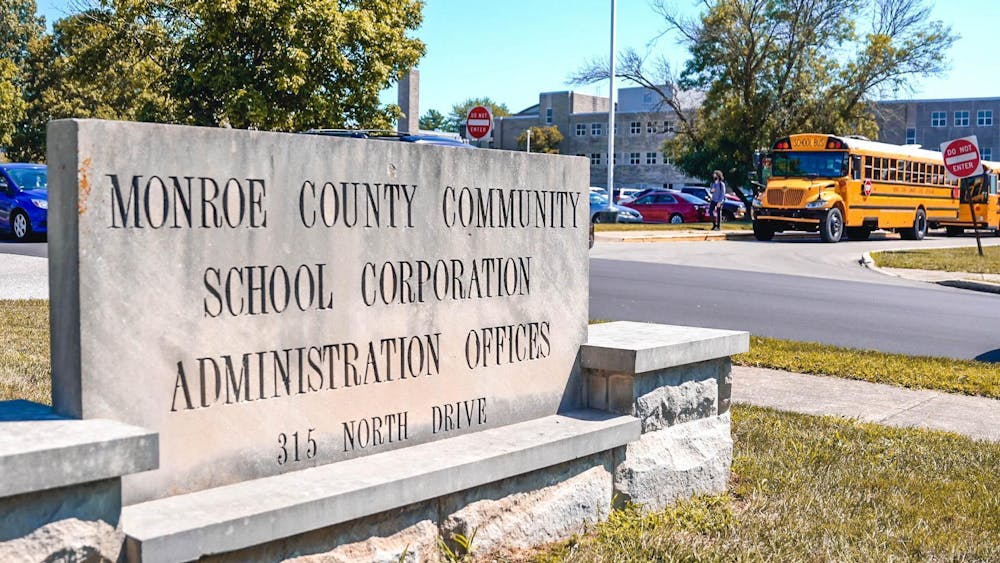
Nineteen Monroe County Community School Corporation third graders will be held back next year under new IREAD testing regulations.
Indiana Senate Enrolled Act 1, passed March 2024, requires all third graders to pass IREAD exams or qualify for a “Good Cause Exemption.” Students who do not pass are retained.
This fall, 104 MCCSC students failed the test, 19 of whom will be held back. This is the largest number in over a decade, according to MCCSC data. In 2024, only one student was held back.
Good Cause Exemptions are granted for a variety of reasons, according to the Indiana Department of Education. The three main categories for consideration include students in special education, identified English learners and students who have already been retained twice.
Several steps of review by a committee of parents, teachers, administrators and reading specialists are required for a student to receive a GCE. This year, 80 of the 104 MCCSC third graders who failed the test received a GCE. The remaining five did not enroll with MCCSC for next year.
About 75% of GCEs across the state were granted to children in special education and 24% were English learners.
Overall, MCCSC had a successful testing year with an 86.8% pass rate for IREAD, which is a 3.7% increase from last year, but .53% lower than the statewide average.
“At MCCSC, our approach to reading instruction is grounded in research-based practices that support all students in becoming confident, capable readers,” Sarah DeWeese, MCCSC director of strategic communications, said. “We prioritize high-quality literacy instruction throughout the school year across all grade levels. Our long-term strategy centers on early intervention and ongoing support.”
SEA 1 covers more than just third grade retention. With the purpose of increasing literacy rates in Indiana, the law mandates testing to start in second grade, giving students more opportunities to pass the test and help with early detection and intervention.
The law is designed to work with House Enrolled Act 1558, which requires reading curriculum to be based on the science of reading. This is a teaching approach that focuses on phonetics, vocabulary and comprehension based on psychology and neuroscience.
The motivation behind HEA 1558, according to Indiana Senate Republicans, was a drop in IREAD scores following the pandemic, which caused concerns about literacy.
Following the passage of SEA 1, the Indiana Department of Education reported a 5% increase in reading proficiency for second and third graders tested by IREAD, the largest increase since the test’s creation in 2013. The 5% increase brings the state to 87.3% pass rate, the highest percentage since the pandemic. This gives Indiana a sixth place ranking for reading from the Nation’s Report Card. The Board of Education’s goal is to raise IREAD pass rates to 95% across the state.
However, the Indiana Department of Education reported 10,663 students statewide failed the IREAD test in 2025, and 3,040 are scheduled to repeat third grade next year. Comparatively, in 2024, 455 third graders were held back.
Several advocacy groups across the state have voiced concerns about retention policies, including the Indiana Coalition for Public Education in Monroe County.
“Retention should always be a local decision,” coalition Chair Keri Miksza said. “It is a decision between a parent and a teacher and a principal. It shouldn't be something that's dictated by the state, because the state doesn't know the full story.”
Miksza was also concerned with the emotional toll that high-stakes testing has on young children.
“Our state government is supposed to support our public schools, and our public schools are supposed to help our communities,” Miksza said. “When it's creating an element of fear and anxiety, it may not be really doing its purpose.”
IREAD is the English language arts portion of the ILEARN assessments, which also test math skills, science and social studies for students in third through eighth grade. The purpose of the exams is to test students’ learning progress as well as the success of curriculum in general.
“It's good to use standardized tests to help track students and make sure that they are progressing,” Miksza said. “It's just wrong when adults use it to compare and contrast one school against another school.”
The Intercultural Devlopmental Research Organization also finds tests to be misleading to the public and that teacher quality and resources are better indicators of education quality. Other arguments against standardized testing include fears such as those cited by the National Education Association, that curriculum is too tailored to the test, meaning students will succeed on the exam but fail to be able to use the skills in other scenarios. NEA recommends using performance-based assessments like a creative project or designing an experiment over standardized testing.
Other community efforts to improve literacy beyond testing come from the Monroe County Public Library’s children’s programming. The library provides opportunities for all ages to get involved in reading starting with the “1,000 Books Before Kindergarten” initiative.
“Any chance a child can get to learn letters or reading will help them immensely when they get into school,” Angelica Candelaria, MCPL children’s services manager, said. “I think people take for granted that we can read and we do it every day, but we all we do start somewhere.”
To improve reading skills, Candelaria recommended reading as much as possible, especially for young children.
“We can all read things, but knowing the context of it, what it actually means and how to take out that information is the most important,” Candelaria said.


