
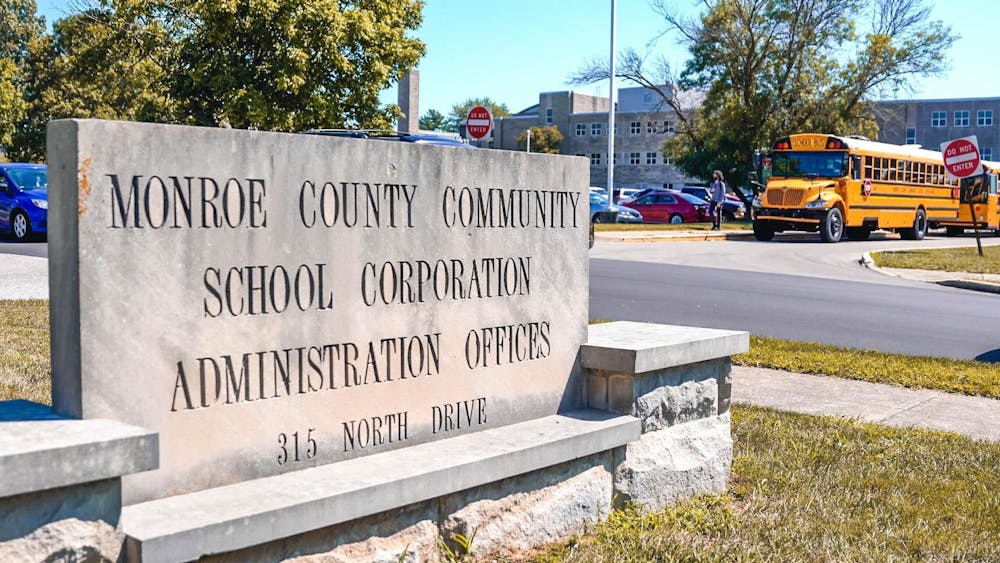
The Monroe County Community School Corporation Board of Trustees decided not to make an overall salary adjustment in its two-year tentative collective bargaining agreement, but they did approve a $1,000 stipend for teachers.
The two-year agreement, discussed at Tuesday’s trustees meeting, includes annual $1,000 stipends for teachers rated effective or highly effective. Those would be paid in two annual installments in December and June. The corporation didn’t answer how those ratings are determined when asked.
The base salary of teachers who update their teaching license by adding an early literacy endorsement will be increased by $200, or less if the endorsement is earned mid-year. The new agreement will continue to give higher salaries to teachers with master’s degrees.
Teachers assigned to instruct students outside of extracurricular activities and regular contracted hours will earn $30 hourly, and teachers who are assigned to supervise, but not instruct these students, will continue to earn $20 hourly. Teachers who are completing professional development work outside of regular contracted hours will continue to earn $20 hourly.
MCCSC uses a salary schedule that determines how much teachers with different levels of experience and education are paid, with row A being the lowest salary and Q being the highest.
Parental leave for all teachers from rows A to E of the salary schedule will increase from eight to 10 days within the first year after a child’s birth or arrival in the teacher’s home. Teachers with children in pre-kindergarten through 6th grade at MCCSC schools will receive a 20% discount September through April for the Extended Day Program, beginning Jan. 1, 2026. Though the program varies in cost by month, the average cost for combined before and after school care in the 25-26 school year is $289.60 a month.
In the 2023-25 agreement, teachers were charged two leave days for every consecutive day taken off before or after a break.
“This “two-for-one” charge is now limited to only two consecutive days before and/or after a break," the agreement reads.
The agreement details new insurance contribution amounts from the corporation to account for increasing insurance costs. The retirement benefit matching percentage for teachers in rows A to E on the salary schedule will change from 5% to 3.5%.
“We always want to do more for our teachers, we always want to do the very best that we can do,” board president April Hennessey said at Tuesday’s meeting. “And we have been extraordinarily limited this year in what we’re able to offer as a result of some of the cuts that are coming and the cuts that we’ve already seen.”
Teacher salary and school budget challenges in Indiana
The MCCSC Board of Trustees is set to ratify the final agreement at its Nov. 18 meeting.
Around the state of Indiana, the period for collective bargaining, the process where teachers unions negotiate salary and benefits with school districts, is from Sept. 15 to Nov. 15 each year.
First, the school board or a school board representative conducts a public hearing and collects feedback. Then the bargaining begins, often behind closed doors, Indiana State Teachers Association President Jennifer Smith-Margraf said.
Both the union and school corporation approve a tentative agreement before the final contract. All teachers in the school district have the right to vote on the tentative agreement. The final contract created through the bargaining can last one or two years.
If a school does not come to an agreement by the end of the collective bargaining window, the state assigns a mediator. This is a rare step, Smith-Margraf said, but this year, because of the lack of funding available, 10 or more local school districts may end up in mediation.
This year, all public schools in Indiana are bargaining, Smith-Margraf said, because of the state’s recent long budget session.
Smith-Margraf said teacher salaries have increased over the past few years because of former-Gov. Eric Holcomb’s teacher compensation commission, but this year, salaries may stay stagnant because of increased inflation and the effects of Senate Enrolled Act 1, a state property tax reform passed in April. Instead, many corporations, including MCCSC, are proposing to implement stipends.
According to Indiana Gateway, the average teacher salary at MCCSC during the 2024-25 academic year was $69,770. That’s much higher than the Indiana average of $58,620 — the state ranked 39th in state teacher pay last year.
In 2010, then-Gov. Mitch Daniels cut $300 million from the budget for K-12 public schools statewide, which Cathy Fuentes-Rohwer, president of the Indiana Coalition for Public Education, said the state never replaced. Then, in 2011, Daniels initiated the school choice voucher program that has grown to be near-universal.
With the shortage of funds and the addition of schools that need to use those same funds because of the school choice program, Fuentes-Rohwer said Indiana can no longer afford to pay public school teachers enough to compete with the surrounding states.
Indiana’s school choice program gives students who are set to attend private or charter schools public funding to do so, causing public schools to be allotted less funds. Fuentes-Rohwer said this lack of funding and low salary makes many prospective teachers leave the state to teach.
Fuentes-Rohwer said teachers’ salaries have also struggled to keep up with inflation.
“Funding public schools and paying teachers well is an investment in the future,” Fuentes-Rohwer said. “It’s not like it’s an expense; it’s an investment.”
Smith-Margraf said Indiana’s spot on the low end of teacher pay in the country affects its recruitment and retention abilities. Less people enter and stay enrolled in teaching preparation programs because they’re aware of the low salary.
Then, Smith-Margraf said, people end up leaving teaching because they don’t see salary increases and can’t maintain their lifestyle or pay back student debt. Smith-Margraf has seen teachers turn to bartending, working for the post office and physical labor careers as higher-paying alternatives to teaching.
Editor’s note: Cathy Fuentes-Rohwer is related to a writer currently on staff at the IDS. That writer was not involved in the reporting, writing or editing of this story.


