
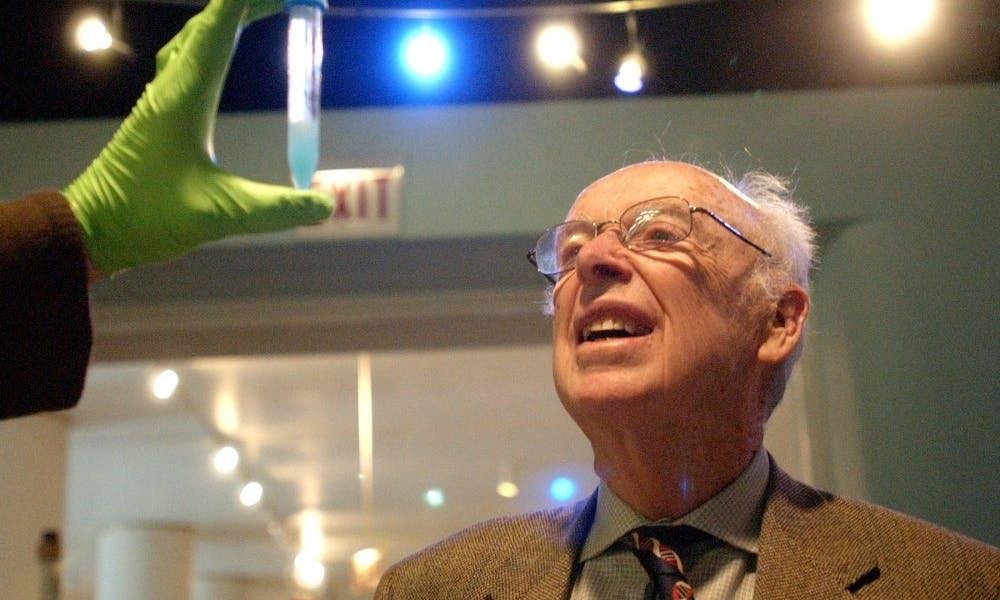
James D. Watson, an Indiana University alumnus and co-discoverer of the structure of DNA, died Thursday in a hospice center in East Northport, New York. His death was confirmed by his son, Duncan Watson.
Watson discovered the double helix structure of DNA with collaborator Francis Crick and using the work of Rosalind Franklin in 1953 when he was just 25 years old. The discovery opened the door to modern developments like genetically modified crops and research on genetic mutations, and won the men the Nobel Prize in Medicine or Physiology in 1962.
After a long career continuing to study microbiology and leading major genetics projects, Watson came under fire for racist and sexist comments.
In an interview with London’s The Sunday Times in 2007, he suggested that Black people were not as intelligent as white people. He doubled down on the comments in on-camera interviews for a PBS documentary. He was dismissed as chancellor of Cold Spring Laboratory following the comment and somewhat shunned from scientific circles, for which he harbored great resentment. Over the years, he was also quoted as making controversial comments about gay people, women and people who are overweight.
Watson came to IU for graduate study in 1947. He completed his doctoral thesis in 1950. While at IU, he studied under two fellow Nobel Prize winners, Hermann J. Muller and Salvador E. Luria.
After studying at IU, Watson moved to the Cavendish Laboratory at the University of Cambridge in England. There, he met Crick, and the two teamed up to construct a physical model of DNA.
Their breakthrough came when a fellow researcher gave them access to X-ray images taken by Franklin. One, Photo 51, provided crucial information about the molecule’s structure.
However, the photo was obtained without Franklin’s knowledge, which goes against standard research protocol. For years, Franklin was left uncredited for her role in the discovery, although today she would have been considered a co-author in the breakthrough research paper.
Watson cemented his status as a major scientific figure through his leadership of the Human Genome Project and publication of the celebrated memoir “The Double Helix.” The Library of Congress listed the book as one of the 88 greatest in American history, and The New York Times hailed the sequencing of the human genome, an effort he led, as “one of the biggest and most significant international scientific efforts ever completed.”
Outside of his more famous endeavors, Watson served as director of Cold Spring and taught at Harvard. There, Watson mentored undergraduate students, wrote a series of notable microbiology textbooks that remain widely used in biology classrooms today and even offended some colleagues with his dismissal of their scientific fields as lesser than his own.
In his 25 years as director of Cold Spring, Watson transformed the small Long Island lab into a center of microbiology research. After stepping down as director in 1993, he took an honorary role as chancellor.


