
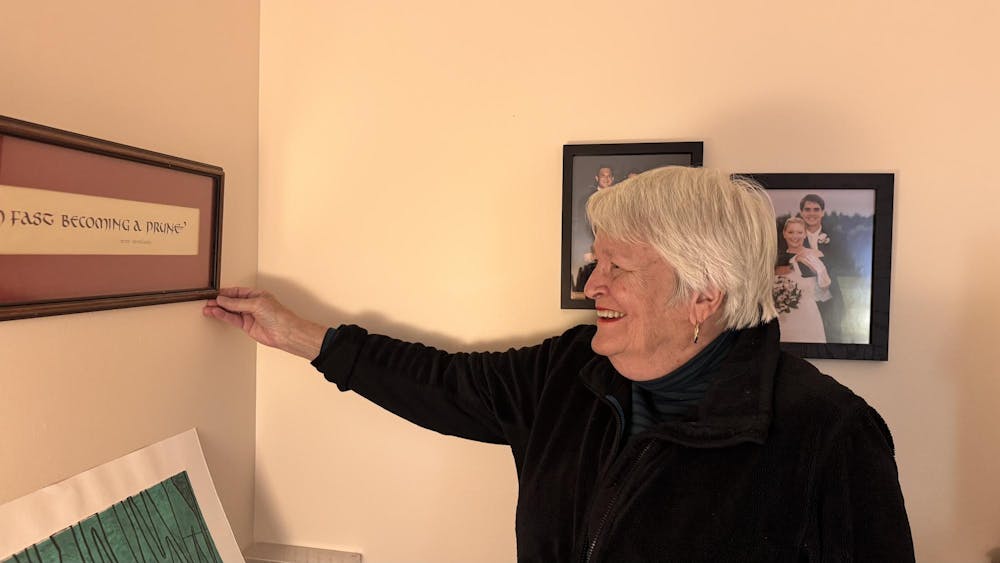
Anne Jones’ weathered hands shake as they graze over silver gelatin print portraits of celebrities from the ‘90s. She uses her fingers to feel for evidence that the photographer, Len Prince, had hand-edited the 11 by 14 photos from his “About Glamour” collection.
Anne works on the third floor of Lindley Hall, the Kinsey Institute’s Collections at Indiana University. The Kinsey Institute, established in 1947, researches and keeps archives of sexuality, gender and reproduction. Its collection contains 2,000-year-old artifacts, books, magazines, amateur erotic films, therapy materials, fine art and works by LGBTQ artists.
The 80-year-old has been a volunteer at the institute for about 15 years. For 20 hours each week, Anne sifts through hundreds of donated materials, cataloging them and assessing their addition to Kinsey’s collection.
Buttons reading, “Uppity women unite.” Feather boas, wigs and masks from a modern-day burlesque queen. Blue hardcover copies of the 1986 “Attorney General’s Commission on Pornography, Final Report.” Volumes of the “International Journal of Impotence Research.”
The “About Glamour” collection she’s looking at consists of celebrity portraits — and one photo of a sopping wet, curly black dog that makes Anne cackle. Much of Prince’s work featured nudes and sexuality.
In an office next to a six-tier rack of white boxes, amid the buzzing of computers and the click of her mouse, Anne sorts through donations of correspondence, sculptures and journals.
As Anne pulls out each book or document from the box she’s working through, she turns to her computer in her creaky black office chair and searches for the title on the IU Library Catalog. Usually, if Kinsey already has two copies of a material, it will offer it to another library.
When Anne comes across a material Kinsey doesn’t have, or only has one of, she takes a yellow sticky note and writes “for Liana” with a black Ticonderoga pencil. Liana Zhou is the institute’s library and special collections director.
“This is a treasure house of material that people can look at and realize that they're not alone,” Anne said. “In fact, that they are standing in a long line of human beings that do not fall in a box.”
***
Anne’s version of the relationships she catalogs started when she was 17, attending Oberlin College in Ohio. She was pre-med, on the road to becoming a doctor.
There, Anne met Edward, an Episcopal chaplain in the college. Everyone knew him as Bishop Ted. They fell in love and got married in 1963 after Anne’s freshman year.
For the next 40 years, Anne and Ted lived in Cleveland, Lancaster, Pennsylvania, and Indianapolis, before moving to Bloomington in 2002.
Ted died in 2007 after living with Alzheimer’s for about six years. Anne never loved anyone else.
“When you meet perfection...” she said, trailing off.
In September, Anne moved into an apartment in Bell Trace Senior Living Community. One day, Anne’s dentist asked her if any of her new single neighbors had been giving her “the eye.”
She told him she got the sense a few might be interested. He laughed and asked her what she was going to do.
“I’m giving him the hairy eyeball,” she said, and scrunched up her face, opened her mouth wide and said, “No. Capital N, capital O.”
Anne attended Oberlin for two years, but didn’t finish after she had her first daughter, Martha Patricof. Anne did not mind that she did not finish college; the life she had with her husband made it worth it.
***
Anne, like her husband, worked in theology throughout her life, attending graduate school at Christian Theological Seminary in Indianapolis. She also worked as a hospital chaplain and as a consultant for the Episcopal church pension fund, meeting with clergy groups to discuss Alzheimer’s.
Anne’s son, David Jones, said she really cares about people.
“She was always about helping people who didn’t have other support,” he said.
At Christmas time, Anne would invite people she knew might be alone for the holidays over for dinner, David said.
She was raised in a home where faith was celebrated and practiced. In Anne’s family, no subject was off the table, a philosophy she carried into her children’s upbringing. David said a core memory of his is the lively conversations his family had at dinner.
Despite gender and sexuality being controversial topics in the Christian church, Anne’s work at Kinsey is intertwined with her faith, the thing her identity is rooted in.
“It’s completely coherent with my faith to celebrate sexuality and gender identity and the beauty of human beings, the infinite beauty and infinite value of human beings,” Anne said.
In 1976, the Episcopalian Church officially approved women to be ordained, an issue close to Anne’s heart. A friend of Anne’s once told her women can’t be priests because Jesus was a man.
“Are you saying that you have to have a penis to be a priest?” she replied. He was taken aback by that, and she pushed forward, telling him that that was what he was really saying.
When the church debated ordaining gay people, people joked that gay men were effeminate, giving the trait a negative connotation, Anne said.
The underlying theme here, she said, was that people are valued by their closeness to being white, male and able-bodied. Anne said the Kinsey Institute stands in opposition to this.
“What are you afraid of?” she asked. “Every human being is beautiful and valuable, every human being. And to me, that’s a radical statement against our culture, and I want to be a part of that.”
Anne’s volunteer career at Kinsey began after a fundraising event in New York City, where she met Liana, who was there with the Kinsey Institute.
“I met Liana in a New York apartment with about 100 other people milling around, eating hors d’oeuvres, and she and I stood in a corner, and she told me about what she was doing,” Anne said. “Before the evening was over, I had said, ‘I want to work for you,’ and she said, ‘and I want you to work for me.’”
Liana was impressed by Anne. She could tell Anne admired the institute’s work and understood the importance of human sexuality in life and relationships. Anne’s a giver, a learner, Liana said.
“Right there and then, a friendship was established,” Liana said. “I just feel so lucky.”
While talking, Anne thought about how volunteering at the institute would satisfy her desire to make a contribution to the world.
“Some of the most interesting things I’ve ever done have been completely unplanned, and they had to do with meeting people that were just fantastic people, doing interesting things, and this was one of those occasions,” Anne said.
***
The Kinsey Institute has faced significant scrutiny for its research. In 2023, the Indiana House blocked IU from being able to use state funding to support the Kinsey Institute, and the university continued to remain affiliated with Kinsey. The institute, which is located on IU’s campus, pays rent to IU. In early 2025, Indiana lawmakers expressed concerns over IU’s transparency about how Kinsey is funded.
In 2024, Plante Moran, an independent accountant, released a report finding IU compliant with Indiana Code 21-20-6-2, which restricted the funding.
Now, the institute is funded by donations, grants and contracts from foundations and nonprofits, among other sources.
Some of the criticism comes from Rep. Lorissa Sweet’s allegations that the institute was hiding child predators.
The institute denies all claims of child abuse stemming from founder Alfred Kinsey. These allegations have led to threats against the institute and its employees, Anne said.
“The world needs what the Kinsey Institute has to offer and the freedom to be a sexual human being,” Anne said. “Fully integrated and safe and cherished is my goal. It won’t be realized in my lifetime, but I can make my small contribution to it.”
Throughout Anne’s life, she’s seen issues and contentious topics cycle back around. Birth control was a fight she thought had been won.
“That access was guaranteed by, or fought for, by generations of women before you and men, some men too, and it’s at risk again now,” Anne said.
Supreme Court Justice Clarence Thomas has said he believed Griswold v. Connecticut, the case that upheld the right for married couples to use contraception, should be overturned.
Accessibility to birth control and the ability for women to make choices for themselves were issues that led to Anne’s volunteer work.
“Those choices are available because I have enough money to make those choices, and I was very aware of that always,” she said. “I treasure those things, and I realize that they’re luxuries, and most women don’t have them. They don’t have the security, and they don’t have the ability to make choices.”
***
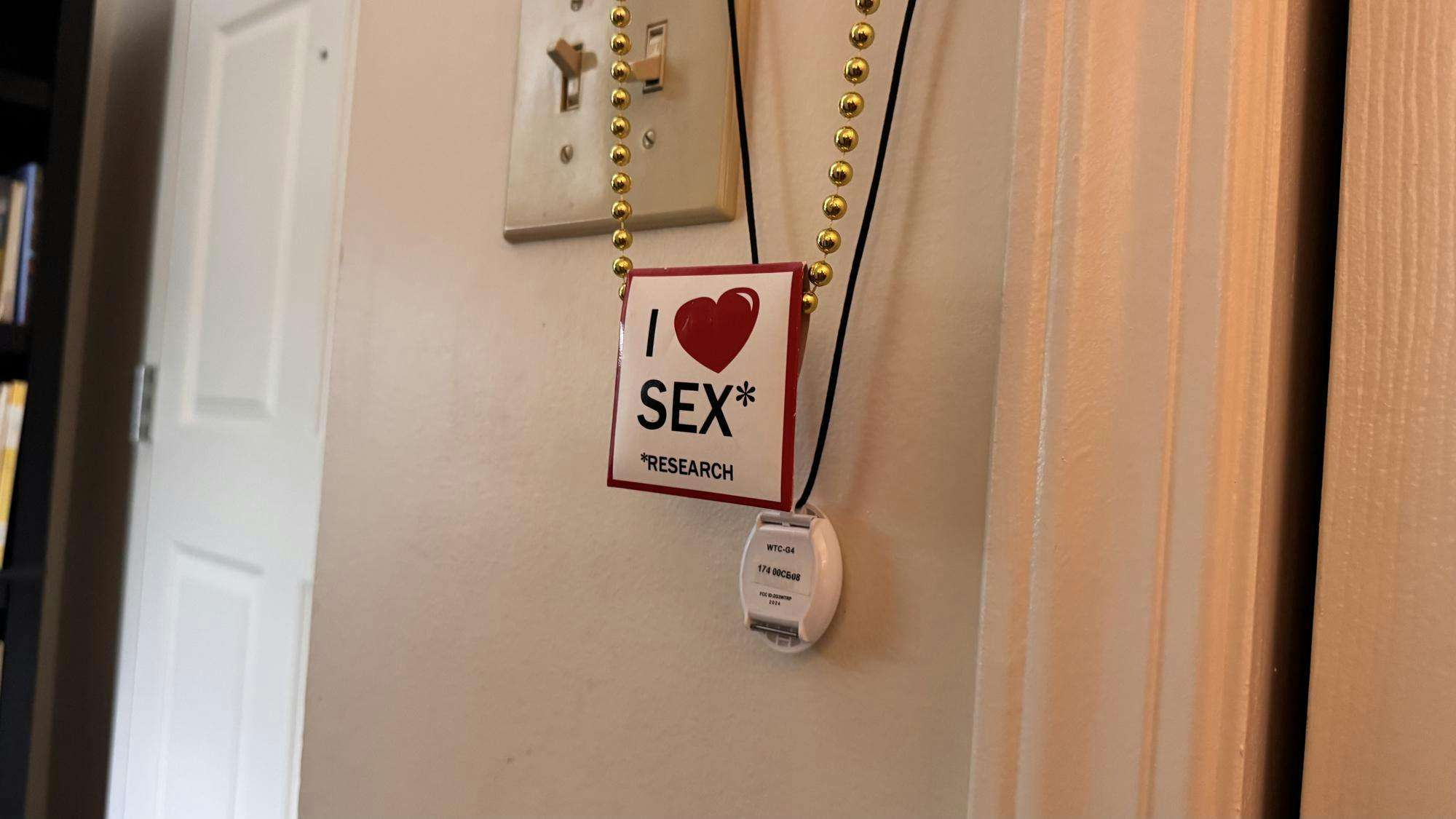
A necklace displaying I heart sex research hangs in Anne Jones' apartment on Nov. 5, 2025, in Bloomington. Jones hung the necklace under an icon of Christ Pantocrator.
In the entryway of Anne’s apartment door hangs a beaded necklace with a square icon that displays the message, I heart sex, with the word “research” in smaller text underneath. It hangs alongside her medical alert necklace. Above the necklace, an icon of Christ Pantocrator hangs on the wall.
“How can you hang a sign like that under Jesus?” Anne’s been asked.
“He started it all,” she responds.
Anne’s church, First Presbyterian Church in Bloomington, knows that she volunteers at Kinsey, and they’re not surprised, she said.
Sexuality is part of human identity from the moment they are born, Anne said
She’s always felt this way. Anne loves sex. She loves sex research. She loves that she’s benefited from it. Life as the world knows it is a result of sex and relationships.


