
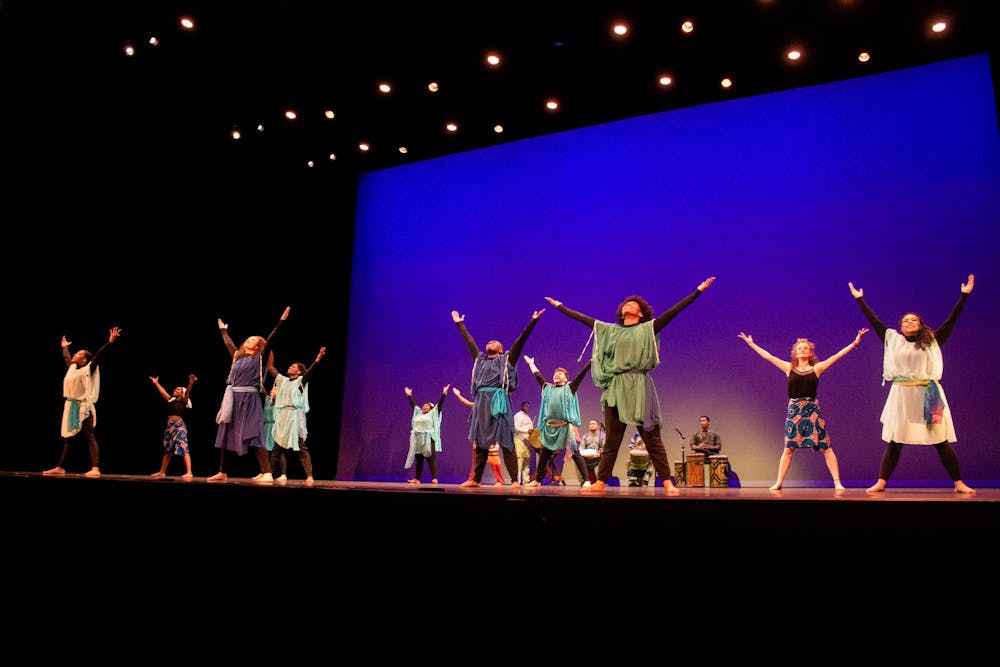
The annual “Potpourri: An African American Performance Showcase” put on by IU's African American Arts Institute returned to the IU Auditorium Nov. 15 after taking a year off to celebrate its 50th anniversary.
The event brought together the three ensembles that make up the AAAI, the African American Dance Company, the African American Choral Ensemble and IU Soul Revue, in a showcase of African American performing arts.
Raymond Wise, the executive director of the institute and director of the choral ensemble, said “Potpourri” was created about 30 years after the three ensembles formed. It serves as a way for the ensembles to showcase what members have learned and worked on, and to engage with the wider Bloomington community.
Wise said the point of this event, especially in today’s political climate, is to bring people from all backgrounds together to celebrate and uplift Black art and culture.
“We don’t understand one another, we continually fight and we go against one another because we don’t spend time together, because we don’t interact, and that’s the one thing that is so exciting about our ensembles,” Wise said. “People come from all cultures, all ethnicities, all backgrounds and together they come together to do their best work and provide wonderful excellent performances for the community.”
Wise opened the evening discussing AAAI and its history, highlighting the vision of Herman Hudson, the vice chancellor for Afro-American affairs at IU in the early 1970s, who helped create the institute. Wise urged audience members to support them in whatever way possible, saying the dismantling of DEI initiatives at IU has cut much of AAAI’s funding.
After Wise’s speech, the show began with a performance from the dance company. They opened their set with an ode to the 1970s, in honor of when AADC was created. Groovy, lively dancing filled the stage as dancers leapt around and shimmied about to “Once You Get Started” by Chaka Khan and Rufus.
They then transitioned into more traditional African dance with a contemporary version of a diansa dance accompanied by live percussionists. The crowd began cheering along.
The performance lasted about 35 minutes and was followed by the AACE, who began with a classic choral sound, performing “I’ll Stand,” written by Wise. The group then sang “Lift Every Voice and Sing,” widely considered the Black national anthem, in honor of its 125-year anniversary. They had the audience stand and sing along, so everyone became a part of the show.
Afterward, they moved into gospel songs that got the crowd standing, dancing, clapping and singing along. These songs shared uplifting messages of living every day to its fullest, coming together to share compassion and being the change you want to see in the world.
Bloomington resident Angela Carter said the choral ensemble set was her favorite part of the show.
“I thought it was awesome,” Carter said. “A lot of fun, a lot of energy.”
The show closed out with an electric performance from IU Soul Revue. They made a grand entrance with flashing lights, shiny outfits and a magnetic stage presence. They performed several contemporary and R&B songs including “On Our Own” by Bobby Brown, “Together Again” by Janet Jackson and, a fan favorite, “Poison” by Bell Biv Devoe that got the audience singing and dancing along.
The energy IU Soul Revue brought to the stage turned the auditorium into a party, giving the audience members a chance to let loose and have a good time. All the performers’ vocals were lively and smooth, and the accompanying band brought the songs to life, adding to the enthusiasm of the performance.
They closed out the night with a rendition of “O-o-h Child” by The Five Stairsteps, and were joined by the other ensembles. The audience participated by holding up their phone lights and swaying along.
IU freshmen Oiza Momoh and Betty Obungu said IU Soul Review was their favorite part of the night, enjoying how they were able to get the crowd involved with the performance. They thought the show as a whole was a great way to bring people together and empower them.
“I thought it was really powerful,” Momoh said. “It had a really important message. I thought that they conveyed it in a really nice way that is open to everyone.”
Obungu agreed with Momoh, recommending that more people go see the show in the future.
“It was very, like, empowering, especially as a Black student,” Obungu said. “To just kind of be, like, surrounded by all sorts of Black music, Black culture; highly recommend it. A million out of ten experience, I can’t wait for next year.”


