
Editor’s note: This story includes mention of suicide and self harm.
SPOILER: This column contains potential spoilers for “Ballad of a Small Player.”
The adaptation of the novel of the same name by Lawrence Osborne, “Ballad of a Small Player,” became available to stream on Netflix on Oct. 29. Directed by Edward Berger, the film takes you on a psychological thriller that will keep you on the edge of your seat.
Some critics deplored the film because of its chaotic and messy nature, and they’re not wrong.
The film was overwhelming. But should it be calm? After all, being a gambling addict with hundreds of thousands of dollars in debt is hardly a walk in the park. I think the chaotic nature made it easier to understand the characters and the overall dangers when gambling is taken too far.
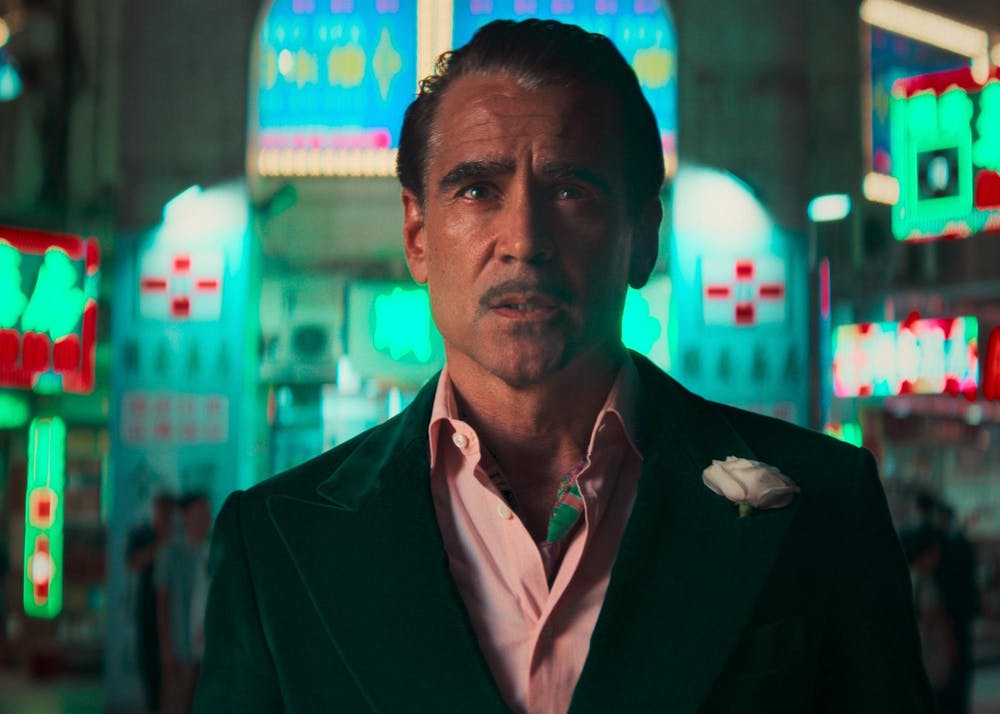
Set in Macao, a peninsula located on the southern coast of China, often referred to as the “Vegas of China,” “Ballad of a Small Player” revolves around Lord Doyle (Colin Farrell), a gambling addict from the UK who comes to Macao to try and hide from his debts back home.
After suffering a losing streak, his desperation to recoup some of his losses leads him to the Rainbow Casino. After witnessing Doyle lose once again, Dao Ming (Fala Chen), a worker at the casino, goes up to him and offers him credit. The next day, Doyle comes back to visit Ming when he sees a man fall from the top of the casino. In shock, Doyle goes down to find the man dead on top of a car. He sees the man’s wife hitting Ming, blaming her for aiding the man’s gambling addiction, which she believes ultimately led him to take his own life.
Suicide is frequently explored in the film. It appears in Doyle’s dreams, as well as multiple instances later in the movie. Throughout the film, the topic feels more and more like a representation of Doyle’s emotional state.
Doyle is a gambling addict who just hit rock bottom, and he's forced to face the consequences of his actions at every turn. However, as an addict, he cannot resist the temptation to gamble – even though he knows that is the very thing that destroyed his life. Suicide symbolizes Doyle’s battle with addiction and how he feels that taking his own life is the only way to free himself from it.
After Doyle saves Ming from the grieving widow, the two bond, and their relationship becomes increasingly confusing throughout the rest of the film. We see Doyle’s feelings for Ming evolve into something almost romantic. However, Ming’s feelings for Doyle seem to stem from a place of empathy rather than romantic interest.
Although the romantic connection between the two is confusing, I feel their characters complement each other well overall. Without Ming, Doyle’s character would feel incomplete. Ming brings balance to his chaos and allows us to see the human side of him. The moments they share in the movie reveal Doyle’s true emotions, helping us understand who he is and form an emotional connection with his character.
Another interesting dynamic is the one between Doyle and Blithe (Tilda Swinton), an investigator who has been sent from the UK to track him down.
Overall, Blithe was a fascinating character. Though the premise of her character seems like she should be a bad guy, Blithe could not help but fold when it came to Doyle. You could see her affection for him in her eyes – like when cartoon characters get hearts in their eyes.
I think Blithe was an important character who helped us get to know Doyle more. Seeing how easily she was charmed by him, it really showed how deceptive and convincing Doyle can be, which also explains how he maintains his gambling addiction.
Throughout the film, both Ming and Blithe help highlight who Doyle is, and how he became the greed driven character we see in the movie.
In the film, Ming tells Doyle about the Realm of the Hungry Ghosts, a place in the Buddhist afterlife for people who are driven by greed – much like Doyle. Just like the viewer, Ming can see that this will be Doyle’s fate if he does not change soon and tells him, “It’s not too late for you.” But, while alone in Ming’s house, Doyle discovers two bags full of money submerged in water in her shed.
Unable to control his greed, he takes Ming’s money and goes back to the casino. That night, Doyle’s losing streak ends, and he wins every hand. However, cameras capture what appears to be a ghost looming behind Doyle.
Doyle doesn’t realize what he is becoming until he sees his reflection in the bathroom mirror. Determined to change his fate, Doyle places everything he has on one last game to win the money he needs to repay his debts.
Farrell’s energetic and captivating performance as Doyle is what makes this movie great. However, Doyle’s character development felt limited throughout the film. Watching him make one bad decision after another became almost frustrating to watch, Still, I think his fate at the end was the right choice. Having seen others like Doyle take their own lives, his ending sends a powerful message to viewers – that you are not bound by your mistakes, and there is always a light at the end of the tunnel.
This film was intense and, at times, an overwhelming watch. However, the chaos of it all was what kept me engaged. If you want a movie where you can’t look away, I think “Ballad of a Small Player” would be a great watch.


