At 11 p.m., opening night, I made my way to Bloomington’s AMC theater and waited for lead actors Madelaine Petsch and Froy Gutierrez to light up the screen.
The overhead lights dimmed and a dark statistic appeared, warning viewers about the rate of random home invasions — a classic fear tactic used in “The Strangers” films.
As a newcomer to the franchise, my main fear was not knowing what had happened in the first chapter. Apparently, it ended with one question: did the deviants succeed in killing both main characters?
For those also unfamiliar with the series, the “Chapters” sequences resemble “The Strangers” films of 2008 and 2018 but are not traditional sequels. The second part of the standalone “Chapters” trilogy, “The Strangers: Chapter 2,” opened with Maya (Petsch) lying on a hospital bed. There was no sign of her partner, Ryan (Gutierrez), whose outcome was left uncertain in the first chapter’s conclusion.
In the first chapter, Maya and Ryan had been traveling from New York to Portland for Maya’s job interview while also celebrating their fifth wedding anniversary. In Venus, Oregon, after stopping at a small restaurant for lunch, their car stopped working and they had to stay at an Airbnb. During the night, they were hunted by three masked killers.
The three latest movies follow a similar template to the original 2008 film, and Collider movie critic Emma Kiely argued “The Strangers: Chapter 1” mimicked the first film too closely.
I was relieved when, within minutes of the opening sequence, flashbacks began playing — pairing faces and scenes from the first movie to the current moment and allowing newcomers to connect the dots and understand the film’s direction.
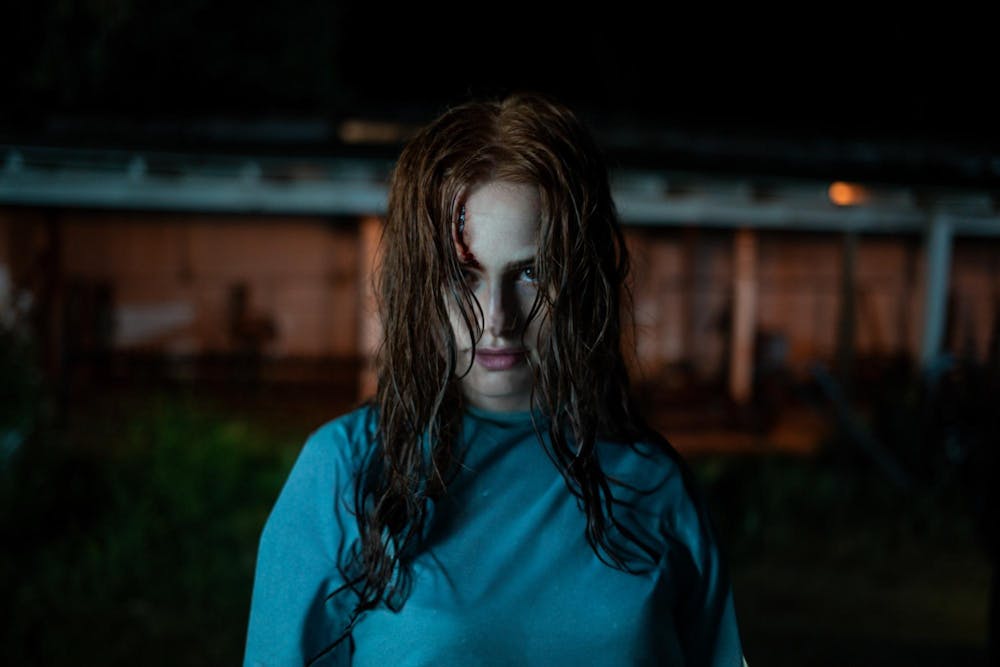
Unlike the previous films with two main characters, “Chapter 2” strays from its predecessor and only focuses on one. Petsch’s ability to draw the audience in and convey emotion allows her to stand alone without a second lead. Her character’s terror pulls people in — so much so that I was genuinely surprised by the first jump scare.
However, jump scares alone cannot make a great horror flick. The franchise leaves time to attach to characters, rather than replacing leads for each subsequent film. The chapters demonstrate Maya’s commitment to survival, and with each narrow escape from certain death, her resourcefulness grows. We observe this in her refusal to stop running, suspicion of all other characters and her increasing violence toward the killers.
While I usually prefer franchises like the “Saw” and “It” series, both of which better illustrate the complex histories and relationships between chapters and characters, this movie’s audience still bonds with Maya as she mourns Ryan’s death.
In one scene, Maya closes herself inside a mortuary refrigeration unit and a killer creeps up to the unit’s door. Covering her mouth with a shaking hand, Maya stares through a small vent in the door, eyes wide, her terror evident. Then, as the camera adjusts, she looks at a familiar face — cold, stiff and lying underneath her. Silently, Maya cries as she waits for the killer to find her. After the danger passes, she takes a moment to touch her partner’s face one last time.
The coldness of the room, fear in Maya’s face and claustrophobic atmosphere made my chest feel tight. I only released a breath when Maya exited the room and made her escape.
Without Petsch’s amazing ability to convey fear, determination, rage and emptiness, the movie would be far less impressive. Throughout the film, Petsch’s facial expressions enhance each scene, conveying her struggles and strengths better than the official script ever could.
Unfortunately, Petsch’s ability to shed tears was abused throughout the film. After multiple instances of a single, giant tear running down her face, the effect wore thin, and the impact lessened.
Perhaps the most disappointing part of the movie occurred when a CGI boar attacked Maya during a scene in the forest. Though it was explained in a flashback, its appearance in the film felt out of place and went against the movie’s tone. Instead of waiting with bated breath, I could feel myself stifling a laugh.
Outside of a few comedic moments though, the overall theme of the film returns to the franchise’s use of the classic trope of killers indiscriminately choosing innocent targets.
While the initial home invasion statistic set people on edge, the film pushed the concept further when a townsperson ominously implied that the killings were random and had no purpose, creating further unease.
While the simplicity of motiveless killing could be seen as a refusal to commit to a more complex theme, the fear of becoming random victims of convenience makes the fear of attack terrifyingly valid.
Already, theories about the next chapter, hypotheses about the number of killers, predictions about Maya’s character arc and questions about the killers’ origin stories have begun.
With the next movie set to debut in 2026, there are still many questions lingering in the viewers’ minds. Although there were disappointments sprinkled throughout the film, I plan to return next year, waiting for an update on Maya’s predicament.