
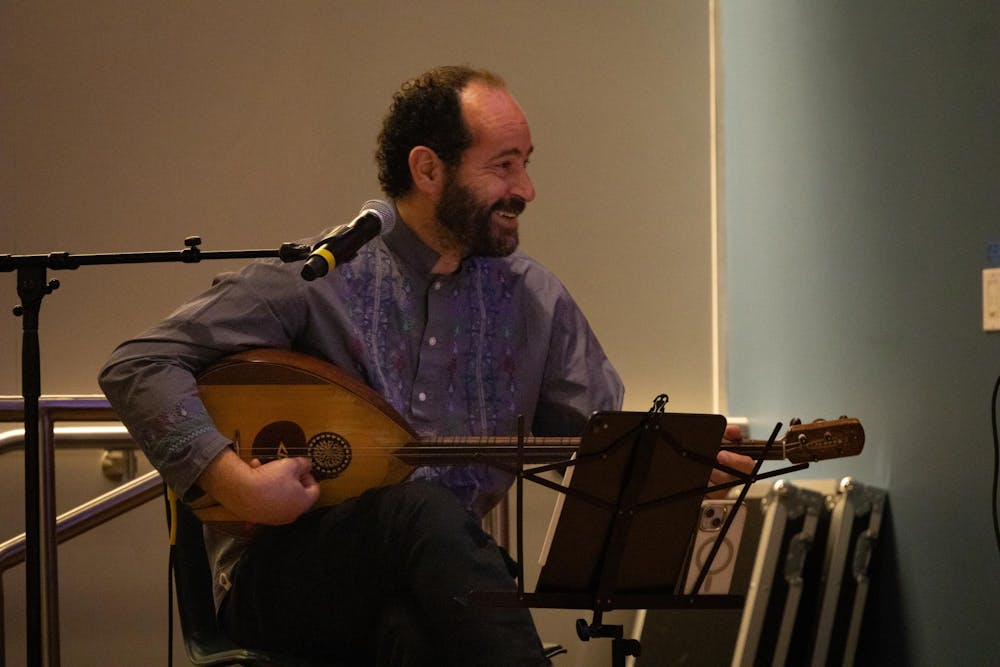
Palestinian musician Ramzi Aburedwan and his Dal’Ouna ensemble took to the stage Tuesday night and transformed the Global International Studies Building into a multicultural musical celebration.
The ensemble, a Franco-Arab fusion band, performed a mixture of songs from Aburedwan’s original compositions and traditional songs from Palestine and the Levant. The performers included Aburedwan, Ziad Ben Youssef, Moneim Adwan and Alber Baseel.
The ensemble was joined onstage by IU students Owen Aycock and Srikar Vaasan, who played the cello and violin, respectively, as well as IU folklore and ethnomusicology professor David McDonald.
McDonald briefly introduced the band and spoke about Palestinian painter Samia Halaby, whose art show was canceled by IU in January 2024 due to “security concerns.” McDonald said he viewed that was one of the IU's first steps in trying to stop the conversation about Palestine on campus.
“We’ve all been touched by this, whether you have affinities for Palestine as I do, whether you have affinities for academic freedom and whether or not you just believe in college campuses as being the place where we talk about ideas and celebrate the arts and culture of the world,” McDonald said to the audience.
After McDonald’s introduction, he joined the Dal’Ouna ensemble onstage and played wind instruments alongside the rest of the band.
The band performed a variety of upbeat songs with rhythmic percussion and somber, haunting songs with intricate string instruments and commanding, powerful vocals. They sang a Palestinian folk protest song, “Yamma Mawil-el Hawa” as well as an Arabic song that tells the tale of Musa Hanifi, a Palestinian student killed by Israeli bullets in the 1980s.
“Today, the Palestinian music and culture are part of what we call the cultural resistance,” Aburedwan said. “Culture, also, is a big important part to defend our identity and to show through the culture that we exist and that we deserve to have freedom and normal life as all other populations.”
Aburedwan is also the founder of Al Kamandjâti, a nonprofit organization that offers music lessons to Palestinian children. He created these music schools in Palestinian refugee camps to provide a positive outlet while living under military occupation. As a child, Aburedwan was a refugee himself and has been no stranger to the violence young Palestinians face.
“I would like to just tell the Palestinian children today that you are a child and that you have the right to get a normal education and a normal life,” Aburedwan said.
The audience erupted in applause, giving the ensemble a standing ovation as the event concluded. Most of the crowd stuck around after the show to talk with the band and get a signed copy of “Children of the Stone,” a book written about Aburedwan’s life.
IU junior Hassan Gedio attended the concert after hearing about it in his Arabic class.
“I kind of understood some of the stories they were saying,” Gedio said. “Like the things that are going on with Israel and Palestine, the history behind it, and like, the way they tell stories in Arabic countries through poems and music.”
IU junior Alexandra McKee heard about the concert through her class with McDonald.
“I thought it was amazing, I thought it was really great,” she said. “I really loved all the different instruments and how everybody kind of joined in and they included themselves through clapping, and I liked how the musicians were interacting with each other just through facial expressions.”
While IU offers plenty of classes about different cultures, McKee said witnessing it in person is better than learning it in a classroom.
“Actually experiencing a person's culture firsthand through music, through arts, humanities, I think is a way more productive way to involve yourself and kind of get a feel for other people's experiences and cultures,” she said, “rather than just listening about it or hearing it, actually being in a setting where people are practicing their own traditions.”


