
Editor's note: All opinions, columns and letters reflect the views of the individual writer and not necessarily those of the IDS or its staffers.
If you scroll through your Instagram feed or TikTok “For You" page, celebrities and influencers spout the same rhetoric.
“I’ve tried everything. It’s just the science for me. Calories in versus calories out. Ozempic works because you eat less food,” singer Lizzo said to Trisha Paytas in a June 19 episode of the “Just Trish” podcast. “It makes you feel full. So, if you can just do that on your own and get mind over matter, it’s the same.”
When everyone — myself included — gets fed news on our daily scroll, the word of these famous faces on our screens starts sounding like gospel. But what do these people really know about GLP-1 agonists, other than the fact that they’re shelling out in pursuit of these common calorie myths? All the while this forces Americans to manage their diabetes with “gray-market” FDA-unapproved drugs like semaglutide and tirzepatide, further normalizing drugs with increasingly common, unusual side effects.
Houston, we have a problem; portion sizes are decreasing, mirroring the shrinking stomachs and bodies of the ruling class. It comes at a time when there’s rising national hunger, which may be further exacerbated among the almost 600,000 Hoosiers at risk of losing SNAP benefits they rely on as Trump fumbles another federal government shutdown.
There are many roots to this Marxist problem — body positivity and neutrality are gone, heroin chic and low-rise jeans are back and even the Kardashians reversed their BBLs — but America’s confusion about calories lies at the center. Let’s debunk some pervasive myths.
The truth is we don’t understand what calories are. Contrary to public belief and Wikipedia, the food calorie, or kilocalorie, was not always the definition we’ve now settled on: the energy used in heating one kilogram of water by one degree Celsius. The original system was developed by American chemist Wilbur Olin Atwater in 1896 — calculating the average number of calories in one gram of fat, protein and carbohydrate — but ignored important differences between human digestion, calorimeters and individuals’ bodies.
Nevertheless, government officials exploited this simplistic, incorrect measure to justify low wages and predatory, commercial marketing tricks; now, this junk science contributes to incorrect calorie labelling because, no, all food calories aren’t made the same. They cannot be equated, and don’t correctly measure what they purport. Sadly, this pattern continues with the U.S. Department of Agriculture’s attempts to do the impossible and create population-wide nutrition prescriptions based on unsubstantiated metrics.
The BMI was created in the 1830s by Adolphe Quetelet, a Belgian mathematician and non-physician, as a population statistic to find “l'homme moyen" or the “average man” — emphasis on man and the unspoken white — while ignoring that strong bones and muscle mass are denser than fat. A further 1970 study by American physiologist and dietitian Ancel Keys also only sampled “healthy” men.
Yet in the 1950s, Louis I. Dublin, a statistician and vice president of Metropolitan Life Insurance Company, used this inequitable formula to determine “normal” weights for clients: my oh my, isn’t it convenient that one decimal place allows insurance companies to charge higher premiums, let alone to racialize fat phobia?
Finally, in 1997, the World Health Organization announced a global epidemic of obesity, a term that means squat, scientifically, and ironically ignores most of the globe: women and people of color. So, what’s the point of comparing everyone to white men post-WWII, again?
Unsurprisingly, similar slip-ups explain the Federal Drug Administration’s 2,000 calories-a-day-rule, and the story is maddeningly simple. The USDA sent out self-reported caloric intake studies — notoriously underreported — and found averages for males and females of 1,785 calories, 1,839 and 2,002 (from studies 1987-1988, 1989-1991 and 1994-1996, respectively). Then, the FDA requested a public comment. Because of course they did, nutrition educators worried anything over 2,000 would encourage overconsumption — despite the dearth of studies supporting such a claim — so that’s what stuck.
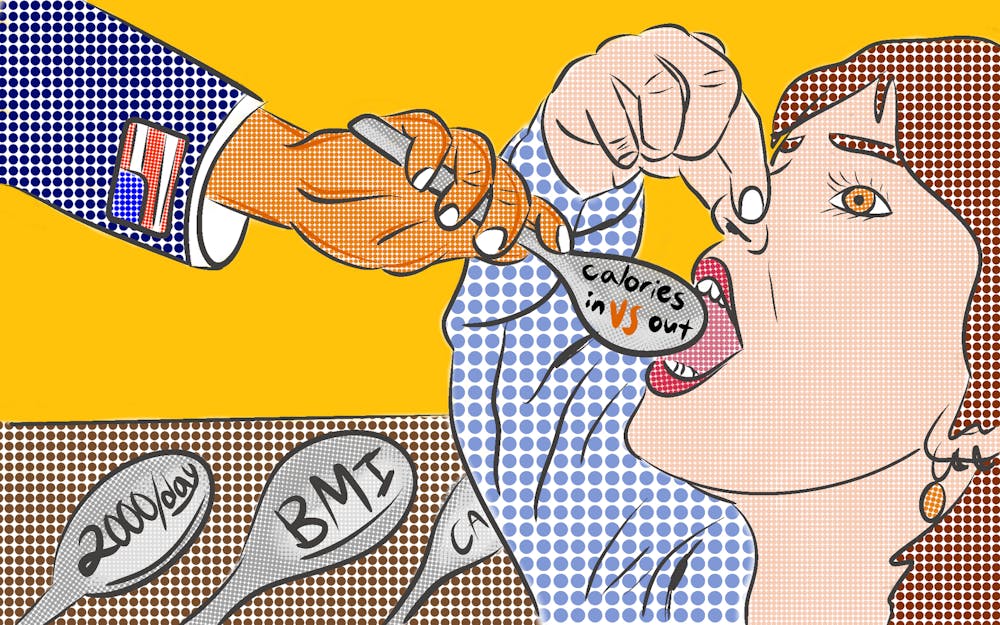
With calories, it’s a broken record. Like the calorie unit, food labels, BMI and daily calorie rules, the idea of “calories in versus calories out” — that journalists, friends, doctors and even celebrities like Lizzo tout — is false. It would be impossible to account for “interindividual differences in metabolic rates and the size of internal organs,” according to a 2017 American Journal of Physiology paper, let alone exercise toward calories out.
Similarly, the gym bro’s favorite fact — that by burning off or restricting 3,500 calories, you lose a pound — is misleading. This myth is based on medical researcher Max Wishnofsky’s 1950s study but mistakenly assumes only fat tissue is lost when losing weight and that weight loss is linear. Further studies have debunked this weight loss myth, but it never seems to stick. Ignoring what the wellness economy directs us to believe, one 2020 Nutrition study rings true: “to date, no optimally effective weight loss diet exists for all individuals.”
The human body is a miracle and a mind-boggle. So, whenever you guiltily open MyFitnessPal, you step on the fraught bathroom scale or a lazy doctor denies you or a loved one rightful health care, remind yourself of one truth about calories: the discourse is thick with heedlessly-accepted myths and junk science, so do what feels right for your body.
Odessa Lyon (she/her) is a senior studying biology and English, pursuing a minor in European studies.



